This post contains affiliate links. If you buy through them, Blaq Vixen Beauty may earn a small commission at no extra cost to you.
This week, the timeline is holding a title fight over a fictional lawyer’s closet.
Jax Stewart — the Los Angeles criminal defense attorney at the center of Hulu’s Reasonable Doubt, played by Emayatzy Corinealdi — is being discussed online the way this altar discusses icons: by her clothes. On November 23, Simpson Street, Kerry Washington’s production company, posted a “Behind the Costumes of Reasonable Doubt” video, and within two days it had drawn the kind of attention usually reserved for verdicts. The fans’ position, stated in a hundred ways, reduces to one: this is one of the best-dressed Black characters on television, and the costume team deserves its flowers — up to and including an Emmy — for the fashion alone.
This altar does not usually seat fictional women. But when the people start talking about a character’s wardrobe like a working, the altar pays attention. Because that is what it is.
The Designers’ Doctrine
The video walks the Season 4 costume warehouse with the two women responsible: costume designer Mercedes Cook and assistant costume designer Mia Nunnally. Their team numbers thirteen, with a shopper sourcing pieces across Atlanta, where the show films. And their process, in their own telling, begins where it should: they design for Jax first, and the world of the show dresses outward from her.
Then they name the inspirations, on camera, on the record: Diahann Carroll. Defense attorney Shawn Holley — a real advocate, whose courtroom presence is its own precedent. And Katharine Hepburn, patron saint of the tailored trouser worn like a decision.
Sit with that trinity for a moment. A Black television icon. A Black woman lawyer who actually walks into actual courtrooms. And the woman who made menswear feminine by refusing to ask permission. Cook and Nunnally describe their aim as fashion that redefines power rather than merely signaling authority — and the inspirations tell you they mean it. This is not a mood board. It is a glamour atelier of thirteen people, building an argument in cloth.
The Inheritance
Here is where this altar leans in.
Diahann Carroll is not a stranger to this site. She is Spellbook Looks No. 08, seated here for exactly the quality Cook’s team is channeling: the Carroll silhouette — Dominique Devereaux’s tailoring, wealth worn as composure, a woman whose clothes never once raised their voice because they never had to. Carroll made an entire career of the doctrine that elegance is not decoration on power. It is the delivery system.
Two generations on, a costume department says her name out loud as the blueprint for a Black woman lawyer on television — and builds accordingly. That is not homage as marketing. That is lineage, acknowledged by its inheritors. The icon is not a credit on a mood board. She is a grandmother in the craft, and the granddaughters know her name.
This is how glamour actually travels: not by trend, but by transmission, woman to woman, silhouette to silhouette, until a fictional attorney in Los Angeles walks into a courtroom dressed like Diahann’s descendant — because, in the only way that matters here, she is.
The Exhibits
The record names two looks, and this altar describes only what the record holds.
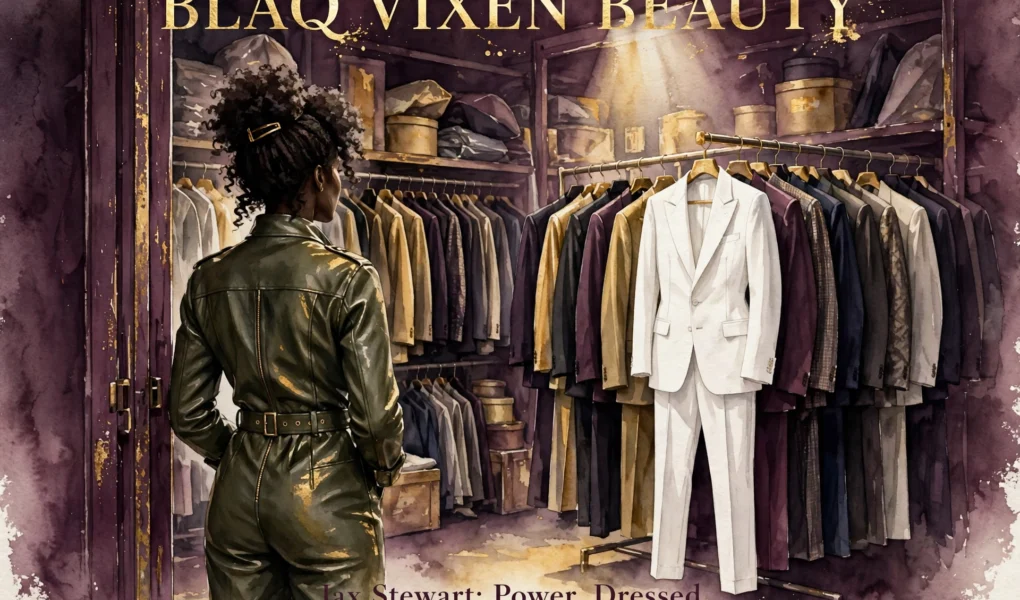
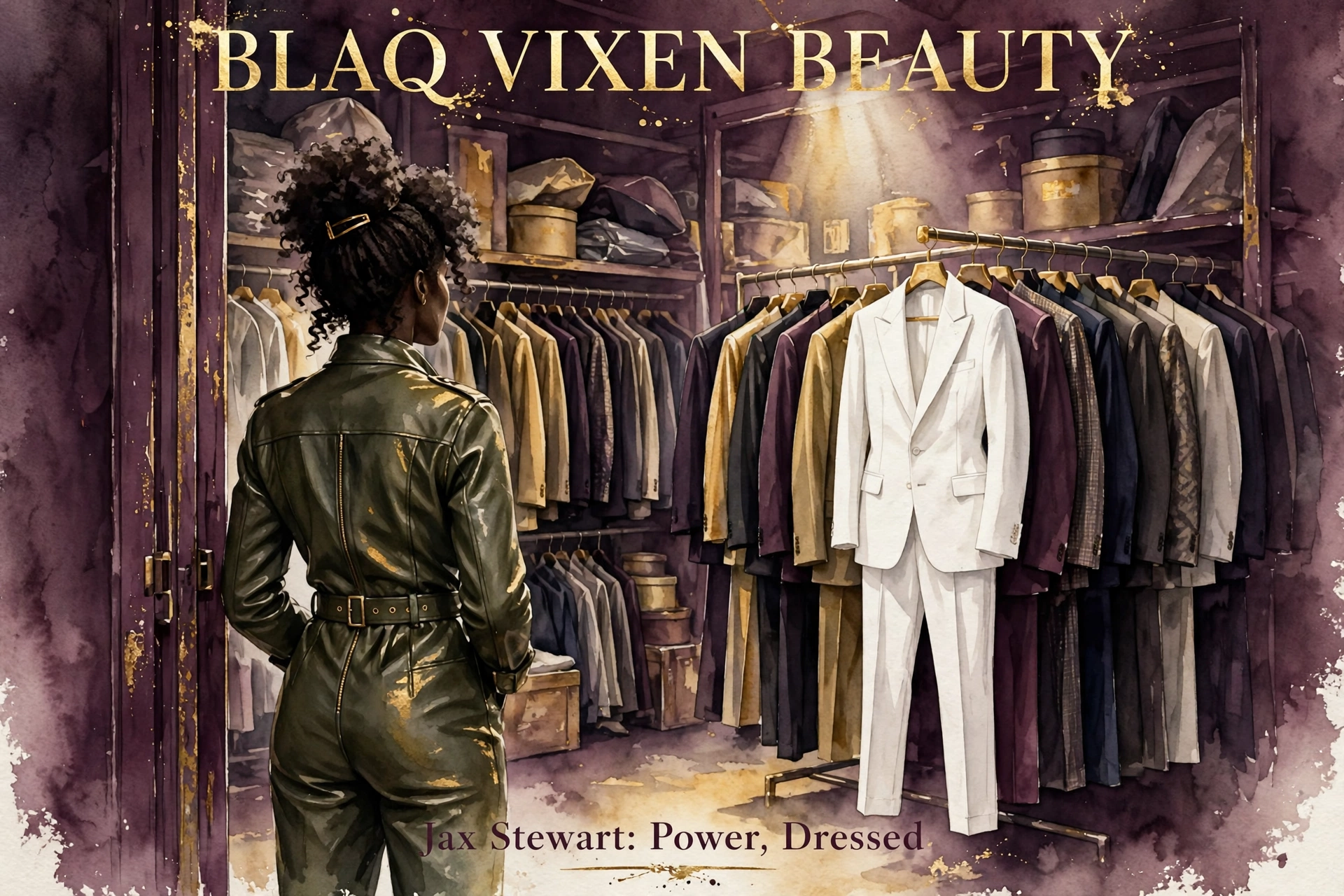
The olive-green leather jumpsuit — the signature piece Cook’s team names themselves, described as balancing femininity and masculinity in a single garment. Consider what that means on a defense attorney: leather, the material of armor and engines, cut as one continuous line on a woman’s body. Nothing to match, nothing to adjust, nothing between the woman and the room. Armor that moves like clothing. Clothing that reads like armor.
The all-white tailored pantsuit — cropped blazer, satin top, circulating among fans from the same conversation. White, in a courtroom, is a decision: the color of the altar cloth and the first communion dress, worn by the advocate as command. Everyone in that room knows the risk of white — it shows everything. That is the point. She is not hiding anything. Let them look.
Two garments. One says I am armored. The other says I am unafraid. A whole defense theory, dressed.
The Doctrine for the Reader
Wardrobe Enchantment has always taught this, and Jax Stewart is its fictional working: dress for the room you intend to rule.
Not the room as it is — the room as you intend it to be when you are finished. Cook and Nunnally do not dress Jax for the cases she has; they dress her for the verdict she means to bring home. The signature piece kept like a talisman. The silhouette held consistent enough to become a reputation. Clothes chosen as argument, opening statement made before a word is spoken.
Every woman reading this has a courtroom — a negotiation, a review, a room where her competence will be weighed by people who started weighing her at the door. The doctrine does not say buy the jumpsuit. The doctrine says: know your Carroll, know your Hepburn, know your Holley — know whose line you are carrying — and then dress like the decision has already gone your way.
A Seat for the Advocate
Jax Stewart is not an ancestor, and this altar does not confuse the fictional wing with the family table. She is a story the people keep telling — created by Raamla Mohamed, carried by Emayatzy Corinealdi, dressed by Mercedes Cook and Mia Nunnally and their thirteen — and this week, the people are telling it about her clothes.
That is how icons begin, though. First the room notices the dress. Then it learns the name. Then, if the work is true, it starts dressing differently itself.
The advocate has her seat. Let the record show she arrived tailored.
Glamour is yours to conjure. — Lakish