This post contains affiliate links. If you buy through them, Blaq Vixen Beauty may earn a small commission at no extra cost to you.
Television has shown us a great many weddings. It had never shown us this one.
A Black society wedding of the 1880s, built with the full budget and the full reverence the genre usually reserves for white brides — a church dressed in flowers keyed to its own stained glass, a bride in lace and pearls, a groom who is a doctor, a love match. And standing behind the bride, the fact the whole scene is built on: both of Peggy Scott’s parents were born enslaved. Their daughter marries for love, in pearls, in the third episode of The Gilded Age‘s fourth season, “Ain’t That Good News.” This altar does not pretend that is a small thing. It is the whole thing.
The Gown as Negotiation
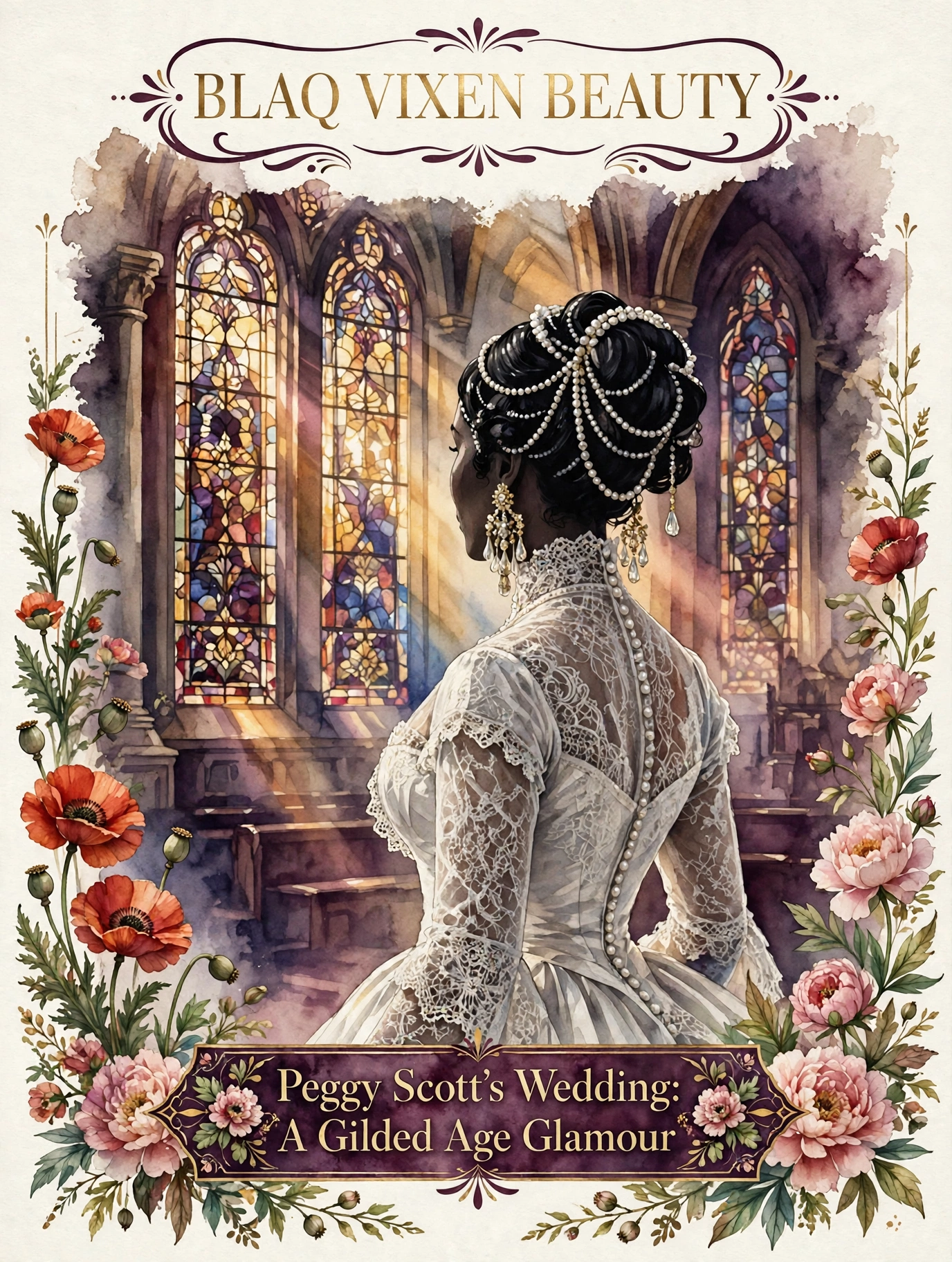
Costume designer Kasia Walicka Maimone built the dress the way she builds the series: out of a reference library she has described as some sixty thousand images, and with Kathy Marshall and her team doing the construction. White lace over a corset — and down the back, more than seventy-five buttons, closed by hand. Denée Benton has told the story herself, in Harper’s BAZAAR’s coverage: the head dresser, Amber, buttoned every one.
But the gown is not only beautiful. It is negotiated, and that is why it belongs to Wardrobe Enchantment. As HelloBeautiful’s breakdown of the wedding look reports, the lace was a concession — Mrs. Kirkland, the groom’s formidable mother, pushed her own hairdresser and a lace, and Peggy Scott rarely wears lace. Her wardrobe runs to silks, brocades, tulle. The dress the audience saw kept Peggy’s own silhouette and took the lace as the single thread surrendered to her new family’s world. One thread. Not the dress.
That is the doctrine of this strand in a single garment: a woman entering a new house does not arrive remade. She arrives as herself, with one graceful concession worn where everyone can see it — which is how you can tell it cost her nothing she wasn’t willing to spend.
Pearls and Chandeliers
The details above the neckline carried the inheritance. Pearls in her hair for the ceremony — period-correct extravagance, HelloBeautiful notes, because in the Gilded Age pearls cost more than diamonds. The bride was not wearing decoration. She was wearing capital, arranged by her own people’s hands.
And at her ears, chandelier earrings — a gift from her mother, Dorothy, chosen against the gown’s lace. Consider what the camera is being told: the most brilliant thing on the bride came from the woman who was born enslaved. The new family’s lace is on the dress. The mother’s gift is at the face, where the light lands. Wardrobe is never only wardrobe. It is an argument about whose hands made you ready, worn in public.
Even the pre-wedding gathering look made the argument early — baby blue, high neck, pleated fabric, ornate flowers, a matching hat — Peggy arriving at every room of that wedding already dressed as the woman the wedding would confirm.
The Face
This altar will tell you the truth about the makeup, because the truth is the interesting part.
The series’ makeup department head is Nicki Ledermann, and her stated doctrine for The Gilded Age — given to Vogue — is portraiture: inspiration drawn from John Singer Sargent and Whistler, the cast made to look like paintings, with hair and makeup carrying class and social position as storytelling. For Peggy’s wedding, no product-level record has been published, and this blog will not invent one. What the record shows is philosophy and effect: period restraint as the glamour. Skin finished like a Sargent portrait. Nothing loud, nothing that would read as costume, nothing that smudges — and the stamina was tested for real, through a humid June shoot day in a corseted gown, as BAZAAR’s account of the day corroborates.
There is a glamour lesson in that restraint, and this altar teaches it gladly: the most expensive-looking face in the room is often the one that refuses to announce its work. Peggy Scott’s wedding glamour is not a product list. It is a portrait that happens to be alive.
The Broom and the Singers
And then the ceremony did the thing the whole series had been holding its breath for.
The flowers first: florist Tess Casey drew the palette from the church’s own stained glass — poppies, peonies, spray roses — in a period church in Troy, New York, famed for its Tiffany glass (BroadwayWorld’s reporting; EBONY names it as St. Paul’s Episcopal). The room itself was dressed from its own windows. Nothing imported. Everything in conversation with what was already sacred there.
The music: the Fisk Jubilee Singers, with Adrienne Warren appearing as Peggy’s cousin Ava among them. Mrs. Kirkland called their music undignified — and there, in one word, is the class argument inside Black society that the episode stages and lets Peggy’s side win. The spirituals of the enslaved, sung by the Fisk Singers who carried them around the world, were not the humble alternative to elegance. They were the inheritance, and the bride chose them in the church, in the lace, in front of everybody.
And the broom. Arthur Scott — born enslaved, a pharmacist, a man who built a family’s fortune out of a people’s catastrophe — gives the couple the broom, as EBONY reports, his gift to the union. The jump plays in slow motion. A folk tradition born when marriage was denied to the enslaved, carried by the father into his daughter’s society wedding, over no one’s apology.
The ancestors are not the opposite of elegance. That is this altar’s whole argument, and The Gilded Age just staged it in prime time.
Peggy at the Altar
Peggy Scott is a fictional woman, and this blog does not confuse fiction with fact. But icons were never only the real. She is a Black woman writer of the 1880s, imagined whole — ambitious, principled, loved by a good man, dressed by the best costume department on television, married in an episode that treated her people’s traditions as the treasure of the scene rather than its problem.
Her wedding is the first true love-match marriage the series has given us. She walked into it in her own silhouette, her mother’s earrings at her face, her father’s broom at her feet, and the Fisk Jubilee Singers in the air.
That is not just a wedding look. That is a glamour, worked in lace and pearl and song, by a woman who knew exactly which parts of herself were not negotiable — and surrendered exactly one thread.
Glamour is yours to conjure. — Lakish