This post contains affiliate links. If you buy through them, Blaq Vixen Beauty may earn a small commission at no extra cost to you.
Every beginner at this altar asks the same question: where do I start with beauty magic?
Start where the record starts. Start with the queen whose own historian could not explain her any other way.
Plutarch, writing about Cleopatra a century after her death, reached a conclusion that should be carved over every vanity: her beauty, he said, “was in itself not altogether incomparable, nor such as to strike those who saw her.” Read that again. The most famous enchantress in history was not, by the testimony of the ancient world itself, the most beautiful woman in the room. What she had was something else — “converse with her had an irresistible charm, and her presence, combined with the persuasiveness of her discourse,” and a voice he compared to an instrument of many strings. Before she ever met Mark Antony, Plutarch tells us, she placed her confidence “in the charms and sorceries of her own person.”
That is the first doctrine of glamour magick, and Cleopatra is its first documented practitioner: glamour is not the face. Glamour is what the face is made to do.
The Painted Rite
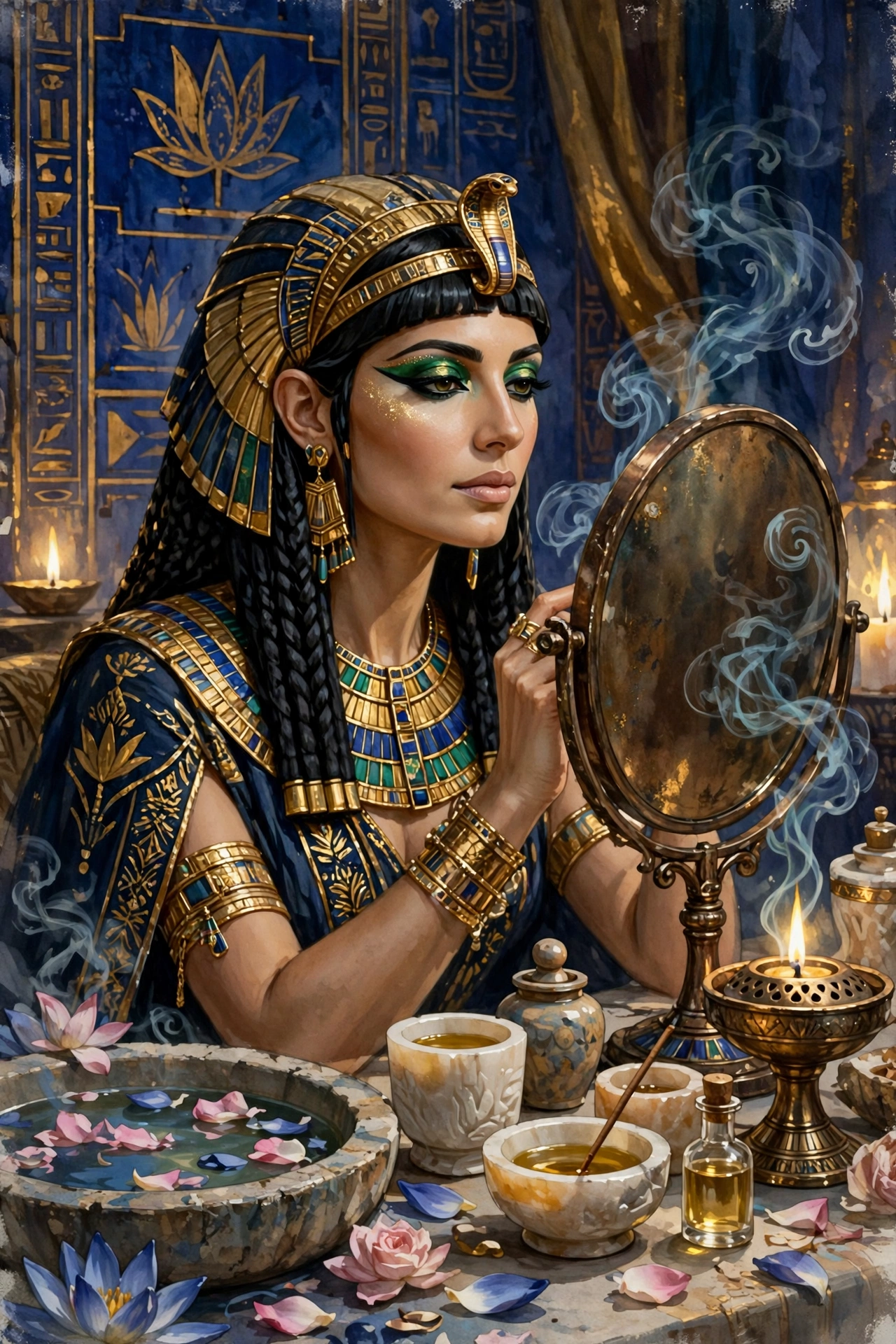
Cleopatra ruled a civilization that had already spent three thousand years treating cosmetics as sacred technology. The Egyptian eye was a working altar all by itself: black mesdemet — kohl — drawn in the almond line we still copy today, worn not only for beauty but as protection, a ward against glare, infection, and ill will. Green pigment ground from malachite shadowed the lid. Red ochre colored the lips and cheeks. Henna stained the nails and palms. Castor oil dressed the hair. And over everything, scent — kyphi and the great perfumed oils of Egypt, so prized that fragrance was an industry of temples.
Later physicians preserved whole collections of cosmetic remedies under Cleopatra’s own name — treatments for hair and skin circulating for centuries as hers. Whether she wrote them or merely inspired them, the ancient world believed the queen of Egypt was an authority on the preparation of beauty. She was, in the language of this altar, a glamatician with a throne.
The Spectacle at Tarsus
When Cleopatra went to meet Antony in 41 BC, she did not arrive as a petitioner. She staged an apparition. Plutarch describes her barge on the river Cydnus: gilded stern, purple sails, silver oars beating time to flutes, the queen reclined under a canopy of cloth of gold, dressed as Venus, fanned by boys costumed as Cupids, her maids dressed as sea nymphs — and before the ship could even be seen, its perfumes “diffused themselves from the vessel to the shore,” emptying the marketplace as the crowd ran to witness it.
That is glamour magick at state scale: scent arriving before the woman, image composed like an altar, every sense enlisted before a single word is spoken. She was not hoping to be found beautiful. She was building the room she would be beautiful in.
Legend, Labeled as Legend
This altar deals honestly, so let the record and the myth be separated at the door. The famous milk baths? No ancient source gives them to Cleopatra. The donkey-milk bath belongs to Poppaea, Nero’s wife, a century later — Hollywood merged the two women when Claudette Colbert played them both in the 1930s, and the legend has belonged to Cleopatra ever since. The Dead Sea cosmetics factory? Josephus does record that Cleopatra held the revenues of the Jericho balsam groves, the most valuable perfume crop of the age — but no ancient writer puts a workshop in her hands or mud on her face. The truth is narrower and, at this altar, better: the queen held the perfume trade itself. She did not need the factory myth. She had the supply line.
Where a Beginner Starts
So begin the way she did — with presence before product.
The bath is the first rite. Water, oil, scent, and unhurried time: the Egyptian purification bath is the oldest glamour working there is, and it costs nothing but intention. Prepare to be seen the way she prepared — as an event, not an errand.
The line is the second rite. One deliberate stroke of kohl-dark liner, drawn as a ward and not an apology. Three thousand years of women have opened their working with that line.
The scent is the third rite. Her perfumes reached the shore before she did. Choose yours the same way — as the part of you that enters the room first.
Cleopatra’s lesson is the one this whole altar stands on: she was not the most beautiful woman in the ancient world. She simply refused to let that be the point. The charm was the craft. The presence was the spell. The face was where she chose to do it.
Glamour is yours to conjure. — Lakish