This post contains affiliate links. If you buy through them, Blaq Vixen Beauty may earn a small commission at no extra cost to you.
A woman turns over her serum bottle and finds her own handwriting in gold — a small mark on the glass base, drawn by her own hand, that no one else in the world can read. That is a sigil. This piece teaches what it is, how to build one, and why the vanity — of all the altar’s rooms — is where it works hardest.
A sigil is a desire compressed until it stops being words. A sentence carries its meaning on its face, where the conscious mind can argue with it, doubt it, rehearse it, wear it out. A sigil buries the meaning in a mark. The mind looks at the mark and sees only a shape; the desire travels underneath, unargued-with. That is the whole technology, and it is older than its famous teacher — but the teacher is where the teaching starts.
Spare and the Method, Taught Plainly
The modern sigil method descends from Austin Osman Spare (1886–1956), the English artist and occultist who set it out in The Book of Pleasure (1913). Spare’s work is the headwater of what became chaos magick’s sigil practice, and his method has four movements. This altar teaches them plainly, because they are public teaching and because a reader of the Grimoire should leave able to build her own.
State it as already true. The intent is written in the present tense, as a fact, never as a lack or a wanting. Not “I want to be seen.” “I am luminous.” The sigil does not carry requests. It carries declarations.

Strip it. Remove the vowels. Remove every repeated letter. What remains is the skeleton of the sentence — the desire with its music taken out, which is the point: what cannot be read cannot be argued with.
Walk it once, letter by letter, with the example above. I AM LUMINOUS. Strike the vowels — I, A, O, U — and the letters fall to M, L, M, N, S. Strike the repeat, and four letters stand: M, L, N, S. Four consonants. The sentence is gone. The bones remain.
Draw the letters into one another. Stretch them, stack them, let the M carry the L on its shoulder and the N lean into the S, simplify every stroke that can be simplified, until the mark no longer reads as language at all. It should look like something found carved, not something written. When you can look at it and not think the sentence, the sigil is built.
Charge it, and let it be forgotten. Spare’s charge happened in a moment of emptied mind — his word was gnosis — when the mark is held in the gaze and the chatter stops, and the desire passes from the drawing into the worker. Then the final discipline, and the hardest: forget it. Deliberately. Let the conscious mind lose the thread between the mark and the meaning, so it cannot interfere. The sigil works in the dark, like a seed. Digging it up to check on it is not devotion; it is interference.
Charging at the Vanity
Spare’s emptied-mind moment translates to this altar’s furniture without strain. Candle lit. Mirror before you. The vessel in both hands. The gaze held on the mark until the drawing stops being a drawing and becomes a presence — the room quiet, the breath slow, the gold catching the light. That held moment is the charge. It does not need to be long. It needs to be empty — one clear instant with nothing else in it.
And let the calendar do its half of the work: this altar’s timing doctrine, taught in its own piece, builds and charges glamour work on a Venus day in a Venus hour, when the planet of the whole enterprise is keeping office hours. A sigil charged in Venus’s hour, for a Venusian errand, starts its life already introduced.
Placement Doctrine
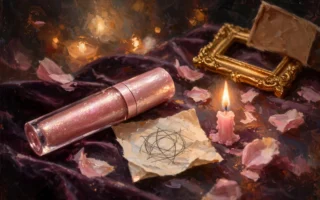
Where the mark goes is doctrine, not decoration. The bottom of the jar, where it sits against the shelf like a seal. The inside of the cap, where it is kissed by the closing hand twice a day. Under the label. The back of the bottle, where the fingers land without thinking.
Hidden or glimpsed? The altar argues it fairly and lays down no dogma. The hidden sigil is the whisper — it works in the dark as Spare intended, unseen even by its maker most days. The glimpsed sigil is the reminder — caught in the mirror’s edge at the moment of use, a small gold pressure at the back of the mind. Workers differ. Workings differ. What does not differ is the one hard rule, and this altar states it as law:
On the container. Never in the product.
Nothing goes into the cream, the oil, the serum — nothing alters what touches the skin. The sigil rides the vessel. The vessel only. This is not merely safety; it is theology. The mark’s office is intent, and intent does not need to be in anything to be at work.
Materials are the vanity’s own: a fine marker, a gold pen, a fingertip of the product’s own oil traced on glass, eyeliner in a pinch — the altar has always worked with what the room already holds.
The Glamour Insight
Here is why this piece exists, and it is the altar’s own contribution to a century-old method.
A talisman is charged once and carried. A product sigil is charged at every use. Every pump passes the hand over the mark. Every opening of the cap is a closing over it. The daily ritual — the most reliable ritual any woman actually keeps, kept at the same hour, at the same mirror, with the same hands — becomes the repetition that other workings have to schedule, remember, and sometimes fail to perform. Nobody forgets to use her serum. The working rides the one appointment the worker never misses.
Spare built the sigil for the moment. The vanity gives it a practice — a small gold mark under a cap, charged once in candlelight and re-charged every morning of its life, carrying a declaration its maker has mercifully forgotten she made. That is not a lesser sigil for being domestic. It is the method finally housed where glamour actually lives.
The Lineage, Honestly, and the Boundary
Three traditions make this one gesture, and this altar names them without blending them. Spare’s sigils — the method, taught above, credited to The Book of Pleasure by name. The grimoire tradition’s talismanic seals, consecrated onto objects — Raphael’s Ancient Manuscript of Talismanic Magic (1916) sits on this altar’s own shelf, the copy Lisa placed in its keeper’s hands in 2018. And Hoodoo’s century of dressing and fixing bottles and containers, documented in Hyatt’s volumes and the Black Southern record — the container treated as a working surface long before any beauty brand thought to print a mantra on one.
Their differences are named, not smoothed: different peoples, different spirits, different rules. And where Hoodoo is touched, this altar’s tenet stands as always — consult your benevolent ancestors first, before the mark is drawn, before the vessel is dressed.
The closing boundary is non-negotiable, and the piece states it in its own voice: a sigil carries intent, not ingredients. It makes no claim for what a product does to skin. It does not heal, brighten, lift, or cure, and this altar does not say it does. What it changes is the worker — her attention, her declaration, her daily return to the mirror with a purpose held under her hand. In glamour work, as this Grimoire has taught from its first lesson, the worker is not the least of the instruments.
She is the first of them.
Glamour is yours to conjure. — Lakish