This post contains affiliate links. If you buy through them, Blaq Vixen Beauty may earn a small commission at no extra cost to you.
Some people enter a room twice: once in the flesh, and once before it — in the turning of heads, the straightening of spines, the small rearrangement of attention that happens before they have said a single word.
The nineteenth century had a physics for that second entrance. It called it magnetism.
This altar keeps that record the way it keeps all of them: honestly, in its own house, with its limits stated. And it begins where every working here begins — before any force is discussed, consult your benevolent ancestors first. They are the first authority, before any root, any book, any current. The strongest magnetism this house knows is not performed. It is inherited, and consulted, and answered to.
Mesmer and the Fluid
Franz Anton Mesmer (1734–1815), the German physician who carried his doctrine from Vienna to Paris, taught that a universal fluid permeated all bodies, and that a trained operator could direct its flow in another person — gathering patients around his baquet, a great oak tub of magnetized water and iron rods, and producing the famous crises: trembling, weeping, convulsions, release. Paris was enthralled. Paris also investigated: in 1784, royal commissions — Benjamin Franklin sat on one — tested the fluid and found no evidence of it. The science ended there.
The phenomenon did not. It walked out of the laboratory and onto the stage, and this piece reports the whole career as what it is — the record of a belief and a practice, never established physical fact. But a record can be false as physics and true as history, and magnetism’s history is enormous: for a century, serious and ordinary people alike organized their understanding of presence around it. Something was being described, even if the fluid was not the thing. This altar’s interest is in the description.
The American Career
Magnetism crossed the Atlantic and changed its class.
From 1836, Charles Poyen toured New England lecturing on the mesmeric trance, and his audiences were not aristocrats around a Parisian tub — they were working people in lecture halls, learning that the force was said to live in ordinary bodies. Phineas Parkhurst Quimby, a Maine clockmaker who heard Poyen and learned the practice, turned the trance toward healing, and American mind-cure descends from his chair. The platform filled with itinerant mesmerists, trance lecturers, and seers.
Among them, from 1852, stood a young Black man working as a trance speaker and magnetic healer: Paschal Beverly Randolph. His full record has its own piece in this Grimoire. What matters here is the setting: magnetism in America was, in the record’s own telling, democratic — a force the lecturers insisted ordinary people carried. Randolph’s doctrine would take that insistence further than any of them: he would make the force a matter of the will, the body, and the life.
Randolph’s Doctrine
The published record only — this piece draws on Randolph’s printed works, Seership chief among them (Lakish’s copy: Toledo, Randolph and Company, 1875), and on the scholarship around him. What that record teaches, in its own terms:
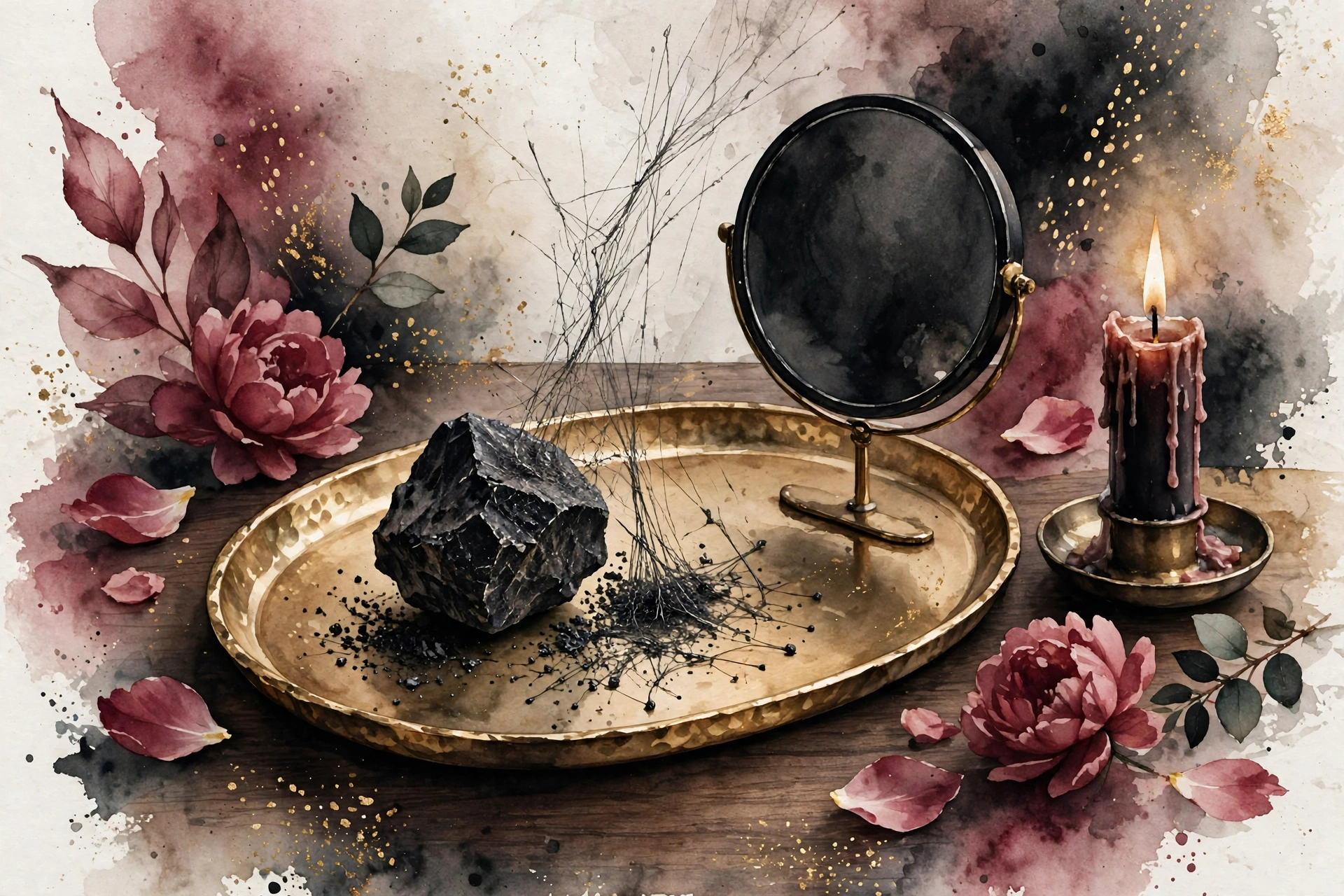
The force is seated in the person, not the instrument. Randolph’s seer works with a mirror — his “magnetised” glass — but the magnetising is done by the seer’s own steady, repeated use; the mirror holds what the person puts into it. The will must be kept awake: his is a doctrine of trained attention, not surrender. And the body is the precondition — the vessel’s condition governs the current it can carry.
Translated carefully into this altar’s terms: magnetism, in Randolph’s doctrine, is not charisma and it is not luck. It is a condition — the state of a person whose attention, will, and body have been prepared, the way a mirror is prepared by the one who will look into it. The drawn room is drawn because somebody prepared to draw it.
The Drawn Room
The record is full of drawn rooms: the lecturer whose hall goes quiet before the first sentence, the preacher whose congregation leans as one body, the woman whose entrance rearranges the seating of a parlor that was built to refuse her a seat at all.
This altar reads those accounts as glamour’s oldest evidence. Long before the word glamour carried this series, the record was describing its mechanism in magnetic language: a force proceeding from a prepared person, acting on a room at a distance, before a word is spent. The vocabularies differ. The observation is the same one every vanity in this series is built on — presence is real, it is unevenly distributed, and it is not an accident of birth. It is an account, kept or squandered.
The Accounting
For the record is unanimous on the ledger: magnetism is built and spent like money.
Randolph’s published teaching gives the price list without romance — plain food, no strong drink, sleep attended to, the life kept in order — and names the leaks just as plainly: disorder, excess, fear. The glamour worker will recognize her own house rules in his regimen, because they are the same rules wearing older clothes: the kept appointment, the attended body, the interior examined before it is displayed. Magnetism is not a struck match. It is a kept house, and the keeping is the doctrine.
Name the parts by this altar’s taxonomy: the keeping is foundational work — the attended body, the ordered life, the examined interior. The draw is glamour: perception moved in a room before a word is spent. The force is one; the altar names its preparation and its effect separately, so neither is mistaken for the other.
The Kept House
So the force that enters before you do is not a mystery the altar refuses to explain. The record explains it the way the record explains everything durable: somebody prepared. Somebody kept the instrument. Somebody paid the small daily prices that the struck-match people call talent when they see the total.
And above the preparation stands the inheritance. The foremothers of this house held rooms that were built to refuse them — held them with less money, less safety, and less permission than any reader of this piece is likely to face — and their force is the first entry in every ledger kept here. Consult them first. Then keep the house.
The room will do the rest.
Glamour is yours to conjure. — Lakish
From the Altar’s Bookshelf
- Paschal Beverly Randolph, Seership! The Magnetic Mirror (1875)
- John Patrick Deveney, Paschal Beverly Randolph: A Nineteenth-Century Black American Spiritualist, Rosicrucian, and Sex Magician (1997)
- Adam Crabtree, From Mesmer to Freud: Magnetic Sleep and the Roots of Psychological Healing (1993)
As an Amazon Associate, Blaq Vixen Beauty earns from qualifying purchases.