This post contains affiliate links. If you buy through them, Blaq Vixen Beauty may earn a small commission at no extra cost to you.
Begin where this altar always begins: before any turning is attempted, consult your benevolent ancestors first. They have seen every version of you — the presented one, the hidden one, the one you survived being. They are the first witnesses to the woman being made, and no work of remaking starts honestly without them.
Then hear the oldest teaching alchemy owns: the gold is not imported. The gold is the lead, turned.
Alchemy’s word for its great work was transmutation — base matter changed in state until it shone. The centuries argued about whether the furnaces ever made literal gold. What they never argued about was the shape of the process, and the shape is the doctrine this piece teaches: nothing in you is waste. The discarded self — the shadow, the old face, the season you barely survived — is not the obstacle to the glamour. She is the material of it.
This is not Beauty Is Alchemy, and the distinction matters. That piece teaches that makeup holds energy — a doctrine of setting, worked on objects at the vanity, the wearer charging what she wears. This piece teaches the turning of the worker herself. The material is not the product. The material is the person. Alchemy holds the mirror; transmutation walks through it.
The Stages, as the Record Holds Them
The old opus moved in stages, and the record names them in color.
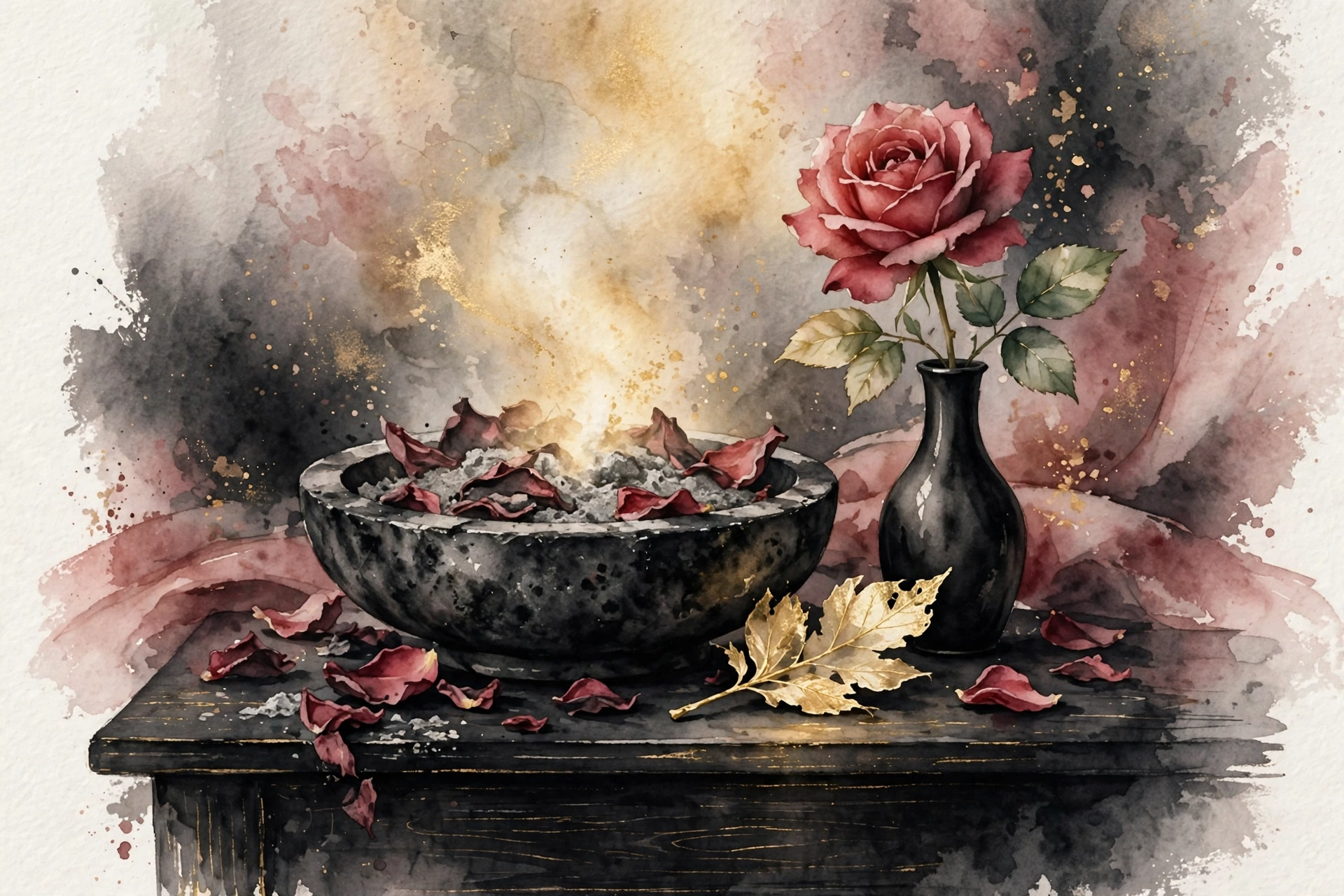
Nigredo — the blackening. The matter is broken down, rotted, reduced; everything false in it fails first. Albedo — the washing. What survives the blackening is cleansed, whitened, clarified; the matter becomes honest. Rubedo — the reddening. The work made manifest, the gold showing its color, the stone complete.
They are presented here as the historical record holds them — stages of a work, described by workers who believed the fire rewarded patience and punished hurry. This altar promises no results on their authority. It borrows their shape, because the shape is true to every remaking anyone has ever honestly done: first the breakdown that cannot be skipped, then the washing that cannot be rushed, then — only then — the shining that cannot be faked.
The Southern Record of Turning
Long before this altar borrowed alchemy’s vocabulary, the Black Southern record was practicing its substance.
Making a way out of no way is documented history before it is a metaphor: scraps taken up as quilts, ashes worked into lye and soap, the broken thing repaired past its breaking into something with a second life. The conjure record carries the same logic in its own grammar — Zora Neale Hurston’s Mules and Men and the testimony in Hyatt’s interview volumes describe a world where what the world discarded was precisely what the worker reached for, because discarded matter is unclaimed matter, and unclaimed matter can be turned. Katrina Hazzard-Donald’s Mojo Workin’ and Yvonne Chireau’s Black Magic document that world as scholars: an African American religious technology built, in part, on the refusal to waste anything — including suffering, including the past, including the selves that survival required and peace no longer does.
The turning was survival technology first. The glamour worker who takes it up should know whose fire she is borrowing.
The Shadow Is Not the Enemy
Here is where the piece must be exact, because the easy version of this teaching is a lie: the discarded self is not burned away.
She is not destroyed, denounced, or outgrown in disgust. She is carried through the fire — the way the alchemists’ matter was carried: not worshipped in its base state, not despised for it either, but worked, stage by stage, until what was lead in her shows its gold. The shadow is the prima materia, the first matter, the only matter the work has ever had. A glamour built by destroying the woman underneath it is a mask, and this altar does not teach masks. A glamour built by converting her — breakdown, washing, reddening, at the pace the stages demand — is a transmutation, and it holds in weather a mask never survives.
The Turning at the Vanity
So the vanity becomes a furnace with better lighting.
The face re-made deliberately — not to cover the old self, but to seal the turning of her: this is the outward sign of an inward state change, and the difference between covering and converting is the difference between paint and gold. Covering says: she is still under there, unchanged, and I am hiding her. Converting says: she went through the fire with me, and this face is what came out. The room can tell. Rooms always can.
The fire the work requires is not drama. It is repetition and devotion — the nigredo endured without lying about it, the albedo done in ordinary water on ordinary mornings, the rubedo arriving, when it arrives, as a color you did not have to announce.
Name it truly, as this altar names all its work: transmutation is foundational work. It is not glamour — nothing here governs what the room perceives. It is not beauty magic — nothing here is offered to beauty itself. It is the turning underneath both, the remaking of the worker that the other works stand on. Glamour is what the room sees. Beauty magic is what the altar tends. Transmutation is what the woman becomes — and a glamour raised on an unturned worker is paint on lead.
The Gold Was Never Elsewhere
What you were handed — the beauty and the damage, the shining seasons and the discarded ones — is not the rough draft of the material. It is the material, all of it, and there was never going to be any other.
The gold was never elsewhere. It was the lead, waiting for a worker patient enough to turn it.
Glamour is yours to conjure. — Lakish
From the Altar’s Bookshelf
- Zora Neale Hurston, Mules and Men (1935)
- Yvonne Patricia Chireau, Black Magic: Religion and the African American Conjuring Tradition (2003)
- Katrina Hazzard-Donald, Mojo Workin’: The Old African American Hoodoo System(2013)
As an Amazon Associate, Blaq Vixen Beauty earns from qualifying purchases.