This post contains affiliate links. If you buy through them, Blaq Vixen Beauty may earn a small commission at no extra cost to you.
Source: Judika Illes, Encyclopedia of Spirits (2009), as carried in the Occult World entry on Anaisa Pyé; the Sanse practitioner record — the Prayer to Anaisa Pye and the misterios profiles at Sanse Espiritismo; and the practitioner wiki of the 21 Divisiones (jaxxom87.wikidot.com). Scholarship on Anaisa Pye herself is scarce — there is no Métraux, no Brown, for her yet — so what follows leans openly on the practitioner record, and says so. It is an account of how she is served, drawn from those records: an homage, not an initiation.
The hook
Her mirror is a hand.
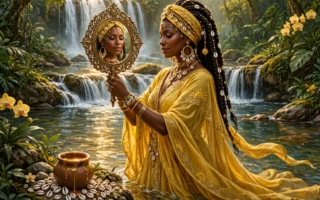
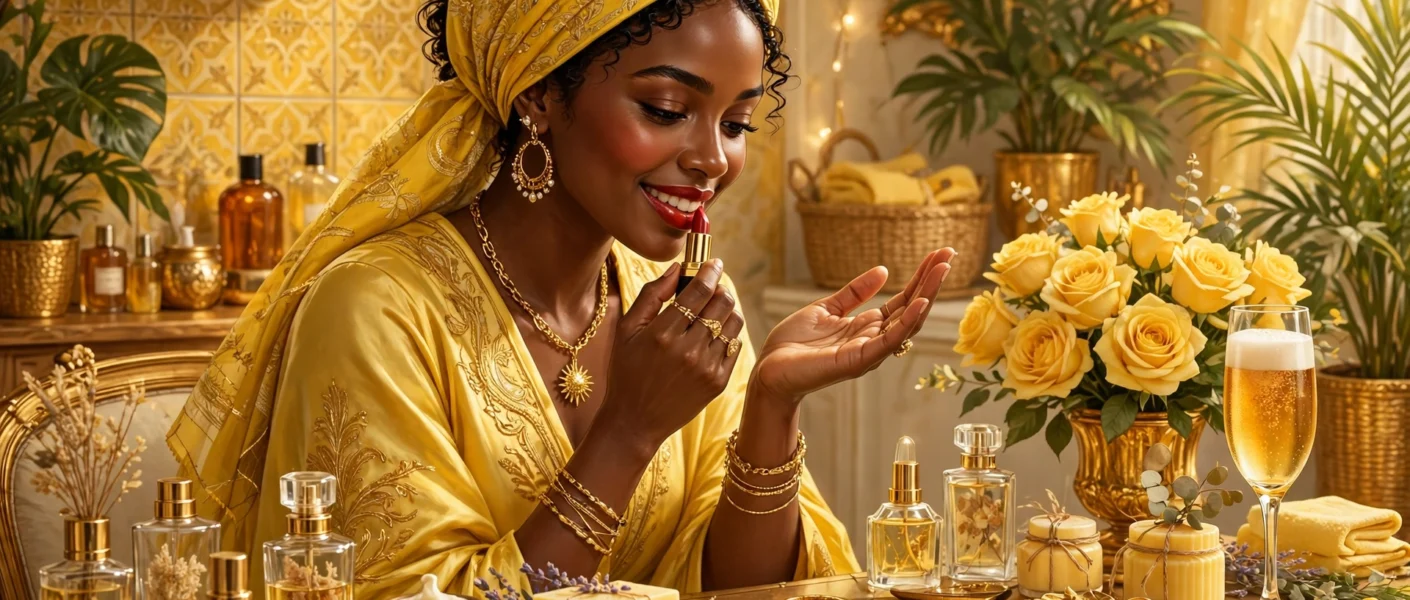
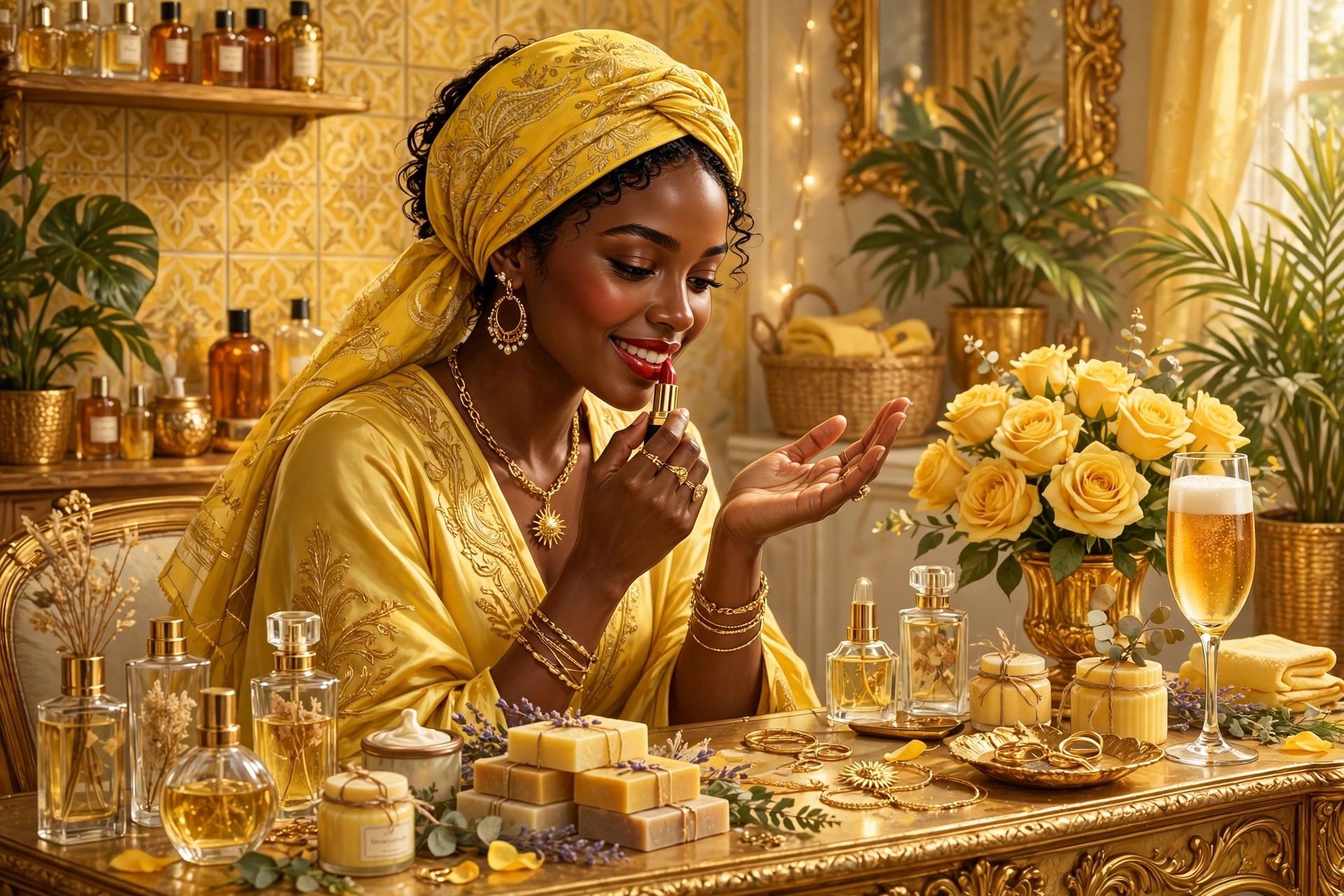
When Anaisa Pye arrives in ceremony — laughing, dancing, flirtatious as a girl at her first ball and jealous as a queen — her servants hand her a yellow headscarf, and she ties it on. She changes into the blouse and skirt laid out for her. And then she lifts the palm of her serviteur’s hand and gazes into it, because that upturned palm is her mystical mirror, and in it she admires herself. Only then come the rest: the makeup, the lipstick, the perfume, the jewellery her devotees have brought her laid on her fingers and wrists. When she is beautiful to her own satisfaction — cigarette lit, warm beer poured into a beautiful glass — then, and only then, is she ready to consult.
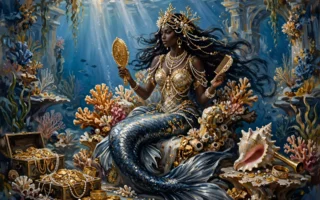
Think about what is being said there. The mirror this goddess trusts is not glass. It is the hand of someone who serves her. She does not look at herself in an object; she looks at herself in devotion, and finds herself lovely there. If Ezili Freda’s toilette taught this altar how glamour behaves in the parlour, and La Sirène’s how it behaves in the depths, Anaisa Pye’s teaches how it behaves in the Dominican houses, in the 21 Divisiones: glamour held in the palm of a hand, by a woman who expects to be adored and intends to check.
The record
Anaisa Pye — Anaisa Pyé — is a misterio of the Dominican 21 Divisiones, the tradition the houses also call Sanse, kin to Haitian Vodou and carrying its own saints, its own divisions, its own ladies. She is the patroness of love, of money, and of general happiness — the Queen of Love in her division — and her record, as Judika Illes gathered it in the Encyclopedia of Spirits, is specific in a way this altar treasures: her devotees petition her for enhanced beauty, sensuality, and desirability, and the record holds that consistent offering and presence in her honour may confer exactly those gifts. She is invoked, too, for the domestic and the romantic and the marital, and she heals disorders of women’s bodies — a lady whose glamour and whose care for women are the same ministry.
Her colours run the yellow-to-gold spectrum, and pink beside it — shimmery, sparkling, radiant, in Illes’s words, like light on sweet water. Her feast is July 26, the feast of St. Anne, and in the Catholic imagery the tradition carries, it is St. Anne she walks with: altars bear Anne with the child Mary, and in the Dominican Republic she is syncretized with the young Mary beside her grandmother. Her altar stands beside that of Belié Belcan — St. Michael — her consort, the old warrior keeping watch next door to the lady of love. Her number is seven. One practitioner record gives her sacred day as Thursday; Illes, with a smile in the prose, notes that Anaisa expects devotion every day. Both are in the record. Houses differ, and so do ladies.
And her kinship reaches back across the water to the family this altar knows. Several sources group her with the Ezili: among her alternate names stands Anaisa Pie Danto, and Illes records that she may be a Dominican variant of Ezili Dantò — or of Dantò’s daughter Anaïs, the girl who speaks for her scarred mother in the Haitian houses. Sister-tradition, daughter, echo — the record offers the possibilities and crowns none of them, and neither will we. What is certain is the family resemblance: the Ezili women and their Dominican kinswoman are ladies of love and beauty whom Black women have served, in house after house, island after island, for longer than any book has been watching.
Her character, the record insists, is joy with an edge. She arrives laughing and dancing, generous, playful, extremely flirtatious — and jealous. Illes calls her a jealous Metresa who demands total devotion, considers herself able to provide anything a person could request, and resents her devotees’ devotion wandering to other female lwa. Read that plainly: this is a lady who believes she is sufficient. All of it — the love, the money, the beauty, the happiness — she holds in her own hands, and she knows it.
The toilette
The practitioner wiki of the Divisiones preserves her arrival in ceremony in unusual detail, and it is the most beauty-specific service record this altar has found for any spirit of her family. Item by item, as the houses document it:
The yellow fula. When she mounts her cheval — the devotee whose body she rides — the celebrants offer her a yellow headscarf, her colour, gold-adjacent, and she takes it. The Sanse record adds her yellow paños, laced with gold, that she dances in.
The change of clothes. She may change into a blouse and skirt provided for her by the house. The spirit does not consult in travelling clothes. She dresses for her court.
The mirror in her palm. Then the moment this post is named for: she looks into her mystical mirror, which is the palm of the serviteur’s hand, and admires herself. No glass, no silver — a hand, offered up, becomes the surface she trusts with her face.
Makeup and lipstick. She puts on makeup and lipstick — the Sanse profile adds facial powders to her loves — dressing her borrowed face the way she would dress her own, because while she rides, it is her own.
Perfume. She perfumes herself, generously; sweet perfumes and oils are among her documented loves, and baby powder too, the soft dusting of a lady finishing her toilette.
Jewellery. She puts on any jewellery offered to her — gold jewellery, bangles at the wrists and ankles. What the devotees bring up to her, she wears. The toilette is completed by other people’s love made metal.
Then, the court opens. With a lit cigarette and warm beer in a nice glass, she is ready to consult — to hear petitions, to advise, to bless. Beauty first. Business after. In that order, every time.
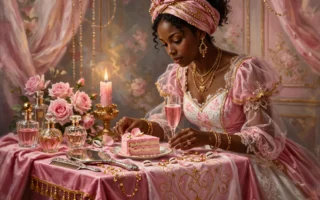
Her table, when it is laid for her, must itself be beautiful — the practitioner record is explicit that her altar must be beautiful, dressed with yellow candles and many flowers. Upon it: champagne; beer served warm in an elegant champagne flute, for Illes records that she is invoked by pouring beer into a champagne flute and adding seven drops of Florida Water or other perfume — the working woman’s drink poured into the lady’s glass, scented like an offering, which is the whole of Anaisa in one gesture. Sweets and delicate fruits — miniature bananas, champagne grapes, marzipan fruits, chocolate-dipped fruits. Cigarettes. Yellow roses. And among the offerings, the ones this altar underlines: perfume, scented soaps, cosmetics, and jewellery — the instruments and ornaments of beauty itself, laid on the altar of the lady who grants beauty. You give her the tools of glamour, and she returns the glamour.
The honest mirror
Now the part this altar will not skip — and with Anaisa, the record itself hands us the tension, in the devotees’ own two voices.
One practitioner wiki describes her as she appears in the printed devotional imagery: “golden-toned French skin, green eyes and long, blonde hair.” The colonial picture again — the same light face the chromolithographs gave Freda, pasted over a lady of the Dominican houses.
But the traditional Sanse prayer, the one her own devotees actually pray, addresses her otherwise: “bella morena de mi devoción” — beautiful brown-skinned one of my devotion — and calls her Gran Cacica, great lady chief, lady of the sweet waters.
Both descriptions survive. Only one of them is the devotees’ voice. The picture is what was printed for them, in an empire’s image of what a beautiful lady must look like. The prayer is what they said to her, in their own mouths, in their own language: morena. Brown. Theirs. As with Freda’s mirror and the figurehead at Bord de Mer, this altar keeps the devotees’ word over the empire’s picture. Anaisa Pye is bella morena — beautiful and brown — because the women who love her have always said so, to her face, in prayer. The mirror in her palm shows her what her people see. It has never shown her a stranger.
A note on the record itself
Honesty about sources is part of this strand’s covenant, so let it be plain: Anaisa Pye has not yet received what Freda received. There is no great ethnography of her, no scholar who sat in her houses for years and wrote the book. What exists is the practitioner record — Sanse blogs and house profiles, a divisions wiki, and Illes’s encyclopedia gathering — kept by the people who serve her. This post has leaned on exactly that, named it where it stands, and invented nothing to fill the silences. If the record is thinner here, that is not her devotees’ failure. It is the archive’s, and archives have always been thinnest where Black women’s devotion was busiest.
For us
What does the Queen of Love of the 21 Divisiones have to say to a Black woman at her own mirror?
That beauty is a legitimate petition. Anaisa’s devotees do not apologise for asking her for beauty, sensuality, desirability — the record lists those requests beside love and money and happiness, unembarrassed, as things a woman may simply want and may ask heaven to help her hold. Wanting to be beautiful is not a lesser prayer.
That glamour is completed by other hands. Her mirror is a palm. Her jewellery is what her people bring. Her toilette is a collaboration between a goddess and the women who love her — which is to say, glamour was never a solo art. It is a community holding the mirror up.
And that joy is her register. Freda weeps in her jewels; La Sirène keeps what the deep takes. Anaisa laughs, dances in gold-laced yellow, drinks her beer from a champagne flute, and expects every day to be a feast day. There is a place on this altar for that too: glamour as delight, glamour as a lady so sure of her sufficiency that devotion itself becomes a party she graciously attends.
Cautions
Homage, not initiation. The 21 Divisiones — Sanse — is a living, house-transmitted tradition. What is written here is respectful homage and an account of how Anaisa Pye is served, drawn from the published practitioner record. Formal service belongs in a house, under those who carry it. This blog initiates no one.
Houses differ — do not blend them. Her day, her counterpart, her kinship to the Ezili: where the record gives more than one answer, this post has said so. If you are ever blessed to sit with a house that serves her, keep that house’s rules whole.
Her jealousy is in the record for a reason. The tradition itself describes a lady who demands total devotion and resents a divided heart. Honour her as a guest honours a queen — with respect for what the houses say she asks — and let the houses, not a blog post, guide any deeper approach.
On July 26, and on every day she expects, in houses across the Dominican Republic and its diaspora, women lay out yellow and gold, pour beer into a beautiful glass, scent it like an offering, and wait for the laugh that means she has arrived — to tie her fula, to dress, to lift a devoted palm and admire herself in the only mirror she trusts.
Bella morena de mi devoción. The prayer had it right all along. Hold up your hand, sister, and look: the mirror was never glass. It was always the love that serves you, showing you your own face — brown, beautiful, and entirely sufficient.
Glamour is yours to conjure. — Lakish