This post contains affiliate links. If you buy through them, Blaq Vixen Beauty may earn a small commission at no extra cost to you.
Every other surface at the vanity receives the glamour. The mirror returns it.
It is the only furniture in the house that looks back — and the record, across more houses than this altar keeps, has never treated it as a neutral object. Mirrors get covered in the record. They get turned to the wall. They get veiled, darkened, and put to rest. This piece is about the closing of the glass: what the customs actually were, what reasons the record gives for them, and what the glamour worker does with a mirror that can be shut.
First, the house order, because a mirror’s first witnesses are the dead who stood at their own: before any working at this altar, consult your benevolent ancestors first. They are the first authority — before any root, any book, any glass. The women who veiled their mirrors in grief did not learn it from a book. They learned it at their mothers’ vanities, in houses where the mirror had rules.
The Covered Glass of Mourning
When death entered a house, the mirrors were covered — veiled in cloth, or turned face to the wall — and they stayed covered through the mourning. The custom is recorded across many cultures and was kept in Black Southern funerary practice as part of the house’s preparation for its dead: the clocks stopped, the door dressed, the glass darkened. Zora Neale Hurston’s record of the South carries that world’s texture — a people whose houses changed their faces when death was in residence.
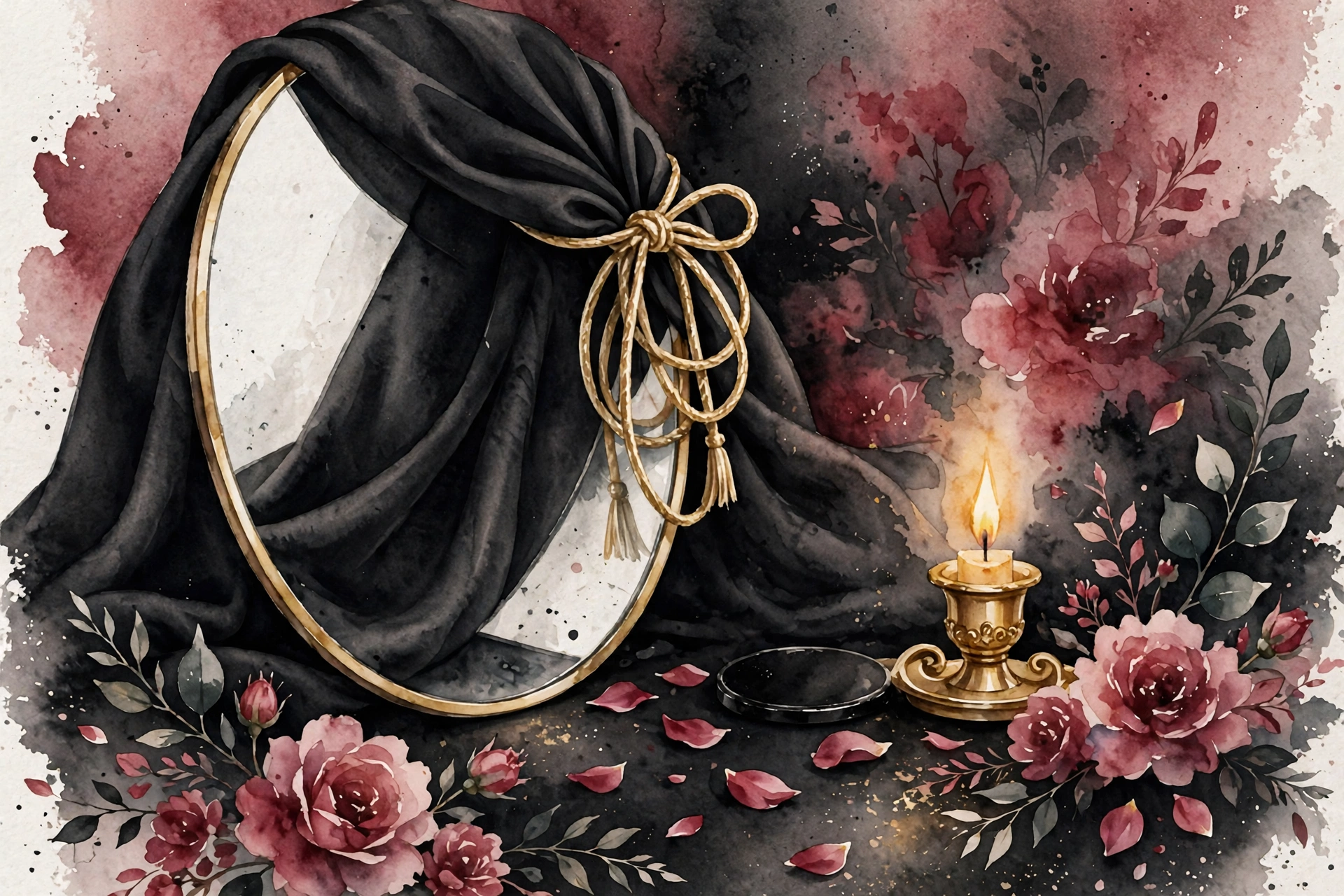
The folk record gives its reasons plainly, and this piece reports them as the record gives them, as custom and belief — not as metaphysics this altar asserts. The soul, newly loosened, should not be caught or confused by its own reflection. The mourners should not be met, in the rawest hour, by their own grieving faces staring back. Vanity itself was suspended in the house of loss: the glass was covered because looking had become the wrong activity for the season.
Whatever a reader believes about the first reason, the second and third need no belief at all. They are the wisdom of people who understood that the mirror makes demands — and that there are seasons when a household declines, together and on purpose, to meet them.
The Black Mirror
In the British Museum today rests an obsidian mirror — polished volcanic glass, made by Aztec hands, carried to Europe in the age of conquest, and associated by tradition with Dr. John Dee, the Elizabethan magus whose name anchors the English occult record. The practice attached to such mirrors in the record is scrying: gazing into the dark surface for visions. This piece names that practice because the record names it; it does not teach it, and it does not romance it. The object’s own history is sobering enough — a sacred technology of one people, taken in conquest, put to work in another people’s magic. The black mirror’s first lesson is not how to look into it. It is whose it was.
But its existence in the record proves the piece’s point from the other side: for centuries, serious practitioners treated a reflective surface as a door — an instrument with an open and a shut position — and handled it with the care a door deserves.
The Mirror as Witness
Why cover a mirror in a sickroom? Why turn it in a death room, veil it in a storm season of the soul?
The folk belief underneath the customs is consistent: the mirror keeps what it has seen. It is a witness that does not forget on schedule. Houses that covered their glass were not afraid of an object; they were minding a threshold — declining to leave a recording surface running in rooms where the veil was, by everyone’s account, already thin.
The vanity mirror is the same instrument in a brighter room. It has witnessed every face its owner has ever made, including the ones no street has seen — the unkept face this altar’s shadow-work piece sits with, in honest light. A witness that faithful deserves governance, not assumption.
Locking and Sealing, as This Altar Teaches It
What follows is this altar’s own practice, built on the record above and labeled as this altar’s building — an extension of custom by a living house, claiming no older birthday than it has:
The vanity mirror is veiled in grief, as the mourning houses veiled theirs — not in fear, but in season-keeping: the face is not for display, and the glass rests with it. It is veiled in illness, when looking has become a tax the sick woman should not have to pay at her own dressing table. It is turned, or covered, in any season when its owner judges that the witness should be off duty — after the warding work, before the deep interior work, on the nights the ancestors are being consulted and no third party, not even glass, attends.
The covering is a cloth laid with intention. The turning is a face given to the wall. The sealing is the word spoken over both: closed, until I open you. No effects are promised for any of it, here or anywhere on this altar. What is claimed is smaller and truer: a custom with centuries behind it, kept by a woman who knows what her mirror is.
Name the work by this altar’s taxonomy: this is glamour’s own office, turned inward. Glamour governs being seen and being unseen — by rooms, by strangers, by the culture’s arithmetic — and the covered glass is that governance applied to the one witness who never leaves the house. In grief and in illness the veiling also keeps a season, and season-keeping is care, not concealment; the altar names both offices and does not confuse them.
A Mirror That Can Rest
A mirror that can be opened can be closed. That is not a limitation on the glamour — it is part of its discipline, the same discipline that teaches when the face is worn and when it is, blessedly, not.
Cover the glass in its seasons. Let the witness rest. And when you lift the cloth — in your own time, by your own hand — meet the face that comes back to you like what it is: the oldest company you keep, returning from its rest, ready to be dressed again.
Glamour is yours to conjure. — Lakish
From the Altar’s Bookshelf
- Zora Neale Hurston, Mules and Men (1935)
As an Amazon Associate, Blaq Vixen Beauty earns from qualifying purchases.