This post contains affiliate links. If you buy through them, Blaq Vixen Beauty may earn a small commission at no extra cost to you.
The Question at the Altar
Where does glamour live in the books?
Not in the margins, and not as a modern word pasted onto old magic. The written record names it as an office from the beginning. The Greek papyri keep a technical term for it. The Solomonic books print it in their tables of contents. The mail-order formularies sold it under its own name.
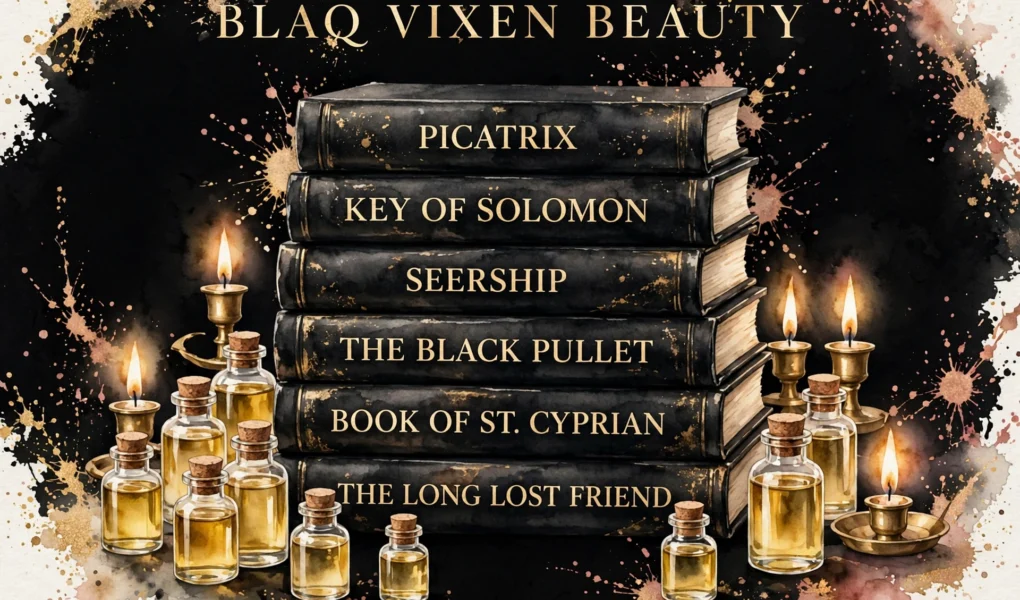
This shelf is the altar’s foundation, laid in public. Glamour, as this house defines it, is perception work: fascination, being beheld with favour, winning favour before authorities and crowds, concealment and passing, commanding attention. Beauty counts only where beauty is the instrument of perception. And before any working drawn from any book on this shelf, the altar’s standing counsel holds without exception: consult your benevolent ancestors first. They are the first authority, before any root, book, or teacher. Hoodoo is a closed Black American practice, and this altar teaches from within its own record.
Walk the shelf with us.
The Ancient Shelf
The Greek Magical Papyri, gathered between the second century before the common era and the fifth century after it, hold a named class of favour workings — the charitēsia, workings “to acquire charm, favor, or success.” One fourth-century roll from Oslo is a young man’s success kit entire: a charm to restrain anger and secure favour that “works even against kings,” a charm for gaining the favour of people in your presence and of crowds, and victory in the courts. Favour before power, favour before the crowd, favour before the law. The house definition, verbatim, in the oldest stratum on the shelf.
Sefer ha-Razim, the Book of the Mysteries, staffs the same office with angels. In its first firmament, the fourth encampment belongs to angels whose work is “granting grace and charm” to whoever approaches them in purity — entertaining kings and grandees, turning the opinion of a king, a ruler, a judge, so the petitioner will “find favor and mercy before him.”
Doctrine, first movement: glamour begins as favour — being beheld kindly by power.
The Solomonic Shelf
The Picatrix, compiled in al-Andalus and carried into Latin, aims its astral images squarely at perception. Its talisman lists promise “that kings and nobles shall love you” and dignity from a lord or king. Its Venus images include a copper ring whose bearer “will be served by women and kings,” and an image such that everyone who carries it “will receive good and be liked by everyone.” The house record says plainly what the register is: celestial influence worked upon another’s heart — astral fascination, not the dragging coercion we will meet at the shelf’s edge.
The Key of Solomon names the work outright, on its own contents page: an Experiment of Seeking Favour and Love, and an Experiment of Invisibility, side by side, with the Venus pentacles among its planetary medals. The Hygromanteia, the older Solomonic treatise behind it, carries glamour more quietly — planetary hours and days graded for love and for public relations, and prayers addressed to the planets to gain their favour. Its invisibility line rests, in our source of record, on Stephen Skinner’s comparative analysis of the line that runs from the papyri through the Hygromanteia to the Key; we state it at that strength, and no stronger.
Two carriers bring this line into print under Solomon’s name, and both are written here at the strength the evidence allows. The Talismans of King Solomon corpus — forty-five talismans in its best-documented printed form — records operations for invisibility and for love among its properties; whether the copy that rests on this altar is that exact corpus is unconfirmed, and the draft says so because the altar does not overstate its own shelf. Raphael’s Ancient Manuscript of Talismanic Magic, a selection drawn from Solomon, Agrippa, and Barrett, promises nearly one hundred talismanic diagrams; favour-and-love talismans are expected among them from its stated sources, but they were not confirmed diagram by diagram.
Doctrine, second movement: favour and concealment are paired experiments in one book — Venus for being beheld, the Moon for not being.
The Folk Shelf
Agrippa’s Three Books of Occult Philosophy, in 1533, catalogues a Venus image “reported to make men pleasant, jocund, strong, cheerful, and to give beauty.” Beauty itself, named as the instrument of regard — the house’s beauty clause, in a Renaissance text.
The Grimorium Verum assigns the offices to named spirits: one who can make anything invisible, and one who gives “attaining invisibility and the love of great lords” together — concealment and favour before the powerful in a single office. The Grand Albert, the French folk grimoire compiled from the Picatrix and Key lines, is described in the record as carrying love charms, invisibility, planetary talismans, and a talisman worn to gain favour with powerful people; we hold it at probable, as our source does. Its smaller companion, the Petit Albert, keeps magical perfumes — glamour’s scent office — in its pages.
Across the Atlantic, The Long Lost Friend carries the favour office into American dress: a charm for when “you call upon another to ask for a favor,” and a working for gaining a lawful suit. The Sixth and Seventh Books of Moses, a book of seals and planetary tables meant to be carried on the person, holds a Table of Venus in its Seventh Book — a table whose recorded promise is to make its bearer beloved. Egyptian Secrets, the German folk book under Albertus Magnus’s name, keeps headings for making oneself invisible and for causing love among its household remedies and protections. And The Black Pullet lists its talismans by purpose: one to penetrate everywhere unseen, one giving invisibility — the concealment office, squarely glamour.
Then the edge, named plainly, because a shelf that will not name its edge is not honest. The papyri also hold dragging spells that torment the beloved into coming. The Book of St. Cyprian’s love shelf runs heavily to binding. The Petit Albert carries material for the control of women. The Black Pullet holds a love talisman whose mechanism is coercive in register. Where the record turns to binding and control, this house says what it has always said: that is not glamour, and the altar does not shelve it as such. Fascination invites the eye. Coercion overrides the will. Only one of those is our work.
One correction, made in public, as the altar corrects its own shelf: Aunt Caroline’s Dixieland Recipes was checked against its full text and is a cookbook — breads, beverages, cakes, and Southern dishes. She is not seated here as a formulary.
The Perception Current
Paschal Beverly Randolph’s Seership: The Magnetic Mirror teaches seeing — clairvoyance, soul sight, the mirror. Let the record stay honest in print: the mirror book is a manual of perception inward, not a book of fascination rites. Its seat on this shelf is through Randolph’s governing doctrine of magnetism — the current his wider corpus treats as the medium of personal influence, the nineteenth century’s own word for what this house calls fascination. The glamour claim belongs to the doctrine around the book, and it is written at probable strength until that doctrine is confirmed, page by page, against the scholarly record.
Doctrine, third movement: glamour has a current as well as a shelf — the trained power of being perceived, and of perceiving, on purpose.
The Mail-Order Shelf
In 1914, L. W. de Laurence’s Chicago edition carried the Greater Key of Solomon — the same Experiment of Invisibility, the same Experiment of Seeking Favour and Love, the same Venus pentacles — to American readers, Black American readers among them, by mail. Lewis de Claremont’s Ancient Book of Formulas in 1940 printed a fascination family: workings named for fascination itself, glamour’s own word in the period’s vocabulary. His Legends of Incense, Herb, and Oil Magic stands behind it as the era’s oil-and-incense formulary. And Henri Gamache’s Master Book of Candle Burning, in 1942, lists an exercise to win love, an exercise to gain power over others, and a colour symbolism that assigns pink to attraction outright.
Doctrine, fourth movement: glamour was democratized by catalogue — and commodified in the same motion. This altar holds both truths at once, because the record holds both.
The Close
Twenty books. Two ancient, five Solomonic, nine from the folk shelves, one mirror, three from the mail-order houses that put the work into Black American hands. The altar’s work stands in a line older than any living practitioner, and the line is documented, not imagined.
Four of these books came to this altar’s keeper from her own teacher’s hand in 2018. That story is not told here; it is told in “I Am Trusting You”: For Ms. Lisa of Memphis Conjure. A breath only — the tribute carries it.
The shelf is inheritance. Take it up at record level, with reverence, and with your ancestors consulted first.
From the Altar’s Bookshelf
As an Amazon Associate, Blaq Vixen Beauty earns from qualifying purchases.
- Hans Dieter Betz (ed.), The Greek Magical Papyri in Translation (University of Chicago Press, 1986)
- Michael A. Morgan (trans.), Sefer ha-Razim: The Book of the Mysteries (1983)
- John Michael Greer and Christopher Warnock (trans.), Picatrix
- S. L. MacGregor Mathers (ed.), The Key of Solomon (1889)
- John Patrick Deveney, Paschal Beverly Randolph (SUNY Press, 1997)
- Carolyn Morrow Long, Spiritual Merchants (University of Tennessee Press, 2001)
- Owen Davies, Grimoires: A History of Magic Books (Oxford University Press, 2009)
Glamour is yours to conjure. — Lakish