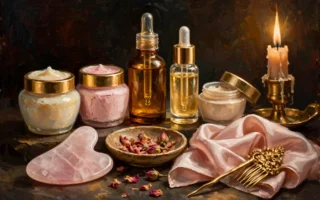
This post contains affiliate links. If you buy through them, Blaq Vixen Beauty may earn a small commission at no extra cost to you.
Source: Deborah Castellano, Glamour Magic: The Witchcraft Revolution to Get What You Want (Llewellyn, 2017).
A woman can be beautiful and still be overlooked. She can do everything the mirror asks and watch the room choose somebody else — somebody less polished, less careful, less ready. Deborah Castellano wrote a whole book about that gap, and she gave it a name worth stealing honestly, with her name attached: beauty is static. Glamour does.
Tonight the Grimoire opens Glamour Magic (Llewellyn, 2017), a modern witch’s book — not a Hoodoo text, and this altar will not dress it as one. It is shelved here because its central argument belongs at a vanity: glamour is not the face you were given. It is what you do with what makes you interesting.
Two definitions, and the one she throws away
Castellano opens her first chapter, “What Is Glamour, Anyway?”, with two definitions. The first: glamour is what makes you exciting and interesting to others. The second: glamour as an illusionary spell — and that one she discards as useless, because it invites the world to dismiss glamour as a Hollywood party trick.
Hold onto how much that matters at this altar. The glamour here was never a false face laid over a true one. Castellano says it plainly: glamour is not an invented landscape or a false self. It is what is already interesting and exciting in the practitioner, lying dormant, now deliberately used. The publisher’s one-line version of her book says the same thing in working language — glamour is taking what makes you exciting and interesting to others and using it as leverage to accomplish your Great Work.

The Great Work: name what you want, in one sentence
That phrase — the Great Work — is an old alchemical term Castellano consciously repurposes, and this post will not pretend otherwise. In her hands it means this: your innermost transmutation, and it begins when you can name, in one sentence, what you actually want.
Her tests for a real Great Work are strict enough to respect. It must require effort. It must be deeply meaningful. And it must need both kinds of work — the practical, mundane work and the magical work, together. Her examples are a regular spiritual practice, finding a mate to marry, discovering a career path, completing a specific creative endeavour, buying a house. And glamour, in her telling, is not a guarantee. It improves the odds. It does not promise the outcome. A reviewer who knows this territory, Lilith Dorsey, noted the distinction this altar cares about: Castellano’s Great Work is not the Gardnerian sense of the term — it is hers, repurposed on purpose.
There is a discipline hiding in that one-sentence rule, sister. “I want to be seen” is a wish. Naming for what, and to what end, in a single sentence you can say without flinching — that is a working.
Kosmesis: Hera at her mirror
Castellano’s most beauty-usable teaching has a Greek name: kosmesis, the art of dress and adornment performed by queens, goddesses, and demi-goddesses. Her exemplar is Hera in the Iliad — bathing, perfumed oil and cosmetics, hair braided in the newest fashion, dress and jewels chosen to sway Zeus and, with him, the outcome of a battle.
Read that scene the way this altar reads everything: adornment, done with intent, before a consequential encounter, is not vanity. It is preparation. In her fifth chapter, “Mirror, Mirror” — the chapter whose heading reads, verbatim, “Beauty Is Static, Glamour Is Magic” — Castellano turns kosmesis into a practice: lay out the chosen outfit ceremoniously, arrange cosmetics and fragrance at the mirror chosen for the intended impression, bathe with that intent held, and style hair and cosmetics at the mirror until confidence in the impression is felt. In a later interview she called the modern version simply “dress with intent.” Label it as she does: this is her modern rite, drawn from a classical precedent — not an old folk formula, and not this altar’s invention.
Small favours first
Her book is built around numbered workings she calls Esoteric Experiments, meant to be done in order, each a compass rose toward an objective rather than a recipe to copy — she opposes, in her own phrase-making, plug-and-play “Betty Crocker spellwork.” The experiment this altar can honestly describe in structure is the one for small favours: enchant an object — ideally new, wearable, beautiful to you — by distilling the favours wanted into one simple sentence, whispering the date and intention to it nightly, and, on the chosen day, preparing with a ritual bath and dressing deliberately before breathing the desire into the object and wearing it.
Notice the order of operations, because it is the ethics of the thing. Small favours first, before grandiose workings. One sentence, plainly named. Weeks to months of wearing, feeding, and returning to the intention — and, she insists, no obsessing: most glamour, in her image, takes place peripherally, watched out of the corner of the eye. This post describes her rite’s structure in summary only; her full ritual texts are hers, and the woman who wants them goes to her book.
The parts of her teaching that guard the practitioner
Three of Castellano’s cautions deserve a place at this altar word-for-word in spirit:
- Genuineness. Drawing on faery lore that faeries could evade or riddle but could not lie, she argues glamour needs a core of truth to stick to — a web of lies cannot sustain it, or build the genuine connections most opportunities actually come from.
- Empathy as glamour’s active half. She teaches active listening — fully present, no phone, asking how something made a person feel — as part of the work, not decoration around it. Her paraphrased formula: empathy is what you do; glamour is what you are.
- The budget caveat. A credit card is not an extension of income, and a luxury bag is not worth a missed mortgage. She names thrift, freecycle, and drugstore testers as her strategies for curating style within actual means. Cosmetics, she is blunt, will do only what they actually do — hair dye changes hair colour, not body shape; a smoky eye puts shadow on lids, not stretch marks off a body.
That last honesty is why this book earns its shelf here. An altar that will not invent a product will not sell a woman a fantasy about what a product can do, either.
An honest word about the book itself
The reviews do not all agree, and this Grimoire will not hide that. Dorsey recommends it to anyone interested in glamour magic and praises its exercises for finding the Great Work. Mat Auryn calls it excellent, practical, and accessible — glamour as perception-management for all of life, not only seduction or beauty. Spiral Nature’s reviewer agreed glamour is a magical tool but found the title misleading: the book spends far more time on why glamour — the Great Work — than on practical how-to, and can feel disjointed. All three can be true. This is a book about naming what you want and becoming the woman who can be chosen for it. The recipes are the smaller half of it, on purpose.
What this altar takes, and what it leaves
Taken, with credit: glamour as what makes you interesting, deliberately used — not illusion. Beauty static, glamour active, glamour as breaking the mold rather than fitting it. The Great Work as a one-sentence desire pursued by mundane and magical work together. Kosmesis — adornment as ritual before the encounter that matters. Small favours before grand ones.
Left on her shelf, where it belongs: her full ritual texts, her correspondence-free system exactly as it is — she presents no planet, herb, or colour tables, and none will be attributed to her — and any claim that her work is Hoodoo tradition. It is not, and she does not claim it is.
One sentence, sister. That is where her book begins, and it is a fair place for a mirror practice to begin too. Not “make me beautiful” — beauty is static, and the mirror already did that work. Name what the glamour is for, in one sentence you can whisper to the glass without looking away. Then dress with intent, do the mundane work beside the magical work, and let the glamour do what glamour does.
Glamour is yours to conjure. — Lakish