This post contains affiliate links. If you buy through them, Blaq Vixen Beauty may earn a small commission at no extra cost to you.
Source: Drawn from the documented record as this blog’s research presents it: cat yronwode’s documentation of the Hoodoo and Lucumí devotional record, and the Lucumí/Candomblé record this altar has already published in its post “Oxum’s Abebé” — one orisha, kept in two houses. What follows is a five-day devotion of homage for a beginner at her own altar — not an initiation, not a house rite, and nothing here replaces a house.
The hook
Five is her number.
Ask anyone who keeps Oshun and the five comes back to you — in her offerings, in her days, in the shape of her sweetness. And five is a kind number for a beginner. One day is a gesture; a season is a vow you will break by Thursday. Five days is long enough for a practice to stop being an errand and become a devotion — and short enough that you can actually keep it, all the way to the end, and know what keeping feels like.
So this post is not a spell, and it is not aimed at her like a request fired across a counter. A devotion is not something you cast at a lady of the river. It is attention you pay her — five small appointments, kept on time, in sweetness. That is the whole of it. First Flame exists to teach beginners the difference between reaching for power and learning regard, and there is no better teacher on this altar than the lady whose mirror never sits still.

Who she is
Oshun is the orisha of the river — of fresh water, love, beauty, sweetness, and gold. Her colors are yellow and gold. Her emblems gather the way her gifts do: the mirror, honey, oranges, cinnamon, pumpkins, sunflowers, brass that shines like the metal she loves. She is the lady of sweet water, and sweet water is not still water. A river gives — drink, fish, passage, coolness on the skin — and a river takes, and everyone who has ever lived beside one knows both truths in the same breath. Her sweetness has that steel in it. She is not soft because she is sweet, any more than honey is weak because it pours.
You have met her on this altar before, under her other name. In Brazil she is Oxum, kept in the terreiros of Candomblé, where her mirror is set into a golden fan — this altar told that story in “Oxum’s Abebé,” and it stands: one orisha, two houses, each keeping honored on its own terms. Here we sit with her Lucumí keeping, as Oshun, at the riverbank a beginner can approach: from the outside, with respect, bearing sweetness.
The five days
What follows is this blog’s own devotional frame — an arrangement for a beginner’s home altar, built only from elements the record documents: her five, her yellow and gold, her honey tasted first, her orange and pumpkin, her mirror. It is homage, arranged by this altar, and it is labeled as such so that no one mistakes a blogger’s devotion for a house’s rite. Keep each appointment small. A devotion you finish teaches more than a ceremony you abandon.
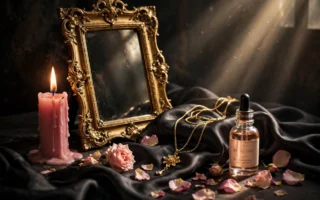
Set your place before the first day: a small, clean corner of your vanity or table, dressed in yellow or gold if you have it. A yellow candle — the record also allows white. Something golden or brass, if it is already yours. A mirror. That is enough. She has never needed you to shop; she needs you to show up.
Day one — arrival. Light the candle and say her name aloud, and say plainly why you have come: not to purchase an outcome, but to pay regard to the lady of the river, of beauty and sweetness, for five days. The documented observance has the petitioner speak her wishes aloud before the candle; on this first day, let the wish be simple and honest — to learn sweetness, to be regarded kindly by your own eyes, to carry your beauty the way she carries hers. Then sit a moment in the candlelight and do nothing. Arrival is a discipline. Let the flame go out on its own schedule or snuff it with respect; you will light it again tomorrow.
Day two — sweetness. Bring the honey. The record is firm on the courtesy, and this altar keeps it exactly: the honey is tasted first. Tradition holds that Oshun was once nearly poisoned with tainted honey, and so the devotee tastes it before it is offered — proof, on your own tongue, that what you bring her is safe and sweet. Taste it. Then set a small portion of that same honey at her place, in a clean little dish, beside the candle. Light the candle. This is the day to learn what an offering actually is: not a bribe, not a fee — a gift whose goodness you have verified with your own mouth before you dared present it.
Day three — regard. Today the mirror works. The mirror is among her oldest emblems, and in Brazil it rides in her golden fan, moving as she moves; at your small altar it can simply be the mirror you already own, honored for an evening. Light the candle. Look at yourself the way the river looks — without flinching and without cruelty. Speak aloud one true and kind sentence about your own face. Only one; beginners rush to lists, and lists turn to bargaining. One true sentence, kept. Regard is the root of every glamour this altar teaches, and she is its patroness: the lady who beholds herself and is pleased.
Day four — adornment. The record’s offerings include the unblemished peeled orange, and a pumpkin dressed with honey and cinnamon, set out in her colors. Bring the orange today — peeled, whole, unblemished — and set it at her place with a dusting of cinnamon’s warmth nearby, and let the pumpkin, if you keep one for her, wear its drizzle of the tasted honey. Then adorn yourself, deliberately, in her honor: hair done with intention, scent chosen rather than grabbed, something gold-toned at your throat or ears if it is already in your keeping. Not costume — consecration of the ordinary. You are not dressing as her. You are dressing for her, the way you would dress to receive a beloved guest, and letting your own beauty be the offering that walks around.
Day five — thanks. Light the candle for the last time and complete the five the way the record completes its observances: with the gifts gathered and gratitude spoken aloud. Set out her oranges — five of them, in her number, as this altar’s arrangement of her documented orange — or complete the pumpkin’s honey and cinnamon if that is the gift you kept. Thank her by name for the five days: for sweetness, for regard, for the discipline of returning. A devotion ends the way it began, with attention — not with a demand for receipts. What she does with your regard is hers. What you did with your five days is yours, and no one can take the keeping of them from you.
The honest mirror
Let this altar be as plain here as it was at Oxum’s fan.
This devotion is homage. It is not initiation, and finishing it makes no woman Oshun’s priestess, her child in the initiatory sense, or a member of any house. Lucumí and Candomblé are living, initiated religions; their rites, their ceremonies, their deep knowledge belong to their houses and the priests and priestesses who carry them. This post teaches none of that, claims none of that, and points every reader who wants more than homage toward the only door there is: a house, and time, and being taught.
And hold the other honesty beside it: her sweetness is not softness, and devotion to her is not decoration. The river that sweetens is the river that floods. To pay Oshun regard for five days is to practice respect for a power that gives beauty and withholds it, that pours like honey and runs like water through fingers that try to grab. Beginners sometimes come to her wanting only the gold. Stay for the whole lady.
Cautions
Homage, not initiation. This is the blog’s standing rule, and it governs every post in this strand: we honor the ladies of other houses from our own altar, in our own names, and we do not wear their titles, perform their rites, or call ourselves what only a house can make us. This altar’s guide to that rule stands elsewhere in First Flame; this devotion is written to live inside it.
No recipes and no rites beyond this frame. Nothing deeper is printed here on purpose — no baths, no formulas, no ceremonial procedure — because anything deeper belongs to her houses, and a blog post is not a house. If a practice cannot be traced to regard, sweetness, and her documented emblems, it does not belong in a beginner’s five days.
Kept appointments, not a transaction. A devotion is not a purchase. These five days promise no outcome — not love returned, not money drawn, not a face transformed — because regard is not a currency and she is not a vendor. What the five days honestly offer is the thing itself: five evenings of sweetness, attention, and self-regard, kept.
Offerings leave the house respectfully. When the devotion closes, dispose of food offerings plainly and safely: outdoors only where it is lawful and harmless, never in or near waterways, never where animals will be harmed by what was sweet for an altar. Honey, fruit, and pumpkin belong to the earth when they are done — not to a river she would not thank you for troubling.
Five days. A candle in her colors, honey tasted on your own tongue before it ever touched her dish, a mirror that tells one true sentence, an orange without a blemish, and a thank-you spoken out loud. Nothing in it you could not begin tonight, and nothing in it that pretends to be more than it is: a beginner at her own altar, learning how regard is paid — to a lady of the river, and, quietly, to herself.
Ora Yeye O, say the houses of Brazil — watch over us, Mother. From this side of the water, in homage, we answer with the only thing a beginner truly has: we show up, five days running, and we keep the appointment.
Glamour is yours to conjure. — Lakish