This post contains affiliate links. If you buy through them, Blaq Vixen Beauty may earn a small commission at no extra cost to you.
Some ingredients arrive at the altar with a résumé written by empires. Shea arrives with one written by women.
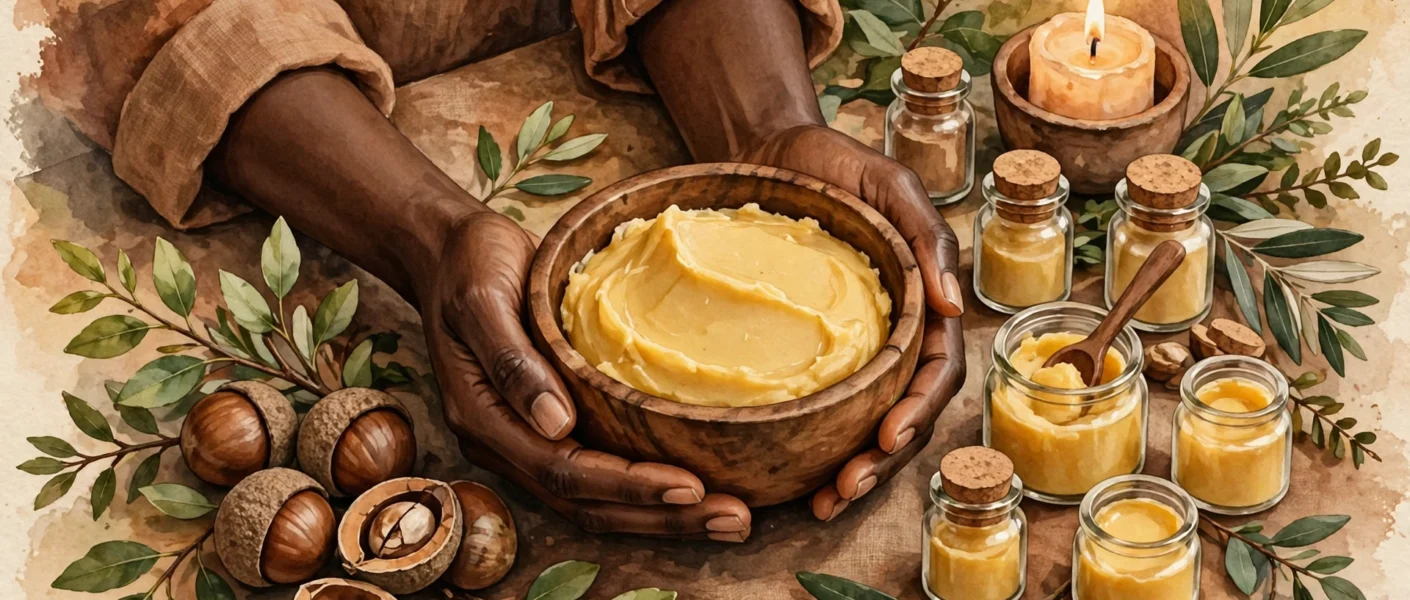
The butter comes from the kernel of the shea tree, Vitellaria paradoxa — you will still see its older name, Butyrospermum parkii, on cosmetic labels — which grows wild across the savanna belt that stretches from Senegal to Uganda. The tree is barely a crop at all. Farmers clearing land leave the shea standing, and the fruit falls to be gathered, as it has been gathered for centuries, mostly by women: boiled or dried, cracked, roasted, ground, and kneaded by hand with warm water until the fat rises. The fourteenth-century traveler Ibn Battuta already found shea moving along West African trade routes. In our own time the trade is still so bound up with women’s livelihoods that shea is called women’s gold.
Know your butter before you work with it. Raw, unrefined shea — ivory to pale yellow, with its nutty scent intact — keeps the full character of the nut: its fatty acids and vitamins A and E. Refined shea has been processed toward whiteness and odorlessness, and much of what made it itself is refined away with the color. The letter grades you will see on jars are a trade custom, not a world standard, so buy by origin and handling, not by alphabet. And keep raw shea like the food it is: cool, dark, and used within its season or two, because a living fat does not sit on a shelf forever.
At this altar, shea’s character is keeping. It is the seal, the cover, the thing laid over water and intention so they cannot escape. Here are its ways, gathered by station.
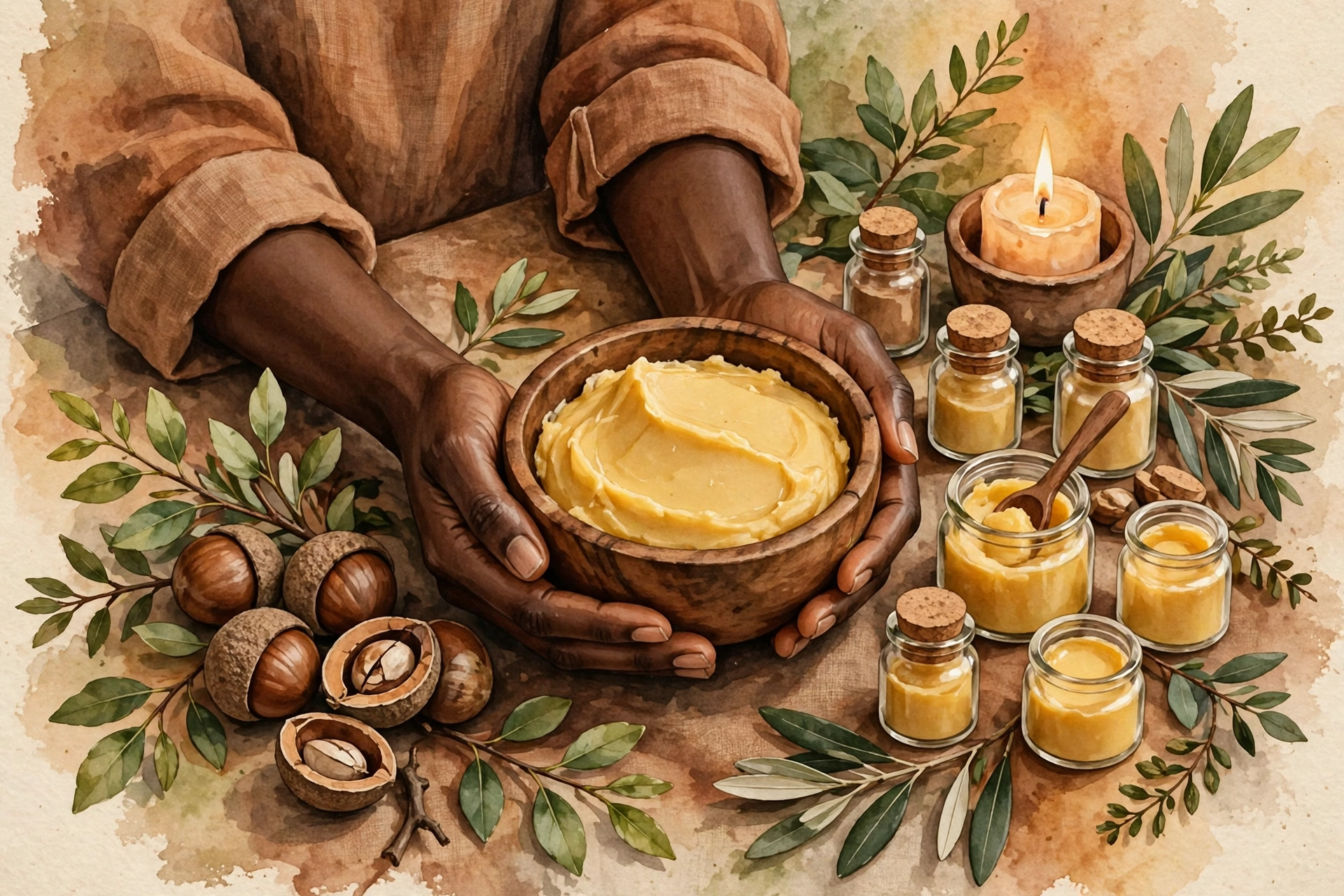
On Skin
- The after-bath seal — smoothed over damp skin to hold the water in.
- Face moisture for dry skin — a pea’s worth, warmed between the palms and pressed in.
- A night layer — worn overnight in place of a cream.
- Hand butter — for hands worn by washing and weather.
- Heel and foot softener — worked in at night and covered with socks.
- Elbows and knees — the rough places, kept.
- Cold-weather barrier — a thin film on cheeks before facing wind.
- After-sun moisture — to re-dress skin the day has dried out.
- Makeup removal — melted on the fingertips, it takes the day’s face off gently.
- A glow finish — the smallest dab on cheekbone and brow, where light is wanted.
- Sheering a base — a touch melted into foundation to thin it toward a tint.
- Cream color base — mixed with loose pigment for blush or shadow.
- Body scrub base — whipped with sugar or salt.
- Massage butter — it melts at skin’s temperature and keeps the glide.
- Shave companion — as the medium, or to dress the skin after.
- Belly and hip care — traditionally massaged in through pregnancy to keep the skin supple.
- Scar-area massage — a rich medium for keeping worked skin soft.
- Healed tattoo care — used to keep finished, healed work moisturized.
- The soap pot — a classic fat in handmade soap.
- The whipping bowl — the base of every whipped body butter.
On Hair
- Pre-shampoo dressing — melted and worked through before washing.
- Conditioner booster — a spoonful melted into your regular conditioner.
- The seal — laid over water or leave-in to close the LOC order.
- Twist-out and braid-out finish — for definition and sheen.
- Ends keeper — a film on the oldest, driest part of the strand.
- Scalp dressing — a little, on a dry scalp, between styles.
- Before the braids — coating the hair ahead of a protective style.
- Hair mask base — melted with honey or oils.
- Finishing sheen — smoothed over a finished style, sparingly.
- Brow dressing — the barest touch to lay brows in order.
Lips and Nails
- Plain lip balm — it is an edible fat; the lips are its oldest station.
- Lip scrub — with fine sugar, before balm.
- Cuticle softener — worked around the nail at night.
- Nail shine — a trace buffed into bare nails.
In the Bath
- Bath melt — a spoonful surrendered to hot water.
- Foot soak — melted into the basin before a pedicure rite.
At the Altar
- Self-anointing — practitioners anoint forehead, heart, and hands with shea before glamour work: the seal, worn.
- Candle dressing — a plain, neutral base for dressing candles before herbs or oils are added.
- An offering of nourishment — a small dish of butter set out where abundance is being thanked or called.
- Care of wooden tools — conditioning the wooden bowls, combs, and handles of the vanity and altar.
Forty ways, and the tree is not finished with us. But notice what they share: nearly every one is an act of covering and keeping — of putting a good thing under seal. That is shea’s doctrine, and it is why this butter belongs in a glamour grimoire. Beauty that is not kept does not last the day. Shea is how the savanna taught its daughters to keep it.
Glamour is yours to conjure. — Lakish