This post contains affiliate links. If you buy through them, Blaq Vixen Beauty may earn a small commission at no extra cost to you.
Begin with the word, because the word confesses everything.
Glamour began its life as a Scots form of gramarye — grammar’s dark cousin, the word for occult learning and the spell of seeming it cast. A glamour was never, originally, a look. It was an enchantment laid over perception: the thing seen was not the thing that was. Centuries of use wore the spell down into a compliment about cheekbones, and the craft hid inside the compliment, where it has been working undisturbed ever since.
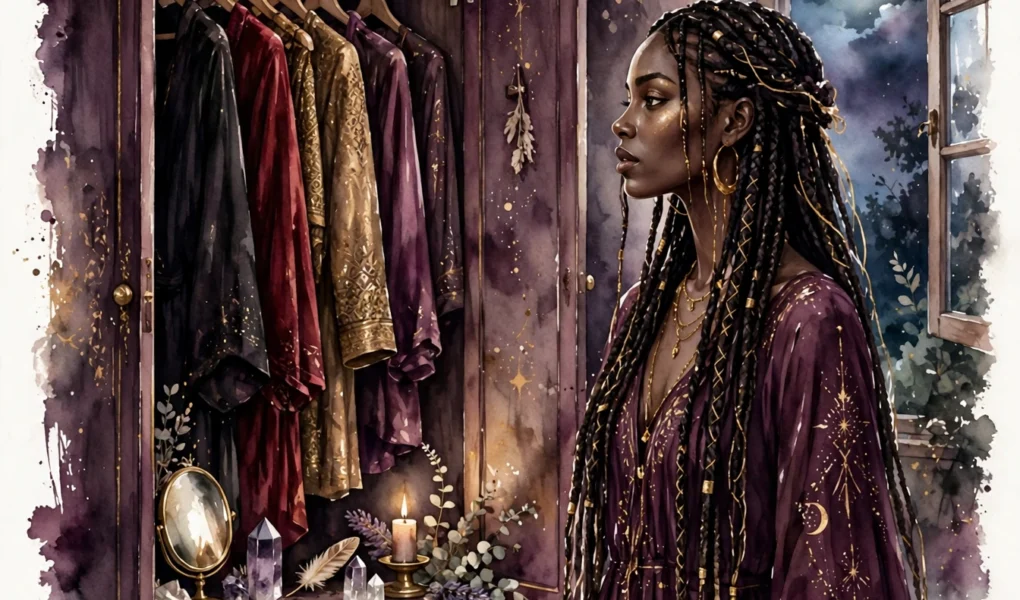
This altar restores the word to its first meaning, and names its oldest instrument. Before the candle, before the cards, before the mirror was ever dressed — there was the garment. Clothing is the glamour every woman already works, whether she names it or not. The closet is an altar room most women tend without a liturgy.
This piece is the liturgy. It founds the strand that keeps it: Wardrobe Enchantment.
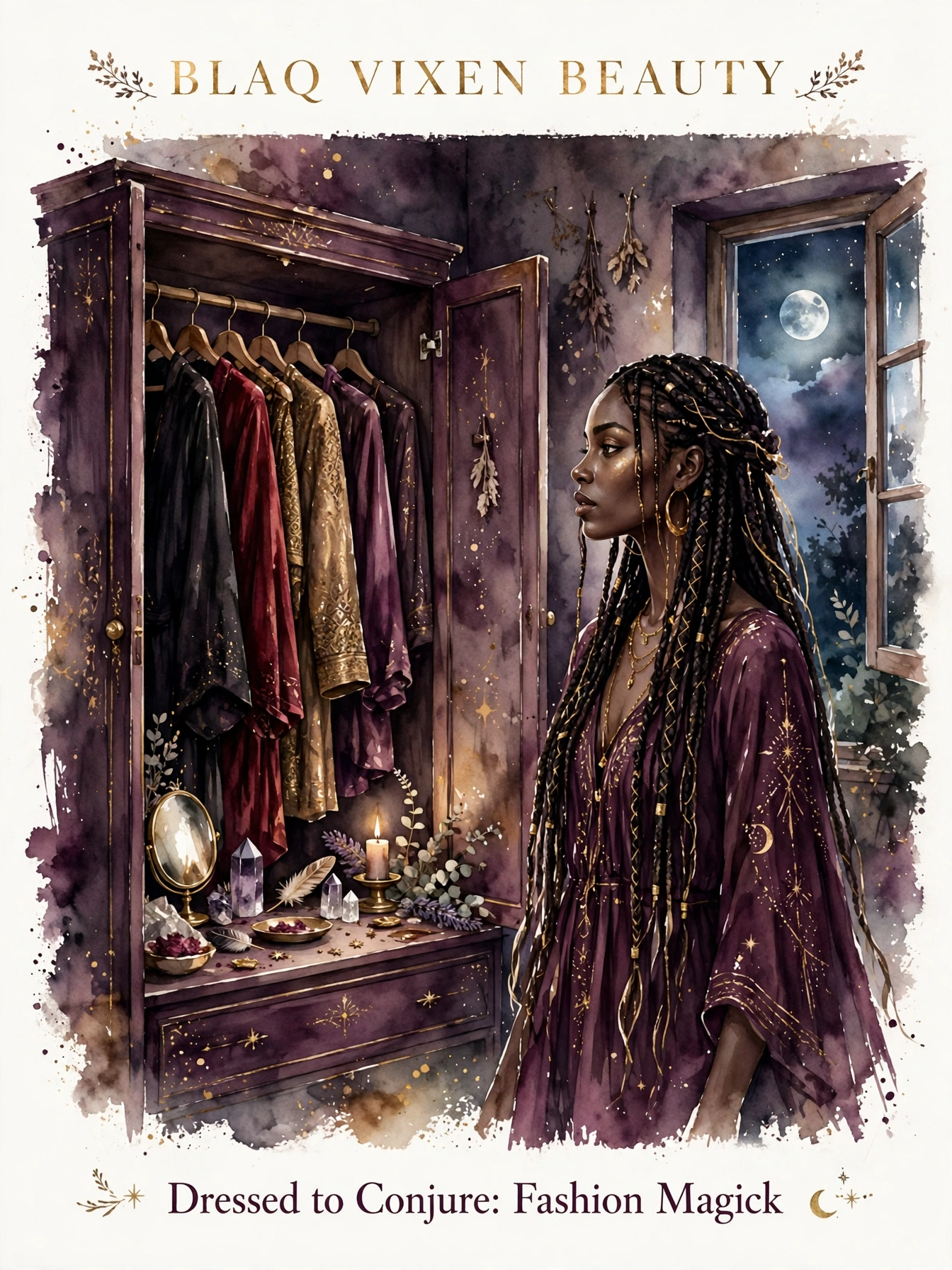
The Capsule as a Lunar Discipline
Angelica Cresci’s Glamour Grimoire — studied at this altar and credited here as there — sets the wardrobe inside the lunar cycle: at the New Moon, the “creation of a new lunar cycle capsule wardrobe.” The wardrobe edited and re-chosen in the dark of the moon, each cycle, on purpose. In her grimoire, clearing out closets is New Moon work, and this altar’s own timing doctrine holds the same line.
Consider what that discipline actually does. A capsule chosen by cycle cannot drift into accident. Every garment in it survived a decision. The woman who edits her wardrobe by the moon is not tidying; she is re-electing her instruments monthly, in the dark, before the light comes back to test them. Dressing stops being a morning negotiation with chaos and becomes what it should have been all along: a rite performed the night before, in private, by the only priestess the wardrobe has.
Color Worn as Correspondence
Color is the fastest layer of the dressing working — the correspondence you can change in a minute. This piece takes one movement of the doctrine; the full color grimoire is its own teaching, for its own day.
Black, for warding and Saturn’s weight: the color that ends arguments, absorbs projection, and walks a woman through a room like weather. Red, for Mars heat and being remembered: the color that files the incident report in other people’s memory. Gold and yellow, for the Sun’s visibility: worn when the work must be seen — credited, chosen, photographed in the mind. Pink and green, for Venus: softness with an economy underneath it, allure that owns property.
None of this is invention; it is the documented correspondence tradition, worn. The doctrine is only this: a woman who chooses her colors the way a worker chooses her candles has already begun the working before she leaves the house.
Consecrating the Garment
The tradition Lisa put into this altar keeper’s hands runs deep on consecrated objects: Raphael’s talismanic manual — the 1916 de Laurence edition of a much older current — is built on them, objects chosen, cleansed, and charged for an office. Cresci’s grimoire works the same seam from the other side, directing the worker to consecrate her Venusian tools, and to time her thrifting and shopping to Venus in domicile or exaltation, when the getting is good.
Applied to the wardrobe, the doctrine is plain. A garment can be kept the way a talisman is kept: chosen for an office, cleansed before its first wearing, charged with its purpose, and stored like it matters. The interview dress. The debut outfit. The signature piece, kept not as a habit but as an instrument. Most women already own the garment their life turns on. Fashion magick simply refuses to let her treat it like laundry.
And the altar keeper’s own authority for saying so is a matter of record on this very site: she reads garments the way other workers read cards — down to identifying, years later and from a screen, the exact Michael Kors aviators a television icon wore onto a magazine cover. The eye is the credential. The wardrobe is a text, and some of us were taught to read it.
Dressing by the Sky
Timing is the wardrobe’s second liturgy, and this altar has already published its calendar. Dress for maximum visibility when the sky is dressed for it — the Full Moon’s blaze, the Sun’s hours, the days when being seen is the whole assignment. And dress the other way when the work requires it: the New Moon and the waning phases, the protective unremarkable outfit, glamour’s other face — the one this altar taught in Guard Your Glamour, where being unseen is not the failure of the glamour but one of its offices.
The doctrine holds both directions in one hand. The same woman, the same closet: a sunrise wardrobe and a midnight one, chosen by the sky she is walking under. Fashion magick is not dressing loudly. It is dressing accurately — to the hour, to the phase, to the errand the day is actually on.
The Hoodoo Thread, Kept Honest
This altar does not pretend the tradition begins with it. Dressing the body and dressing clothing with condition oils is documented Hoodoo practice, present in Harry Middleton Hyatt’s interview volumes and across the Black Southern record — the worker anointing what she wears so the wearing itself carries the condition. This piece stands at the level of that record, and goes no further into another house’s rooms: the formulas are not this blog’s to publish, and the practice is a closed one, kept by its own people.
What this altar does say — what it is required to say, whenever Hoodoo is touched here — is the tenet: consult your benevolent ancestors first. Before the dressing, before the charging, before the choosing. The wardrobe is a working, and workings at this altar begin at the family table, or they do not begin here at all.
The Signature
Every worker of this altar has a piece the room remembers her by — or she is still looking for it, which is the same sentence at an earlier hour.
The doctrine of this founding piece reduces to one line, and the strand will build on it from here: choose it like a talisman, keep it like an altar, wear it like a working. The glamour was always a spell of seeming. The garment was always its instrument. All this altar has done is say so — in the open, where the closet can hear it.
Glamour is yours to conjure. — Lakish