This post contains affiliate links. If you buy through them, Blaq Vixen Beauty may earn a small commission at no extra cost to you.
It is a question readers bring to this altar more often than any other, usually half-laughing, as if they already know the answer is a story somebody made up: Is it true that angels taught women glamour magick?
The honest answer is that it is written down. Not in a modern witch’s paperback, not in a marketing department’s imagination — in one of the oldest religious texts that survives, the Book of Enoch, in the section called the Book of the Watchers. The book stands outside most Bibles; it survives complete in the Ethiopian tradition and is canonical in the Ethiopian Orthodox Church. But the verses are there, and they are specific, and this altar does not look away from a specific verse. So let us read what the record actually says.
The Descent and the Syllabus
The story, in brief: two hundred angels, the Watchers, whose charge was to watch over humankind, looked down and desired the daughters of men. Their leader, Semjaza, bound them by a mutual oath — none would turn back alone — and they descended, and took wives, and began to teach. Genesis keeps only the compressed seed of it, four verses (Genesis 6:1–4): the sons of God, the daughters of men, the giants in the earth. Enoch keeps the curriculum.
“And all the others together with them took unto themselves wives,” the text says, “and they taught them charms and enchantments, and the cutting of roots, and made them acquainted with plants” (1 Enoch 7:1). Charms. Enchantments. Roots. Plants. That is the first lesson, and it is already, whole and entire, a grimoire.
Then chapter 8 names the faculty, teacher by teacher — and here is the verse around which this whole piece is built, quoted in full, from the Charles translation:
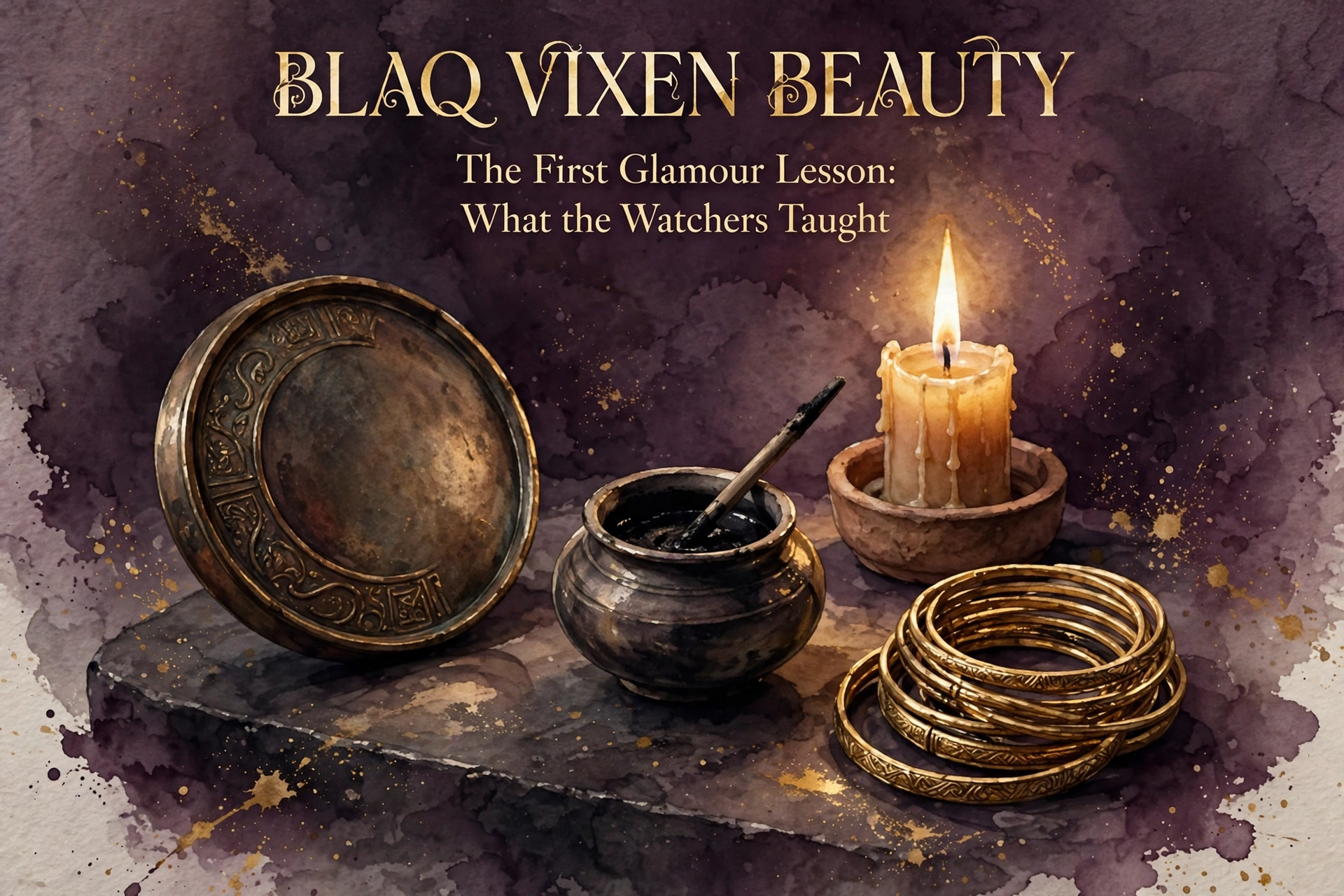
“And Azâzêl taught men to make swords, and knives, and shields, and breastplates, and made known to them the metals of the earth and the art of working them, and bracelets, and ornaments, and the use of antimony, and the beautifying of the eyelids, and all kinds of costly stones, and all colouring tinctures” (1 Enoch 8:1).
Read the list slowly. Bracelets. Ornaments. Costly stones. Colouring tinctures — pigment, dye, colour laid on the body. And antimony: the dark mineral powder the ancient world ground and lined the eyes with — kohl. The beautifying of the eyelids. The first cosmetic named in the angelic curriculum, written down in a text older than Rome, is eyeliner.
The rest of the faculty stands in 8:3. Semjaza, the leader, “taught enchantments, and root-cuttings.” Armaros taught “the resolving of enchantments” — the undoing, which this altar counts as its own discipline. Baraqijal taught astrology; Kokabel, the constellations; Ezeqeel, the knowledge of the clouds; Araqiel, the signs of the earth; Shamsiel, the signs of the sun; and Sariel — remember him when you read this altar’s work on timing glamour by the moon — “the course of the moon.”
Understand what the syllabus is. Adornment and enchantment are not two subjects in it. They are one course of study, taught by the same teachers, in the same descent, to the same women. How a woman looks and how she works were a single knowledge before they were ever two.
What the Text Itself Says It Means
This altar respects its sources too much to launder them, so hear the text’s own judgment, in its own words. Enoch does not tell this story as a gift. It tells it as a fall.
“Thou seest what Azâzêl hath done,” the accusation runs, “who hath taught all unrighteousness on earth and revealed the eternal secrets which were preserved in heaven, which men were striving to learn” (1 Enoch 9:6). The teaching is named unrighteousness. The secrets were heaven’s, and they were not supposed to leave. In the text’s accounting, what followed the lessons was corruption — giants, blood, a world so ruined that the Flood stands at the end of the story like a door closing.
That framing stays on the page of this piece, unsoftened, because it is the truth of the document. The Book of Enoch does not endorse the beautifying of the eyelids. It indicts it.
The Counter-Witness
And yet the tradition argues with itself, as living traditions do. Another ancient text, the Testament of Reuben, tells the encounter from the other direction. There, it is not that the angels taught the women adornment. It is that the women were adorned — braided hair, painted eyes, ornamented faces — and the Watchers, seeing them, were the ones who fell. The adornment came first. The angels were its casualties.
Set the two texts side by side and they cannot agree on the direction of the current. In Enoch, glamour flows down: heaven teaches it to women, and the teaching is a catastrophe. In Reuben, glamour flows up: women wear it by their own art, and it is strong enough to pull heaven down. The record, read whole, cannot decide whether women learned glamour from angels or angels fell to glamour from women.
What both texts agree on — the accuser and the counter-witness, the indictment and the reversal — is the premise underneath: adornment is power. Real power. Power worth a fall, worth a flood, worth two thousand years of argument. Nobody in the ancient record calls it trivial. Nobody calls it vanity. The word the moralists would later use for the vanity table appears nowhere here. What appears here is fear — and fear, in a text like this, is a form of testimony.
The Altar’s Reading
Now this blog will mark its own reading as its own, the way it always does. The text says corruption; we read the same verses and see the evidence of something else: that beauty work and spellwork were born as one knowledge, and that the pairing was not invented by this altar, or by any modern glamour witch, but stands written at the very head of the record. Later centuries split the syllabus in two — the adornment kept, and shamed; the enchantment dropped, and feared. Glamour Magick, as this altar practices it, is simply the refusal of that split. Azazel’s list and Semjaza’s were one list. We teach them as one list again.
Why does a Black woman’s glamour altar keep an Ethiopian-kept, ancient Jewish text on its Grimoire shelf? Not as Hoodoo doctrine — it is not, and this altar does not present it as such. Not as the blog’s scripture — the blog has none. It is kept as testimony: the oldest surviving written witness that the knowledge this altar practices was once understood to be a single, sacred, dangerous thing. The root-cutting Semjaza taught has a long afterlife in the Black Southern record this altar draws on — in Hyatt’s interview volumes, in Hurston, in the documented practice of the rootworkers — and the course of the moon Sariel taught is the same moon this altar times its glamour by. The threads run forward. We simply show where some of them start.
And the altar’s posture toward this material is stated plainly, so there is no mistaking it: study, not invocation. This altar petitions no Watcher and teaches no working out of this text. Our first law stands over this page as over every page of the Grimoire: consult your benevolent ancestors first — before any book, any root, any name in an ancient list. The ancestors are the authority. Enoch is a witness. There is a difference, and the difference is the discipline.
The Eyelids, Ever Since
The beautifying of the eyelids was written down before Rome had an empire. Empires have risen and burned since then; libraries have been lost; the book itself survived only because one church, in one highland kingdom, refused to let it go.
And through all of it, in every century we can document, women have gone on lining their eyes.
The text calls it the first lesson of a fallen curriculum. The counter-text calls it the power that felled the teachers. This altar calls it what the record, read whole, supports: the oldest written testimony that adornment was never mere decoration — that it arrived in the human story as knowledge, and knowledge of the kind heaven itself was said to keep under lock.
Women have been lining their eyes ever since, whether or not heaven approved.
Glamour is yours to conjure. — Lakish