This post contains affiliate links. If you buy through them, Blaq Vixen Beauty may earn a small commission at no extra cost to you.
Source: Karen McCarthy Brown, Mama Lola: A Vodou Priestess in Brooklyn; Elizabeth McAlister, Afropop interview (Wesleyan); Murphy Pizza, “Sacred Body in a Clear Mirror,” Journal of Haitian Studies 13:1 (2007); Omise’eke Natasha Tinsley, Ezili’s Mirrors; Erzulie’s practitioner-house archive (erzulies.com); Wikipedia, “Ezili Dantor” (citing Brown and Desmangles). What follows is an account of Ezili Dantò drawn from those records — an homage, not an initiation.
The hook
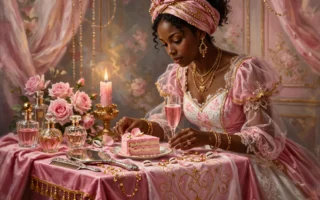
This altar has laid out a toilette for Freda — perfume, pink cake, mirror and comb. It has followed La Sirène down to her palace under the water, where the finest comb and mirror a devotee can afford wait on pale blue silk. So it is fair to ask what waits on the dressing table of the third Ezili, the one who completes the triptych.
Nothing. And that nothing is the truest thing this series will ever publish.
There is no toilette for Ezili Dantò. No source — not the ethnographers, not the practitioner houses, not the scholars who have spent careers in her company — documents a mirror laid out for her, a comb, a perfume, a jewel tried on in ceremony. To write her a beauty ritual would be to invent one, and this altar does not invent. What the record gives instead is a woman with a scarred cheek and a cut tongue, working, raging, protecting — and a different kind of mirror entirely. Freda’s mirror shows you the woman adored. La Sirène’s shows you the woman sovereign in her depths. Dantò’s shows you the woman who endures — and insists that endurance, too, is a form of glory.

The record
Ezili Dantò is a senior lwa of the Petwo nation in Haitian Vodou — the hot, hard-working family of spirits, where Freda’s Rada coolness does not reach. She is dark-skinned, and the record insists on it: in Karen McCarthy Brown’s account, Mama Lola’s Alourdes describes her as “black, black, black.” She is a mother — a hardworking, solitary, sometimes raging mother — and the scholar Elizabeth McAlister names the contrast at the heart of the Ezili family in a single breath: Dantò is “a spirit of hardworking, serious, feminine strength,” set against Freda, “the coquette… powdering her face and perfuming herself.”
She is a fierce protector of women, of children, of the marginalised — of everyone the world handles roughly. She resonates, the scholars record, with poor women and with single mothers, who recognise their own lives in hers. Erzulie’s house archive calls her a single mother of fierce independence and maternal devotion, the spiritual mother of Haiti and a symbol of Black independence. People petition her, among other things, for work — for the means to feed a family by their own hands. Omise’eke Natasha Tinsley, who wrote a whole book on the Ezili, calls her simply “the fierce protectress.”
Tradition holds her close to Haiti’s founding fire: the 1791 slave revolt is accounted to have begun with a pact made following a feast in her honour, and she is considered a national lwa — a spirit of the country’s very birth. Hold the hedging the sources keep: these are traditions and legends carried by her people, and they are honoured here as her people carry them.
Her most common Catholic counterpart is the Black Madonna of Częstochowa, the dark-faced Polish Madonna robed in red and blue — an association scholars hypothesise arrived with icons carried by Polish soldiers sent under Napoleon, many of whom defected to the Haitian cause. Other houses and sources name Mater Salvatoris, Our Lady of Lourdes, Our Lady of Mount Carmel. A dark Madonna for a dark mother: whatever road the image travelled, her devotees knew her when they saw her.
The mirror that is not a vanity
Now sit with the two marks the record gives her body, because they are the opposite of adornment, and the post that pretended otherwise would be lying to you.
The first is her scar. Dantò’s cheek carries the twa màk — the three marks. In some legends, the stories say, Freda herself left those scars in a fight between the sisters over the warrior Ogou. Read that slowly: in the mythology, the goddess of the toilette is remembered as the one who cut her. The second mark is her silence. Other stories say her tongue was cut out by her own fellow revolutionaries, so that she could never betray their secrets. When she mounts her devotees in ceremony, she utters only stuttered syllables — kay-kay-kay — and her daughter Anaïs speaks for her, interpreting what the silenced mother cannot say.
A scar is a wound that closed. It is not jewellery. It is not a beauty mark, and no honest altar will call it one. But notice what her devotees have done with these marks across two centuries: they have not hidden them. The scarred cheek and the cut tongue are carried in her images, in her stories, in the very names of her counterpart Madonnas, as credentials — the proof of what she survived and what it cost. Pizza’s study, summarising Brown, writes that Dantò “represents the constant struggle and the harshness that make up the lives of poor Haitian women.” Her face is not decorated. Her face is documented. And there is a glamour in that which no toilette can confer: the glamour of a woman whose history is written on her and who does not flinch from the reading.
The third mirror
Why does she belong on this altar, then, between the parlour and the deep? Because Brown — who lived this material alongside Mama Lola in Brooklyn — reads the three Ezili as one instrument. Her words deserve to stand whole:
“The three most important are La Sirene, the mermaid who links ancient African senses of woman power and water power; Ezili Dantò, the hardworking, solitary, sometimes raging mother; and Ezili Freda, the sensual and elegant, flirtatious and frustrated one… Taken together, they give a remarkably accurate and detailed portrait of the forces that shape women’s lives both in contemporary Haiti and in Haitian immigrant communities.”
Brown calls the Ezili “both mirrors and maps” of women’s lives. A mirror shows you what is. A map shows you where you are. Freda’s mirror is the parlour: the longing to be adored, the standard of the finest, the tears when the world falls short. La Sirène’s mirror is the deep: dreams, hidden wealth, knowledge that surfaces in its own time. Dantò’s mirror is the one neither of those rooms contains — the morning after, the work that remains, the child who must be fed, the rage that is sometimes the only honest answer to how a woman has been treated. Brown’s own account records women mounted by Dantò overtaken by a righteous anger that shakes the body itself. That, too, is in the portrait. A series about glamour that only hung the first two mirrors would be showing you a woman with the labour — and the fury, and the scars — cropped out of the frame.
The record adds one more line to her portrait, and this altar will not crop it either: Alourdes says of Dantò that she “takes many lovers and marries no one,” and the scholars name her a patroness of lesbians. The hardworking mother is no one’s meek Madonna. Her love, like her labour, is on her own terms.
Where the record disagrees
Freda’s post could lay out her colours and her day with confidence. Dantò’s cannot, and the disagreement is itself part of her record — so here it is, carried openly, exactly as the sources leave it.
Colours. The scholarly-derived accounts give blue, black, and red. Erzulie’s house gives red and green — and notes that in Haiti’s West and South she wears red and dark blue. A rootworker reference gives blue and yellow. No single palette is canonical.
Days. Tuesday is the day most often named. Erzulie’s gives Tuesday and Saturday. Both stand in the record; neither cancels the other.
Offerings. One account lists crème de cacao, jewels, golden rings, and Florida Water. Erzulie’s house table is a working woman’s feast: fried pork — griyo — with onions and hot peppers, rice with black or red beans, kleren, plain and spiced, a red candle. What recurs across the disagreement is a pattern rather than a list: pork, strong drink, Florida Water. Beyond that pattern, the houses keep their own tables, and this post will not blend them into a single menu no house ever served.
That is not a failure of the record. It is the record — a spirit kept by many houses, in many regions, by women whose lives did not run to a central authority’s standardisation. Dantò’s altar is as unstandardised as the work itself.
For us
What does the third mirror show a Black woman at her own vanity?
That dignity is an adornment no one can hand you and no one can take. Dantò has no toilette because her glory was never in the laying-out. It is in the getting-up: the shift worked, the child raised, the secret kept, the boundary defended, the rage honoured instead of swallowed. The women who serve her — single mothers, working women, women the world calls marginal — did not need a scholar to tell them she was beautiful. They saw a dark-skinned mother with a scarred face and a silenced tongue being revered, generation after generation, exactly as she was, and they recognised the most radical beauty standard in this entire series: nothing about her had to be softened, lightened, decorated, or explained for her to be worthy of an altar.
Freda teaches this altar to ask for the finest. La Sirène teaches it to trust the deep. Dantò teaches it the third lesson, the one the other two stand on: that the woman who works, who protects, who carries her history on her face and keeps her own counsel, is not glamour’s opposite. She is its foundation. The parlour and the palace are beautiful. Somebody’s hands built them, and the hands were hers.
Cautions
Homage, not initiation. Vodou is a living, initiation-based religion. What is written here is respectful homage and an account of Ezili Dantò drawn from the published record — scholars and practitioner houses. Formal service belongs in a house, under a manbo or an oungan. This blog initiates no one.
Houses differ — do not blend them. Her colours, her days, her table: where the record disagrees with itself, this post has said so rather than smoothing it over. If you are ever blessed to sit with a house, keep that house’s rules whole.
Do not decorate her wounds. The scar and the silence are the record’s, carried by her devotees as history and credential. They are not symbols to borrow for an aesthetic, and this post offers no ritual in her name, because the record offers none to give. What it offers is recognition — and recognition, honestly given, is the whole of the gift.
Three mirrors hang on this altar now. One is polished in a pink parlour, where a goddess weeps for a love finer than the world. One is held under the water, where a queen combs her hair among the treasure of the deep. And one — the third — hangs in a working woman’s kitchen, and shows a dark face, scarred and unsilenced in every way that matters, still standing, still feeding everybody, still owed reverence exactly as she is.
Look in whichever mirror you need tonight, sister. But do not skip the third. She is the one who proves the other two were never fragile.
Glamour is yours to conjure. — Lakish