This post contains affiliate links. If you buy through them, Blaq Vixen Beauty may earn a small commission at no extra cost to you.
Source: This post follows the documented Hoodoo tradition as recorded by cat yronwode — the Jezebel Root monograph in her Hoodoo Herb and Root Magic and her documentation of the root’s traditional uses — as gathered in this blog’s research. The biblical reference is 2 Kings 9:30, quoted from the World English Bible (WEB).
The hook
Not every root in the box is demure.
This altar has already introduced you to Queen Elizabeth Root — the woman’s root of dignity, carried by a woman who means to be regarded as a queen is regarded: with respect, with the upper hand, with her head high. Jezebel Root is her other hand. Where the Queen carries dignity, Jezebel carries nerve. This is the root women reached for when they meant to be looked at, desired, and paid — when the glamour they needed was not respect me but want me, and show it generously.
Welcome back to First Flame, this altar’s strand for Black women new to glamour and beauty magick. Tonight we open the bold drawer of the root box, and we do it honestly: who carried this root, what they carried it for, and what it can — and cannot — teach a beginner about the glamour of daring.
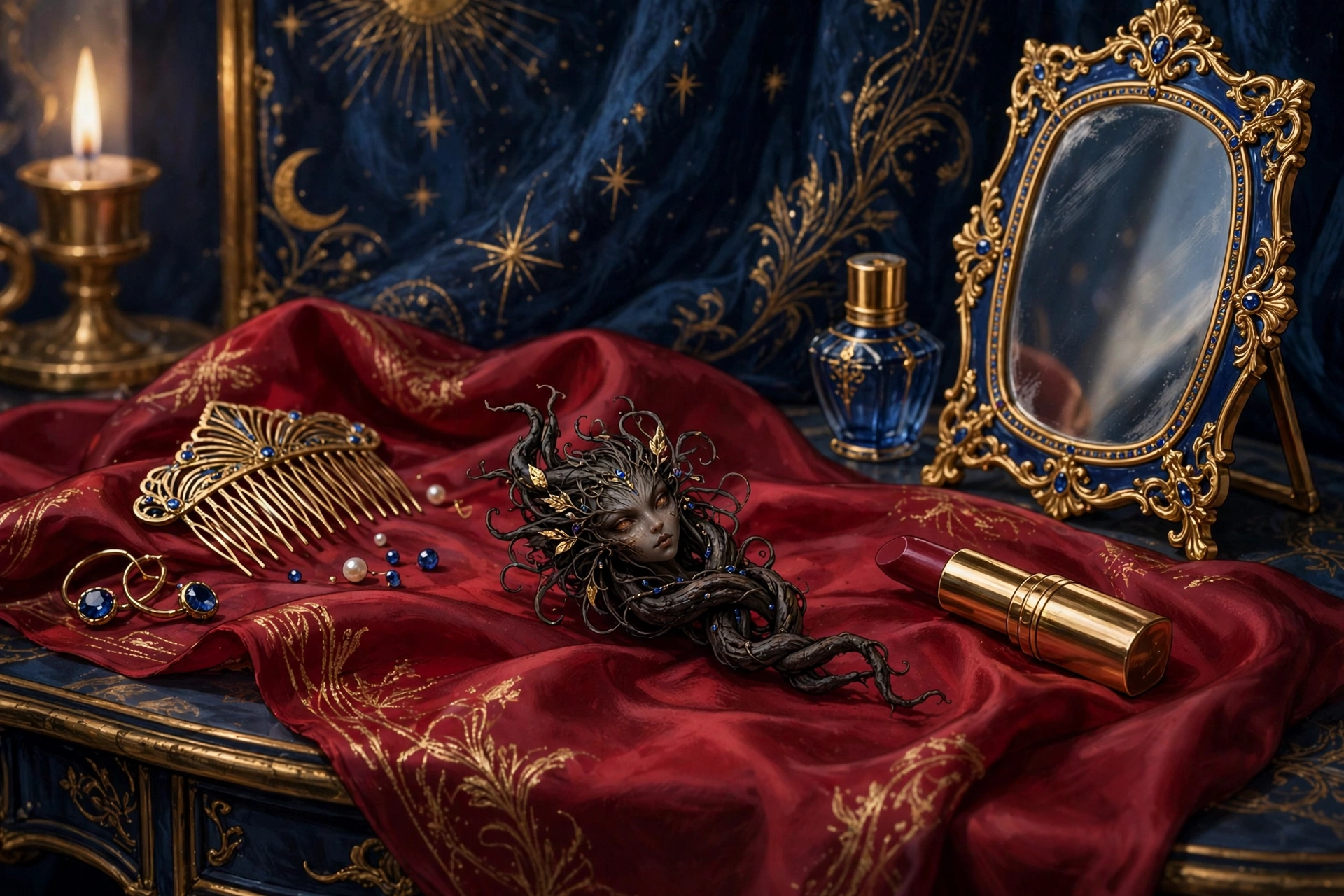
The root
Jezebel Root is a true Hoodoo curio with its own monograph in the tradition’s herb-and-root record. Botanically it is a wild Louisiana iris — of the Iris fulva and Iris hexagona group — which makes it a cousin, not a twin, of Queen Elizabeth Root: both are irises, and the tradition itself insists they are different roots with different characters, sold as distinct curios. Hold onto that; we will return to it in the cautions, because the two are confused constantly.
Its documented character is bold attraction. In the tradition’s own short form, the root is carried by women “to attract men with money” — and generous treatment with it: the glamour of being valued, tipped, and provided for. Practitioners also wear Jezebel oil as a perfume before business dealings, and carry the root itself in a pocket or a mojo. The whole root is carried in a mojo bag to draw willing, generous clients. Around that central carrying, the tradition built a small family of uses: bath crystals bathed in before the work, sachet powder dusted in the insoles of the shoes, incense burned to dress the premises, and the oil worn as perfume or used to dress candles.
Now hear who carried it, because this altar will not whisper it. The documentation says it plainly: this root was carried historically — and unapologetically — by sex workers. Sit with that the right way. These were women who lived by their allure in a world that gave them few other wages, and they were professionals of regard: they understood, as a trade, how being seen turns into being valued, and they kept tools for that trade the way any professional keeps tools. The root was one of theirs. When this altar teaches it, it teaches it in their honor — not as a joke at their expense, and not as a costume of their lives.
That working-woman lineage runs through the glamour formulas beside this root in the record, too — scents worn by dancers, readers, waitresses, and barmaids who worked rooms where charm was income. Jezebel Root belongs to that company: the arts of women whose beauty was not decoration but livelihood.
The tradition even lets a woman choose between the two roots inside a single working. In the documented lodestone lover-drawing mojo — a carried hand built to draw a worthwhile lover — the bag takes Queen Root or Jezebel Root, the worker’s own pick, alongside the lodestone and orris. Same bag, same lodestone, two different weathers: the hand can be made in the Queen’s register or in Jezebel’s, and the tradition leaves the choosing to the woman tying the bag. Remember that when we reach her teaching — the choice itself is part of the craft.
The name she carries
The root carries a Bible name, and this post will not pretend otherwise.
In the Book of Kings, when the end came for Queen Jezebel, the record gives her one last act of adornment: hearing that her enemy had come to the city, “she painted her eyes, and adorned her head, and looked out at the window” (2 Kings 9:30, WEB) — and from that window she met her death, unbowed and painted to the last. Her whole story belongs to another post, benched for later; she will get her own reckoning here, in full, another night.
For tonight, only this, and it is this blog’s reading, labeled as such: the working women of the tradition who took up this root took up her name with it — and the tradition itself, in yronwode’s own documentation, speaks of reclaiming the name of Jezebel with pride. A name the pulpit made into a warning, the root box made into a tool. This altar notices that, and honors it: the women who carried this root refused to be shamed out of their own boldness, and they signed the refusal with the most shamed name they knew.
Her glamour teaching
Here is what Jezebel Root teaches a beginner, and it is worth learning early: boldness is a legitimate register of glamour.
This altar keeps both queens of the root box, and it will not rank them. There is the woman who is regarded because she is dignified — Queen Elizabeth in the bag, command in her bearing, love drawn to her because she carries herself as someone to be reckoned with. And there is the woman who is regarded because she dares — Jezebel in the bag, allure turned up and aimed, generosity drawn to her because she is not afraid to be wanted out loud. Neither register is the true one. They are two weathers of the same sky.
So the beginner’s lesson is not be bold. It is know which one you are carrying, and why. A root carried without knowing its character is just a thing in a bag. A root carried knowingly — tonight I am asking for nerve; tonight I am walking into a room where my charm is my work and I mean to be valued in it — that is glamour with its eyes open. The tradition gave its women both roots because a woman’s life has both kinds of rooms in it.
And notice how Jezebel’s register is worn, in the documented forms: powder in the insoles of the shoes, so the boldness walks in with her; oil on the skin as perfume, so it enters the room a breath before she speaks; the root in the pocket or the bag, close enough to touch. This is glamour carried on the body and in motion — not a portrait hung on a wall but a presence moving through a working night. A beginner does not need the whole family of forms to learn the lesson inside them: boldness, in this tradition, is something a woman puts on deliberately, the way she puts on her scent, before she goes where she means to be valued.
The honest mirror
Now the honesty this altar owes you, because this root has been sold hard for a very long time.
The traditional promises around Jezebel Root — rich admirers, generous men, easy money — are the tradition’s own sales talk, repeated across a century of catalogs, and this post reports that tradition without adopting its promises. The altar promises none of it. Allure is a presentation, not an income guarantee; no root in a bag has ever paid a bill by itself.
And look again at the women who actually carried it: they worked. The root accompanied labor — the shift, the room, the performance, the dealings — it did not replace any of it. A dancer’s root did not dance for her. A reader’s root did not read for her. What the tradition really hands down, under the catalog language, is working women dressing their work with intention: arriving scented, prepared, and self-possessed, with a token of their own daring carried close. That part, a beginner can honor and practice truthfully. The guarantee, she should leave in the catalog where she found it.
One line of history, noted and set aside: the root’s name also appears in an old working against enemies — the Curse of Jezebel recorded alongside its monograph. That is not beauty work, it is not this post’s business, and this altar leaves it in the record where it lies.
Cautions
Know your curio. Jezebel Root and Queen Elizabeth Root are sold as distinct curios, and they are confused constantly — by sellers as much as by buyers, both being irises. The documentation warns that mislabeled “Jezebel root” is common, and that other plants get substituted under the name. Learn what the true root looks like, buy from reputable sellers, and if what arrives does not match the description, do not work with a question mark. The wild Louisiana irises behind this curio should be bought cultivated, never wild-harvested — a glamour that strips a wetland to dress a mojo has missed its own point.
Carried, not ingested. The tradition carries this root — in the bag, in the pocket, its oil on the skin as perfume, its powder in the shoe. It is not food and it is not tea. Do not eat curios; a root’s power in this tradition has never once depended on swallowing it.
Boldness is a register, not a transplant. This root will not make a shy woman brazen, and this altar would not ask it to. What it can do — what any carried intention can do — is remind the woman who chose it why she chose it, at the moment she reaches into her bag and feels it there. If your glamour is the quiet kind, Queen Elizabeth is waiting and there is no demotion in her. Jezebel is for the nights, and the women, and the work that call for nerve. Carry her knowingly, or not at all.
Two roots, two queens, one box. One teaches a woman to be regarded for her dignity; the other, for her daring — and the tradition, wiser than its critics, kept them side by side for the women who needed each in turn.
Know your rooms, sister. Know which queen the night is asking for. And when it is nerve the night wants, carry her boldly — eyes open, name unashamed, bag tied tight.
Glamour is yours to conjure. — Lakish