This post contains affiliate links. If you buy through them, Blaq Vixen Beauty may earn a small commission at no extra cost to you.
Source: This post follows catherine yronwode’s published documentation of Queen Elizabeth Root in Hoodoo practice — the root’s monograph in her Hoodoo Herb and Root Magic (2002) and her catalogue and forum writings on it — as recorded in this blog’s research. Where this altar adds a framing of its own for beginners, it says so.
A Root a Woman Can See Herself In
Some materia a woman chooses for its power. Some she chooses because, the first time she holds it, she recognizes herself.
Queen Elizabeth Root is the second kind. It is a whole root a woman carries — in the old book, in a bag of red flannel, kept close against her own body — and everything about it is feminine and sovereign at once: an iris root, named for a queen, documented in the tradition as the woman’s glamour root above all others. Women have carried her to be loved, yes. But the record yronwode preserves keeps insisting on something larger than being loved: being regarded. Regal power. Command. The upper hand. A confidence that walks into the room a half-step before the woman herself does.
Welcome — or welcome back — to First Flame, this altar’s strand for Black women new to glamour and beauty magick. Tonight’s lesson is small enough to close your fingers around: a little queen, kept in the hand, and what she has to teach a beginner about dignity.
If you are new to rootwork entirely, she is a kind first root to study. Her keeping asks for no altar full of tools and no elaborate rite — a root, a bag, your own body, your own bearing. Everything else she teaches grows out of that simplicity.
The Root Herself
Queen Elizabeth Root is orris root: the dried rhizome of the iris, Iris × germanica in yronwode’s botanical documentation. Before she was ever a queen of the rootworker’s shelf, orris was already royalty in another court — perfumery has prized this root for centuries, because the dried rhizome carries a soft, violet-like fragrance unlike anything else in the scent-maker’s art. A root that perfumes queens is well named when it becomes one.
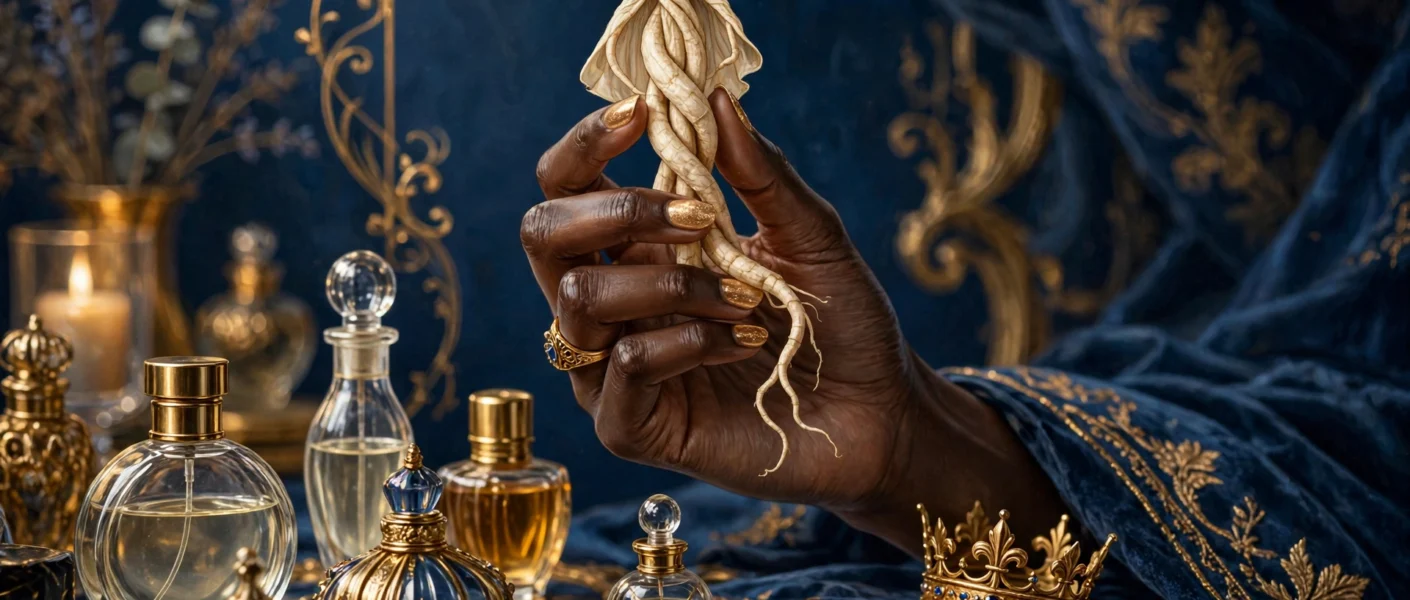
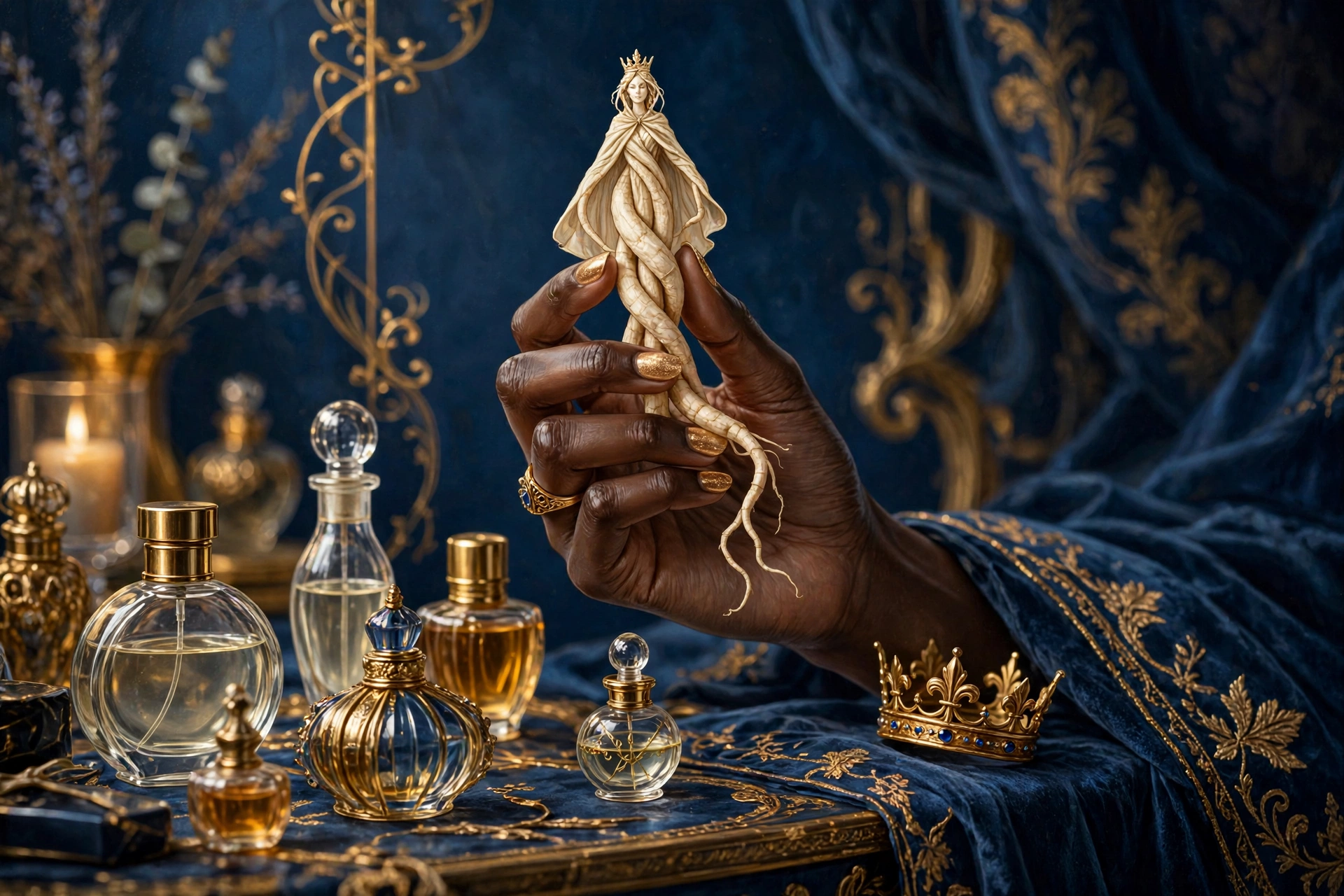
The tradition prizes her whole. In the “Mojo to Attract a New Lover” preserved in Hoodoo Herb and Root Magic, a woman carries a whole Queen Elizabeth Root in a red flannel bag — and the book is plain that the roots are gendered: a man, in the same working, carries John the Conqueror instead. Old-style workers, the same entry records, kept a whole root in its red flannel bag and used it as a divination pendulum — a root held in the hand, consulted like a small counselor. Hold a whole dried piece in your own palm and you will feel why the whole root, and not only the powder, became the treasure: it has a presence. More than one woman, holding one, has seen a little upright figure in it — a small queen standing in her hand. This altar will not pretend the old books say that in so many words. They say something better: they say women carried her whole, and kept her close, and asked her questions.
Her documented character is a woman’s character. The catalogue’s plain words for the root are “to attract men and to cause them to love you,” and the documentation of Queen Elizabeth Root in oil describes it as used “to enhance the regal power and command of a woman and to awaken love and passion in a mate.” Read those two together and you have her whole doctrine: love, yes — but love drawn toward a woman who commands. The practitioners writing in yronwode’s forum stress the same balance: this root is as much about female power, confidence, and the upper hand as it is about attraction. She is not a root for shrinking. She is a root for standing.
She also keeps company in the documented record: practitioners report combining her with the tradition’s attraction and bewitching formulas, the way a queen keeps a court. A beginner need not begin with combinations — one root, well kept, is a whole education — but it is worth knowing that the tradition treats her as a sovereign among materia, not a servant: other workings attend on her; she does not disappear into them.
How a Beginner Keeps Her
The documented keepings of this root are a carried root, a dusted powder, and a dressing oil — and a beginner does best to begin with the first and simplest.
Carried whole. The book’s own form is the whole root in a red flannel bag, carried on the woman’s person. That is the keeping this strand recommends: the little queen riding with you, against your own body, in your own keeping — no one’s hand but yours upon her.
Dusted on your own clothes. Powdered, she makes sachet powders for dusting the body, papers, and clothing, and the old book’s love-working turns on exactly that: the powder on a woman’s own clothes before she goes out to be seen. This altar teaches it in that form and no other — glamour you wear, on your own person, aimed at no one’s plate or cup.
Dressed and spoken to. A mojo hand, in the tradition’s general way of things, is not a dead packet: it is dressed — anointed — and spoken to, tended the way you tend anything you expect to stay alive to you. The documented oil of this root is used to fix candles and dress amulets as well as to anoint; a beginner keeping the carried root can dress her bag with a drop and her own plain words. Keep it simple. Keep it honest. Tell her what she is for.
And here is this blog’s own framing, labeled as ours: keep the little queen at your vanity mirror when she is not riding with you. Let her stand among the bottles and the brushes, where you make your face for the world. Hold her for one breath while you dress — a reminder in the hand, older than the mirror’s glass, that the woman in the reflection is the sovereign of this room. The tradition gives the root; the vanity is where this altar sets her throne.
Her Glamour Teaching: Dignity Is a Glamour
Every root on this altar teaches something, and Queen Elizabeth Root’s teaching can be said in one breath: a woman who carries herself as a queen is regarded as one.
Notice what the documentation never describes. It never describes this root making a woman smaller, softer, more pleasing, more easily overlooked. Its words are regal, command, upper hand. The glamour here is not decoration laid over a woman to make her acceptable; it is self-possession radiating outward until other people’s eyes have no choice but to adjust. Perception follows bearing. The room reads the woman who has already read herself.
This blog has drawn its line before, and she stands squarely on it: beauty magick adorns the woman; glamour magick adorns how the world sees her. Queen Elizabeth Root is glamour in a red flannel bag — a carried argument that how the world sees you begins with how you hold yourself, and that dignity, practiced daily and kept close to the body, is one of the oldest spells a woman can work.
That is why she belongs at the vanity as much as in the bag. The vanity is where a woman rehearses her bearing every single morning — chin, shoulders, gaze, the set of her own face before the world gets its turn. A root whose entire doctrine is carry yourself as a queen is not out of place among the brushes. She is the curriculum, sitting still.
The Honest Mirror
Now the honesty this altar owes every beginner. A root is a root. Orris is a real, cultivated botanical, dug and dried and traded for the fragrance trade long before any worker carried her — a rhizome with real fragrance chemistry, whose violet sweetness is nature’s own work and not a metaphor. What arrives in an herb seller’s envelope varies, as with all botanicals, which is why the cautions below matter. And the tradition’s high regard for her is documented, deep, and sincere. This altar honors that tradition and teaches it as it stands. What this altar will not do is promise you that a rhizome in a bag will do what only a woman’s own bearing can do. The root is a companion to dignity, a reminder you can hold, a small queen whose whole documented doctrine points you back at your own posture. If your shoulders rise when you carry her, she has done the truest part of her work — and your shoulders did it.
One more honesty, briefly: the old books preserve harder workings under this root’s name, tricks aimed at other people’s food, drink, and will. This strand does not teach them, here or anywhere. The queen we keep is the one carried and worn on a woman’s own person. That is enough. That is, in fact, the point of her.
Cautions
Skin first. Orris root is a documented fragrance allergen and skin sensitizer for some people. Keep your queen as a carried and kept piece, as this post teaches — not a cosmetic. If you ever handle her powdered or oiled forms, treat them the way you would any strong fragrance material: with care, and never carelessly against the skin.
Never eat the root. Orris is not a food and not a tea; it has an old history as an emetic. She is carried, kept, and honored — never ingested.
Know what you hold. Buy botanicals from reputable sellers, and learn this root’s name carefully, because the iris family is full of queens and the documentation itself warns against confusing them. Jezebel Root is a different root entirely — a wild Louisiana iris with its own documented work — and Queen’s Root and Queen of the Meadow are different plants again. Mislabeling happens in the herb trade. A queen deserves to be correctly named, and so does the woman carrying her.
A companion, not a substitute. No root on this altar comes with a promised outcome — not love, not regard, not the upper hand. What is promised is older and smaller and entirely yours: a little queen in your hand, reminding you, every time your fingers close around her, whose bearing the room is about to read.
Carry her well, sister. Stand like you mean it.
Glamour is yours to conjure. — Lakish