This post contains affiliate links. If you buy through them, Blaq Vixen Beauty may earn a small commission at no extra cost to you.
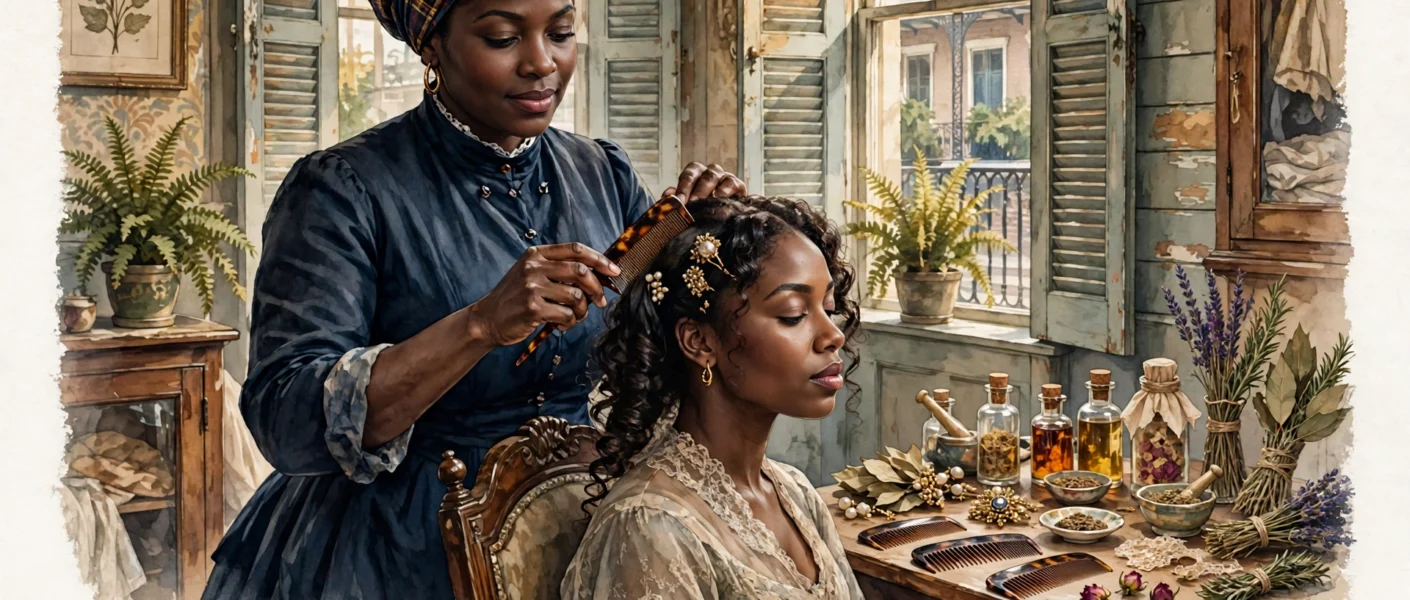
Before she was a legend, Marie Laveau was a working woman with a comb in her hand. That is where this altar begins with her — not at the tomb, not at the snake dances of Congo Square, but in the chair, in the great houses of New Orleans, where a free woman of color built an empire out of the most underestimated room in the city: the room where women were made beautiful.
The Chair Was an Intelligence Post
The documented spine of Marie’s life is thinner than her legend, and this post will keep the two separate where it can. What the record and the oldest recollections agree on is the trade: she worked as a hairdresser to the wealthy women of Creole society, and she was superb at it. She knew the latest hair and makeup of the day. She knew herbs and the remedies that could be made from them for hair, scalp, and skin. She was, in the plainest modern terms, a celebrity beautician — and she served as her own best advertisement, because Marie Laveau was beautiful, and every woman who sat in her chair could see what her hands could do.
But understand what a hairdresser’s chair was in that city, in that century. It was a confessional with better lighting. The women in that chair talked — about the husband straying and the rival rising, about the business failing and the baby not coming, about who was in love with whom and who was quietly at war. Marie listened. A glamour worker who does not understand this has missed the first teaching of her life: beauty work is intelligence work. The woman who tends the face learns the heart, and the woman who knows the hearts of a whole society holds a power no spell bag alone can give her.
Beauty Was Her First Glamour
Before Marie was called a queen of anything, she practiced the oldest glamour doctrine on this altar: she made herself the evidence. Her beauty opened the doors of the great houses. Her skill kept her inside them. Her discretion made her indispensable to them. That is the full circuit of glamour as this altar teaches it — attraction, craft, and silence — and she ran it for decades, in a city that gave a free woman of color almost no lawful road to power at all.
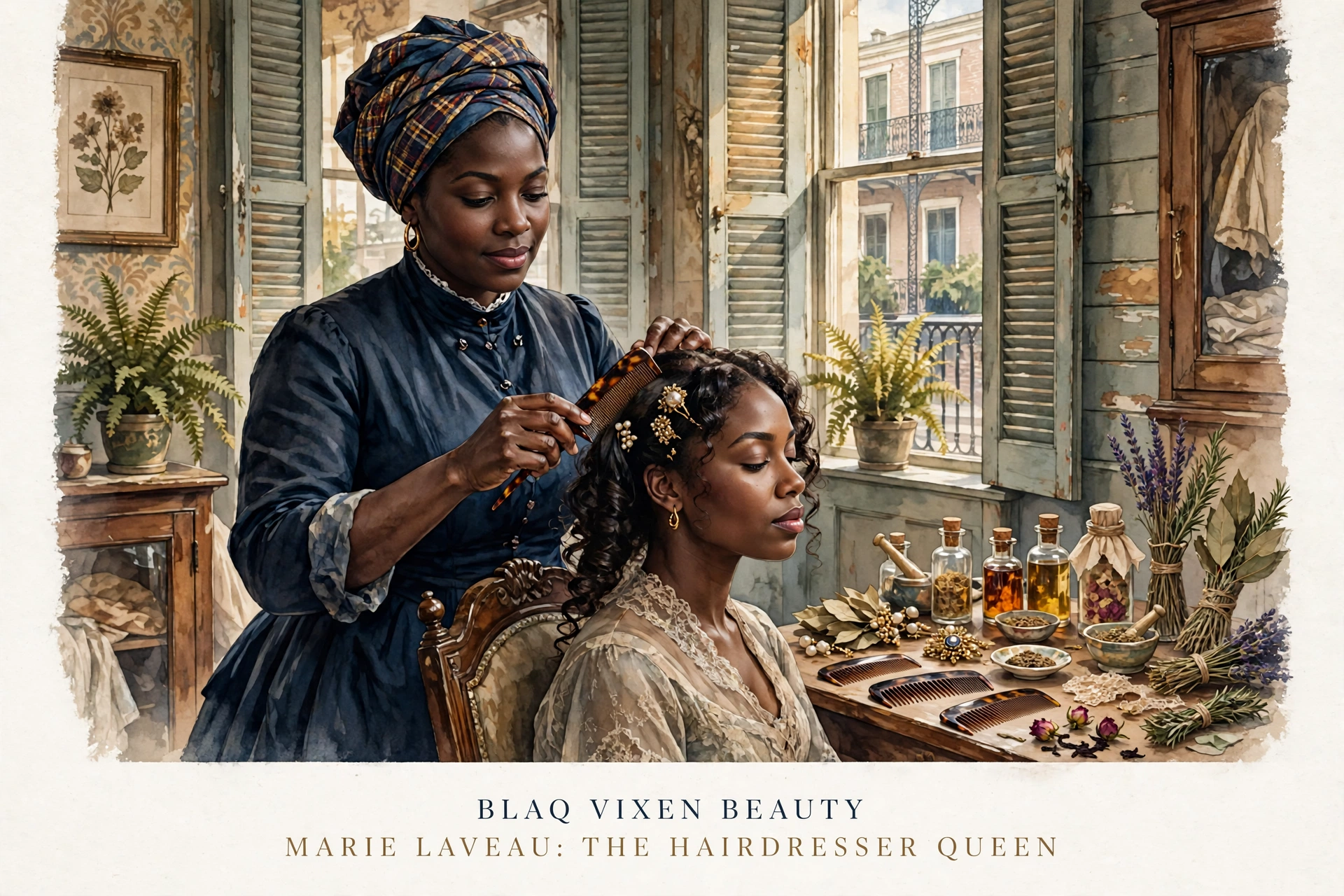
It is worth pausing on the herbs, because they are the Hoodoo root showing through the legend. The same hands that dressed hair for galas prepared remedies for the scalp and skin, sat with the sick during the yellow fever years, and carried food to condemned prisoners in their last hours. Marie’s power was never only performance. It was service, plant knowledge, and presence — the beautician, the nurse, and the priestess were one woman, and the city knew it.
Romance and Finance
The lore of New Orleans remembers what her practice specialized in: romance and finance. Lovers gotten, lovers kept, lovers dismissed. Fortunes raised and rivals quieted. Strip the folklore down to its working bones and the specialty makes perfect sense, because love and money were exactly the two subjects her chair had taught her better than anyone in the city. She did not merely promise to work on a client’s love life. She often knew the other parties, their households, their weaknesses, and their secrets. Whether you read her power as spirit, as strategy, or as the two braided together — and in New Orleans they were always braided — the lesson for the practitioner stands: glamour work is strongest when it is informed. Know the terrain before you work the terrain.
Two Altars, One Woman
Marie was a devout Catholic who attended Mass, and she was the Queen of the Voodoos, and New Orleans has never seen a contradiction in that, because New Orleans is where Hoodoo, Voudou, and Catholic folk practice were stirred into one gumbo and served at the same table. This altar names her honestly: she is a Voudou queen and a conjure ancestor, honored in Hoodoo houses because the traditions in her city grew up in each other’s yards. She is not a lwa. She is something this series holds just as sacred — an elevated ancestor, a woman of our own soil whose name still carries charge more than a century after her death.
People still go to her tomb in St. Louis Cemetery No. 1 to ask. The old accounts say appeals were made three times, with full concentration, and the lore names her offerings — money, cigars, white rum, candy. The modern truth must be spoken alongside the lore: the cemetery is restricted now, and offerings are not left at the tomb as they once were. So honor her the way the tradition actually survives — at the home altar, with a candle, a glass of water, and a petition spoken by a woman who has done her own work first. Marie Laveau does not reward the lazy. She never did.
What Marie Teaches This Altar
Set her teachings in a row and they read like a syllabus for every strand of Glamour Magick. From The Enchanted Vanity: master your craft until your own face is your advertisement. From the Grimoire: knowledge is a root — gather it quietly and keep it close. From Moonlit Rituals: serve the sick, feed the condemned, sit with the dying; glamour that never serves is only vanity, and vanity alone has never crowned anybody. And from the whole of her life, the teaching that holds the rest: a Black woman with no vote, no office, and no inherited fortune built a reign out of beauty, information, faith, and nerve — and the city is still saying her name.
That is why she stands on this altar. Not because she was the most beautiful woman in New Orleans, though they said she was. Because she understood, earlier and better than almost anyone, what beauty does — and she did it on purpose, for a living, for a lifetime.
This altar keeps two tenets. Hoodoo is a closed Black American practice, and what is taught here is taught from inside its own inheritance. And before any working — before any root, candle, or book — consult your elevated and benevolent ancestors first. They are the first authority.
Glamour is yours to conjure. — Lakish