This post contains affiliate links. If you buy through them, Blaq Vixen Beauty may earn a small commission at no extra cost to you.
In June of 2018, a teacher in Memphis put a book in my hands. LisaKay Jones, of Memphis Conjure, sent me Seership — Paschal Beverly Randolph’s guide to the magnetic mirror — with the care of a woman handing over something that was not for everybody. She was right about that. It is not for everybody. But some of it belongs at this altar, because the man who wrote it is one of the ancestors of everything this room practices, and most of the world has never heard his name.
The copy that came to me is the Toledo edition, printed by Randolph and Company in 1875 — the last year of his life, in the city where he died. Bibliographers trace the work’s first forms to the end of the 1860s, but it is this final edition that sits on my shelf: Seership! The Magnetic Mirror, “a practical guide to those who aspire to clairvoyance-absolute.” Hold that subtitle in mind. Randolph did not write for the curious. He wrote for those who aspire.
The Life
Paschal Beverly Randolph was born free in New York City on October 8, 1825, to Flora Beverly, an African-American woman, and a father of the Virginia Beverly and Randolph families. Orphaned young, he went to sea as a cabin boy, and the sea gave him an education no school of his century offered a Black boy: England, France, Egypt, Syria, Turkey — ports and libraries and adepts, by his account, gathered into a mind that would spend its life refusing every fence built for it.
From 1852 he stood on the Spiritualist platform as a trance speaker, and he edited journals — the Boston Leader, the New York Messenger of Light — in an age when a Black man’s byline was itself an argument. He made the argument with his whole life. He was an abolitionist orator when abolition could get a man killed. He helped raise Black troops for the Union cause. And when Emancipation came, he went to New Orleans and taught freedpeople to read — because he understood, earlier than most, that literacy and liberation are the same door with two names.

In 1858, by his dating, he founded the Fraternitas Rosae Crucis; its first lodge opened in San Francisco in 1861. A. E. Waite would later describe it as the earliest known Rosicrucian order in the United States. Let that settle: the first Rosicrucian order on American soil was founded by a free-born Black New Yorker, a sailor, an abolitionist, a man the republic had no seat prepared for — so he built his own, and put a mirror on its table.
He wrote more than fifty works on magic, medicine, health, and love before his death in Toledo on July 29, 1875, at forty-nine years old.
The Teaching
Randolph’s great break was with the mediumship of his own movement. The Spiritualist medium emptied the mind and lent the body, and called the surrender a gift. Randolph called it an abdication. His word was seer, and the difference is the whole doctrine: the medium is passive; the seer keeps the will awake and the self in command, and sees by the soul’s own power. Sight, for Randolph, is not something that happens to you. It is something you do.
“I hold it to be emphatically true,” he writes at the opening of Seership, “that clairvoyance is the birthright of every human being.” Not a gift for the chosen — a birthright, “a universal possibility common to the human race,” latent in all and developable, he insists, by most who will work for it. “All that is required,” he says, in the plainest sentence in the book, “is simply patience.”
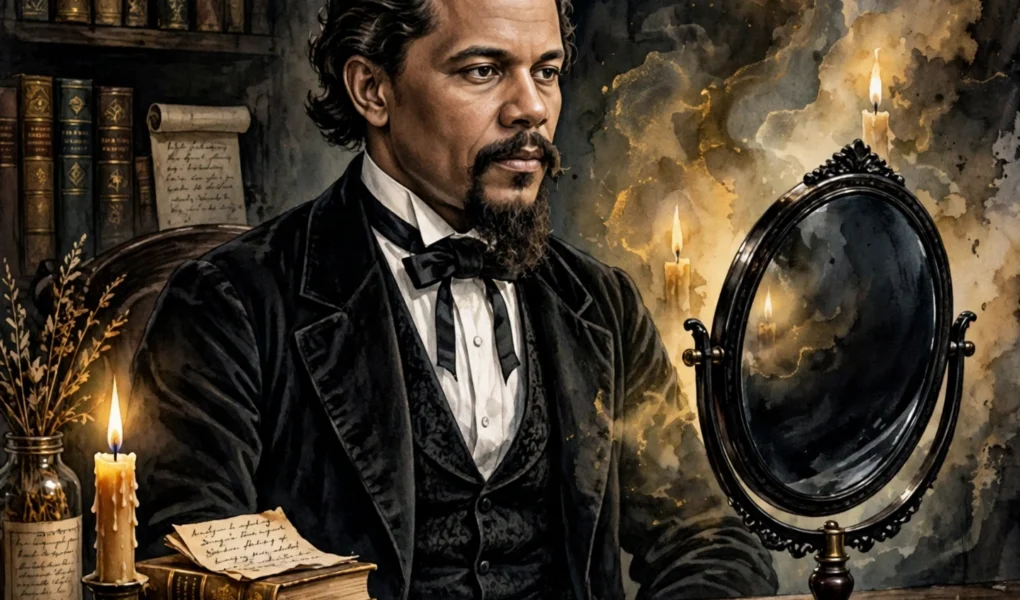
The instrument of the work was the magnetic mirror: a dark, polished surface, often concave, gazed into steadily until the glass clouds and opens and images rise in it — scenes, faces, knowledge not available to the outer eye. But Randolph is precise about where the power lives. The mirror sees nothing. It is a focus, a place for the soul’s sight to gather, magnetised by the seer’s steady use. The mirror is the excuse. The seer is the instrument.
And so the book’s real teaching is not about glass at all. It is a rule of life. Plain food, in moderation. No strong drink. Sleep attended to. The body prepared the way an artist prepares paints — his own comparison: “Artists prepare their paints, — you must prepare your body; else no good picture comes, no lucidity follows.” Fear, doubt, and bad intent retard the work; excess destroys it. And over it all, the instruction he sets in capital letters, which any glamour worker who has ever held a practice past the first enthusiasm will recognise as the entire secret: KEEP YOUR DESIGN CONSTANTLY BEFORE YOU, AND YOUR SOUL AND INNER SENSES WILL MAKE GROOVES FOR THEMSELVES. Sight is trained, not granted. The groove is cut by return.
The Glamour Thread
Why does a beauty altar claim this man? Because the mirror is glamour’s oldest instrument, and Randolph is its American root — a Black one.
Everything this altar teaches about the mirror begins in his doctrine. The vanity mirror is not a neutral object; it is a surface that gathers what is gazed into it, and the woman who sits before it is never merely checking her lipstick. She is doing what Randolph’s seers did: governing perception, her own first of all. The seer keeps the will awake before the glass. So does the glamour worker. Neither surrenders to the reflection. Both command it.
His doctrine also points forward, to work this altar has not yet published: if a mirror can be opened by steady use, it can be closed. If it can gather, it can be sealed. The locking and sealing of mirrors — how a woman secures the most powerful surface in her house — descends directly from the teaching in this book, and it is coming to this altar in its season.
The Legacy, Honestly
Honesty is owed at an altar, so let the whole record stand. Randolph’s influence ran further than his fame: the Theosophical Society drank from his work, the Hermetic Brotherhood of Luxor more deeply still, and his teaching on the sacred power of sex — which he held to be among the highest forces available to the human soul — passed, often without credit, into the foundations of orders that came after him, Crowley’s among them. That chapter of his teaching is historically central and this altar will not pretend otherwise. It is also not this piece’s subject; the mirror is.
What can be said without qualification is the neglect. For a century, the historians of American occultism walked around this man as if the room were empty. It took scholars like Joscelyn Godwin, who named the neglect in 1994, and John Patrick Deveney, whose 1997 biography restored him in full — Paschal Beverly Randolph: A Nineteenth-Century Black American Spiritualist, Rosicrucian, and Sex Magician — to put his name back on the shelf where it had always belonged.
A Seat at the Altar
This altar’s first law is that we consult our benevolent ancestors before we consult any book — and then, sometimes, the ancestors hand us a book. That is how Seership arrived here: through the hands of a living teacher, out of a tradition of Black women and men who kept this knowledge when the world would not keep them.
So Paschal Beverly Randolph takes his seat at this altar — not as a curiosity, not as a footnote recovered for fashion, but as what he was: a free-born Black seer who taught that sight is a birthright, that the will must stay awake before the mirror, and that the groove is cut by return. Keep your design constantly before you. He wrote that in Toledo in 1875. The women at this vanity have been living it ever since, whether or not they knew his name.
Now they know his name.
Glamour is yours to conjure. — Lakish