This post contains affiliate links. If you buy through them, Blaq Vixen Beauty may earn a small commission at no extra cost to you.
Source: This post is grounded in the Song of Songs, quoted here from the public-domain World English Bible (WEB). The woman at the poem’s center is never named in the text; “Shulamite” is the name the poem itself gives her, once, at 6:13 — “Return, return, Shulammite!” This altar reads the poem plainly, as the love poem on the page: a woman’s own voice, desiring and desired. It is a companion to this blog’s published “So Shall the King Greatly Desire Thy Beauty: The Psalm 45 Anointing Oil” — two songs, two women, one altar.
The hook
Every woman in the Bible is described by somebody. Sarah is called beautiful by the narrator. Esther is weighed by a king’s eyes. But there is one woman in the whole Book who describes herself — who takes the naming into her own mouth before anyone else can do it for her — and the first thing she tells us is the color of her skin.
“I am dark, but lovely, you daughters of Jerusalem, like Kedar’s tents, like Solomon’s curtains” (1:5, WEB).
Hold on to that “but” a moment, because we are going to set it down gently and pick up the word she actually said. But first, hear the shape of the thing: a dark-skinned woman, standing before the polished daughters of the city, announcing her own beauty in her own voice, in a book of the Bible. Not apologizing. Not asking. Announcing.

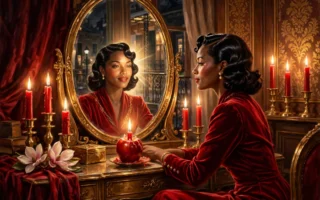
She has no name. The poem never gives her one — the name we call her by is spoken once, by others, near the end: “Return, return, Shulammite! Return, return, that we may gaze at you” (6:13, WEB). She is the Bible’s unnamed queen of self-description, and her book — the Song of Songs, the song above all songs — is carried on her voice. She speaks more of it than anyone in it. Tonight we set her mirror on the altar.
The record
The book opens in her mouth: “Let him kiss me with the kisses of his mouth; for your love is better than wine” (1:2, WEB). That is the first line of desire in the poem, and it is hers — a woman asking, out loud, to be kissed. Everything this altar teaches about glamour begins somewhere in that sentence: desire voiced, not hidden.
Then her self-naming, and the story that comes with it. “Don’t stare at me because I am dark, because the sun has scorched me. My mother’s sons were angry with me. They made me keeper of the vineyards. I haven’t kept my own vineyard” (1:6, WEB). Her darkness, in her own telling, is the mark of labor — of sun and work and brothers who spent her strength in fields that were not hers. And folded into that one grieving line is the whole arc of the poem: my own vineyard I have not kept. By the book’s end she will say it the other way — “My own vineyard is before me” (8:12, WEB) — but we are getting ahead of her. She tells her story at her own pace.
Now the word we promised to set down. English Bibles — the King James, and the WEB we quote here — print her sentence with a but: dark, but lovely, as though the loveliness had to argue its way past the darkness, as though the two needed excusing. The Hebrew does not argue. It joins the two words with the plain little conjunction and: dark and beautiful, one breath, no concession standing between them. The skin and the beauty were never set against each other in her language. Men with pens did that, centuries later, in another tongue. This altar keeps her and.
And what a world she moves in. The poem is soaked in scent the way a name can be soaked in oil: “Your oils have a pleasing fragrance. Your name is oil poured forth” (1:3, WEB). While the king sits at his table, her spikenard sends out its fragrance (1:12). Her beloved rests against her as “a sachet of myrrh, that lies between my breasts” (1:13, WEB). A procession comes up out of the wilderness “like pillars of smoke, perfumed with myrrh and frankincense, with all spices of the merchant” (3:6, WEB). And when the beloved catalogues her garden, the list runs like a spice ledger of wonders: “spikenard and saffron, calamus and cinnamon, with every kind of incense tree; myrrh and aloes, with all the best spices” (4:14, WEB). She answers in kind, describing him: “His lips are like lilies, dropping liquid myrrh” (5:13, WEB). Perfume in this poem is not decoration. It is vocabulary — the language these two speak when ordinary words run out.
And the poem seals its argument the way it began, in her keeping: “Many waters can’t quench love, neither can floods drown it” (8:7, WEB).
The honest mirror
This altar does not varnish its women, and hers is not a story without bruises.
Behind 1:6 stands a household that used her: brothers angry with her, her labor assigned to vineyards that were not hers, her own ground left untended. And in the poem’s darkest passage, the city itself turns on her. She rises at night to search the streets for her beloved — she has done it before, and found him (3:1–4) — but this time: “The watchmen who go about the city found me. They beat me. They bruised me. The keepers of the walls took my cloak away from me” (5:7, WEB). A woman alone at night, looking for love, beaten by the very men charged with keeping the city’s peace, and stripped of her covering. The poem does not explain it away, and neither will we. Her desire walked through danger. It is part of her record, and any reading of her that crops it out has stopped reading her.
Two more honest things. The text never names her and never crowns her — no title, no throne, no biography. She is a voice and a body and a garden, and the centuries have rushed in to fill the silence. And those centuries have mostly read her book as something else entirely: an allegory of God and Israel, of Christ and the church. Those readings are old and honored, and this altar does not mock them. But allegory becomes an erasure when it insists the woman on the page is not really a woman on the page. We read the poem that is actually written: a human love song, in which a dark woman loves, is loved, speaks, seeks, suffers, and names herself. The sacredness, for us, is not instead of that. It is in it.
Her toilette
Look at how the praising runs in her book, because it runs both ways.
He describes her at length and in wonder — eyes, hair, lips, neck, breasts — long catalogues of praise in chapters 4 and 7, a man inventorying beauty like a man counting treasure. And she — this is the part the centuries tried to skip — describes him right back. When the daughters of Jerusalem ask her what makes her beloved better than any other beloved, she answers in public, in detail, head to heel, and finishes: “This is my beloved, and this is my friend, daughters of Jerusalem” (5:16, WEB). Desire here is not a one-way gaze. It is a conversation, and she holds more than half of it: the poem’s first word of wanting and its last cry of longing — “Come away, my beloved!” (8:14, WEB) — are both hers.
And notice who she is talking to. The daughters of Jerusalem are her chorus, her witnesses, her girls. She confides in them, teases them, and teaches them — again and again she adjures them not to stir up or awaken love until it so desires (2:7). The poem imagines a woman whose beauty and desire are spoken of among women, carried by women’s voices, judged by no tribunal. Her body, throughout, is described in praise and never in shame. Nobody in her book tells her to cover up her wanting. Nobody calls her forward or fast or too much. She wants, and the wanting is holy text.
Here is the teaching this altar takes from her toilette: she is scripture’s patron of self-description. Before the beloved ever names her beautiful — and he does, again and again — she has already named herself. Glamour, in her book, does not begin when the room decides you are lovely. It begins when you say what you are, out loud, with the and in it: dark and beautiful, labor-marked and lovely, desiring and desired. Her first anointing was a sentence. The myrrh and the spikenard are its punctuation.
For us
What does an unnamed woman in an ancient love poem hand a Black woman at her mirror tonight?
First: say it about yourself first. She did not wait for the beloved’s catalogue, the king’s favor, or the city’s permission. The first beauty verdict in her book is her own, spoken to other women, in her own voice. Let it be a practice and not just a poem — your sentence about your face, spoken by you, before the world gets its turn.
Second: keep the and. The sun that darkened her was not a flaw in her; it was the evidence of her labor, of vineyards she kept for other people. Whatever your skin carries — sun, years, work, survival — it does not stand on the other side of a but from your beauty. It stands beside it, joined to it, in one breath.
Third: come back for your own vineyard. My own vineyard I have not kept may be the most recognizable sentence in the book for a woman who has kept everyone else’s — everyone else’s house, everyone else’s children, everyone else’s feelings, everyone else’s emergencies — while her own ground went untended. The poem does not leave her there. By its end she stands in possession of herself: “My own vineyard is before me” (8:12, WEB). Reclaiming is not selfishness in her book. It is the ending the whole song was walking toward.
Cautions
Read her whole. Do not crop the poem into a slogan — a skin-affirmation with the hard verses trimmed away. The brothers, the sun, the watchmen are in her book too, and her beauty is not truer for pretending otherwise. She is not a poster. She is a whole woman, and this altar receives her whole.
Allegory is a reading, not an erasure. Other traditions have read this book as God and Israel, as Christ and the church, for a very long time, and they will go on reading it so. This altar respects those readings and keeps its own. Ours is the woman on the page — and holding her plainly does not require taking her away from anyone else.
Her sensuality is the text’s own. Nothing in this post dresses her desire up as a rite, a working, or a technique. It is scripture’s candor — a love poem the Bible itself kept, unembarrassed — and we honor it as meditation, not as method. There is no working here. There is a mirror.
She never got a name, and in the end she never needed one. She got a voice — the loudest, sweetest, most unashamed voice in her book — and with it she named herself before anyone could name her wrongly: dark and beautiful, keeper of other people’s vineyards, come at last into her own.
Stand at your mirror tonight and borrow her grammar, sister. Not but. And. Say what you are, all of it, in one breath — and let the naming be the first anointing.
Glamour is yours to conjure. — Lakish