This post contains affiliate links. If you buy through them, Blaq Vixen Beauty may earn a small commission at no extra cost to you.
Source: Henry John Drewal, “Mermaids, Mirrors, and Snake Charmers: Igbo Mami Wata Shrines,” African Arts 21(2), 1988; Henry John Drewal, “Performing the Other: Mami Wata Worship in Africa,” TDR 32(2), 1988; Henry John Drewal (ed.), Mami Wata: Arts for Water Spirits in Africa and Its Diasporas (Fowler Museum, 2008); Smithsonian Magazine, “The Many Faces of Mami Wata”; Carlos Museum, Emory University, Mami Wata shrine figure object record. What follows is an account of how Mami Wata is served in West and Central Africa, drawn from those records — an homage, not an initiation.
The hook
At the edge of the water in West and Central Africa, there are shrines kept like the finest dressing tables in the world.
They are spotless. White cloth, polished and clean. And on them, arranged with a shopkeeper’s pride and a lover’s care: mirrors. Perfume bottles. Tins of talcum powder. Combs. Jewelry. Fruit, shells, porcelain — beautiful foreign things, laid out for a beautiful foreign lady who lives beneath the water and pays her debts in riches.
Her name is in the language of trade itself. Mami Wata: pidgin English, the tongue of the marketplace and the port, because she rose with the centuries of international trade and she is, in the scholar Henry John Drewal’s phrase, a “capitalist par excellence.” She gives wealth. She gives beauty. She gives healing. And she is dangerous the way deep water is dangerous — which is to say, completely, and without malice, and without apology.

This altar has met her daughters across the ocean. Tonight we go to the source: to Africa, to the water’s edge, to her own vanity.
The record — and its honest shape
First, the honesty this post owes you before anything else: Mami Wata is not one spirit.
She is a complex of water spirits — a whole shining company, worshipped across West and Central Africa and carried into the diaspora, her devotion documented by Drewal from Senegal to Tanzania. There is no single canonical profile to hand you. No one feast day belongs to her across the complex; this post will not invent one. No single set of colors is hers everywhere: her shrines dress her realm in white, blue, and green, the colors of water and foam, and that is as tidy as the record honestly gets. Peoples differ. Regions differ. She differs. Any page that gives you Mami Wata as one neat lady with one tidy list has flattened a multitude into a mascot, and this altar will not do that to her.
What the record does hold, everywhere, is her domain: beauty, wealth, sexuality, healing, and danger, braided together like the strands of her own long hair. Her primary gift to devotees, Drewal records, is wealth — especially monetary riches from abroad, the money of ships and strangers and distant markets. She grants sudden wealth, beauty, and healing by covenant: a bargain struck between the spirit and the devotee. And the covenant has teeth. Devotees who break it lose everything. In some regions, Drewal records — citing Fabian’s 1978 research — she demands sexual abstinence in exchange for riches: her wealth is a lover’s wealth, exclusive, jealous of rivals, priced in devotion.
She calls her own. The Carlos Museum’s record of her shrine figures tells it plainly: she summons future devotees through dreams, through maladies, through unusual behavior — and establishing her shrine is what ends the affliction. Her relationship with those she claims is often framed not as a parent’s claim but as a lover’s: she chooses, she courts, she keeps. Market women visit her to better their lot. The sick come for healing, for female and childhood illnesses. She is not a distant goddess on a throne. She is a presence at the water’s edge, negotiating.
The picture
Now the heart of this post, and it is a story about a printed picture.
The most widespread image of Mami Wata in the world is a chromolithograph of European origin: a snake charmer, a beautiful woman draped with a great serpent. It was printed in Hamburg around 1885, copied and reprinted in large numbers in India, and carried along the trade routes — and within eighty years, that foreign picture had become her key image, the face of an African water spirit. The earliest evidence of its landing is a photograph from 1901, taken by J.A. Green at Bonny in the Niger Delta: a masquerade headdress, sculpted by African hands, from the print.
Hold that the way Drewal teaches us to hold it. The devotees were not fooled by a foreign picture, and they were not colonized by it. Drewal’s reading is the opposite: African worshippers took an exotic imported image, interpreted it by their own indigenous precepts, and re-created it for their own devotional needs. The snake in the picture spoke to something already ancient in Africa — the water serpent, the rainbow serpent, the power that moves between the worlds. The picture arrived as cargo. It stayed as scripture. (Her daughter in Haiti carries a carved figurehead ashore in just this way, and this altar has told that story elsewhere — the rhyme is real, and it is the devotees, on both shores, who do the making.)
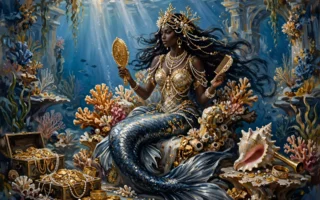
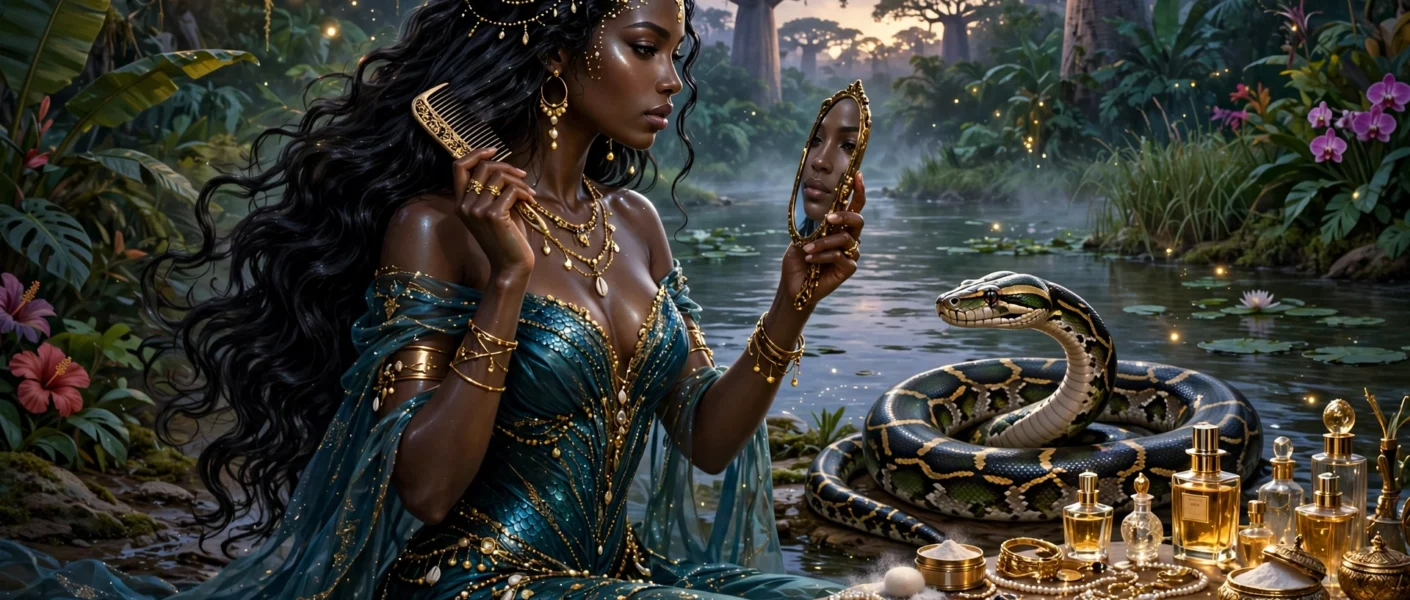
So she is shown as a beautiful woman — often described as light-skinned, foreign, for devotees regard her as not African in origin, a lady from across the water — or as a mermaid, holding a great snake or draped in one. And on an Ewe shrine mural that Drewal reproduces, she is in the pose this whole blog is built upon: a mermaid gazing into her mirror while combing her hair. At the water’s edge. Regarding herself. The vanity is not our invention laid over her tradition. The vanity is hers, documented in her own houses, on her own walls.
The vanity
Come closer to the shrine, then, because the shrine is the toilette.
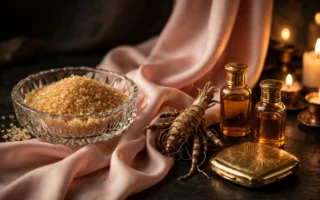
Drewal and the museum record describe her altars as spotless, white-clothed, and stocked like a vanity and a luxury shop at once: mirrors lining the walls. Perfume bottles. Talcum powder tins. Combs. Plastic jewelry. Sunglasses. Watches. Soaps. Porcelain, fruit, shells, flowers. The Carlos Museum’s record for a shrine figure says the altar “would have been densely packed with offerings like alcohol, perfume, talcum powder, plastic jewelry, and other imported luxury goods, all spiritual magnets to attract Mami Wata.” Spiritual magnets — hear the theology in that. Beauty is not decoration on her altar. Beauty is the mechanism. The lovely foreign thing is bait and offering and language in one: it is how you speak to a spirit whose whole power moves through wealth, adornment, and allure.
And she sets a standard for whoever approaches. Smithsonian Magazine, writing on Drewal’s exhibition, gives the law of her threshold in one breath: “To win the favor of Mami Wata, one must be clean and sweet-smelling both inside and out.” Worshippers bathe before approaching her altar. They drink talcum powder. The smell of perfume hangs in the air of her shrines. In trance, her initiates powder their faces and breasts with talcum and may drink perfume — the toilette does not stay on the table; it enters the body, it is worn, it is taken in. Clean and sweet-smelling, inside and out: her glamour is a discipline before it is a gift.
Notice what this means. In parlours across the ocean, her daughters ask for the finest comb and mirror you can afford. At the water’s edge in Africa, her own people arrived at the same law independently, because it is hers: you do not approach beauty empty-handed, unwashed, or careless. You come adorned to be adorned. You come sweet to be sweetened. The vanity is the theology.
The price
Every account of Mami Wata carries the other half, and this altar will not cut it for the sake of a prettier post.
She enriches, and her riches cost. The covenant that brings sudden wealth can take everything when it is broken. The lover-spirit who grants beauty and fortune demands fidelity like a lover — in some regions, abstinence itself is the price, her devotee’s body reserved from all other embraces while her money fills the house. Devotees reach her underwater realm in dreams and visions, and what is dreamed with her is not always safely woken from. Her domain, as the record gives it, is beauty, wealth, sexuality, healing — and danger, listed plainly among the gifts, because in her world they are one list.
This is not a flaw in her glamour. It is the oldest shape of it. Water gives the mirror its shine and the river its current, and the same water takes. A tradition that has kept her for centuries, from Senegal to Tanzania and across an ocean, has never pretended otherwise: she is served with love, with luxury, with scrupulous cleanliness — and with respect for exactly how much power sits at that vanity, smiling, combing its hair.
For us
What does the lady of the water’s edge have to say to a Black woman at her own mirror?
That glamour has an address in Africa, and it is older than the trade that named her. Her devotees built her vanities out of mirrors and talcum and perfume generations before anyone coined a word for beauty ritual in English, and they built them spotless. Cleanliness, sweetness, adornment, order: in her houses these are not vanity. They are protocol before power.
That the foreign picture does not own her. A Hamburg print became an African goddess because African hands and African meanings remade it — the same alchemy your grandmothers performed on everything the world handed them. What is yours is what you have made yours.
And that wealth and beauty, in her covenant, are not shameful appetites to be apologized for. They are gifts a spirit gives and gifts a woman may ask for outright — with her eyes open about the price, her table kept clean, and her perfume on.
Cautions
Homage, not initiation. Mami Wata’s cults are living traditions across many African and diaspora peoples, transmitted in their own houses and lineages. What is written here is respectful homage and an account of her service drawn from the published scholarly record. This blog initiates no one.
No single house speaks for her. She is a complex of spirits, not one figure; there is no universal day, color list, or rule this post could honestly hand you. Where peoples differ, they differ — keep any house’s way whole if you are ever blessed to stand in it.
Hold both halves. Her wealth enriches and her wealth costs; the record says both, and a glamour that prints only the first sentence is not reverence — it is advertising.
At the water’s edge, in shrines kept spotless from Senegal to Tanzania, her people still lay out the mirrors and the perfume, the talcum and the combs, for the lady who came across the water and stayed to be made their own — capitalist and healer, lover and danger, mermaid at her mirror, combing hair that has never been dry.
Keep your table clean, sister. Come to your own depths sweet-smelling, inside and out. And ask for the beautiful things with your eyes open, the way her market women have always asked.
Glamour is yours to conjure. — Lakish