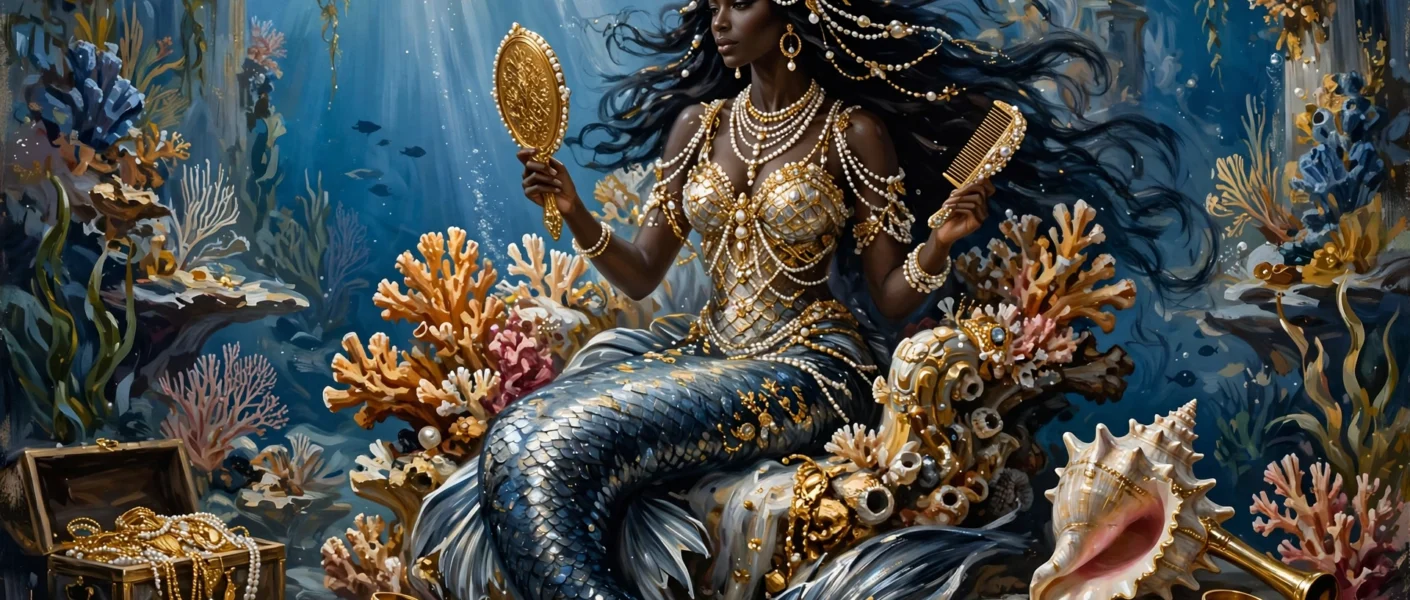
This post contains affiliate links. If you buy through them, Blaq Vixen Beauty may earn a small commission at no extra cost to you.
Source: Erzulie’s practitioner-house archive (erzulies.com); Kenaz Filan, Vodou Love Magic (2009); Elizabeth McAlister, “Sacred Waters of Haitian Vodou”; “The Saint and the Siren,” Studies in Religion 41(2), 2012. What follows is an account of how La Sirène is served, drawn from those records — an homage, not an initiation.
The hook
Somewhere under the water there is a palace, and in the palace there is a dressing table.
She sits at it the way she sits on the rock at the river’s edge in the old stories: comb in one hand, mirror in the other, drawing the comb through hair that has never been dry. Around her, the sea keeps everything it has ever been given — gold that went down with ships, jewels, sunken treasure, songs, secrets. All of it is hers. She is the wealth of the deep, and she is beautiful the way the deep is beautiful: generous, glittering, and not entirely safe.
Her name is La Sirène — Lasirèn, the mermaid, the siren — and if Ezili Freda’s toilette taught this altar how glamour behaves in the parlour, La Sirène’s teaches how it behaves in the depths: in dreams, in hidden knowledge, in riches that surface only for those who know how to look below.
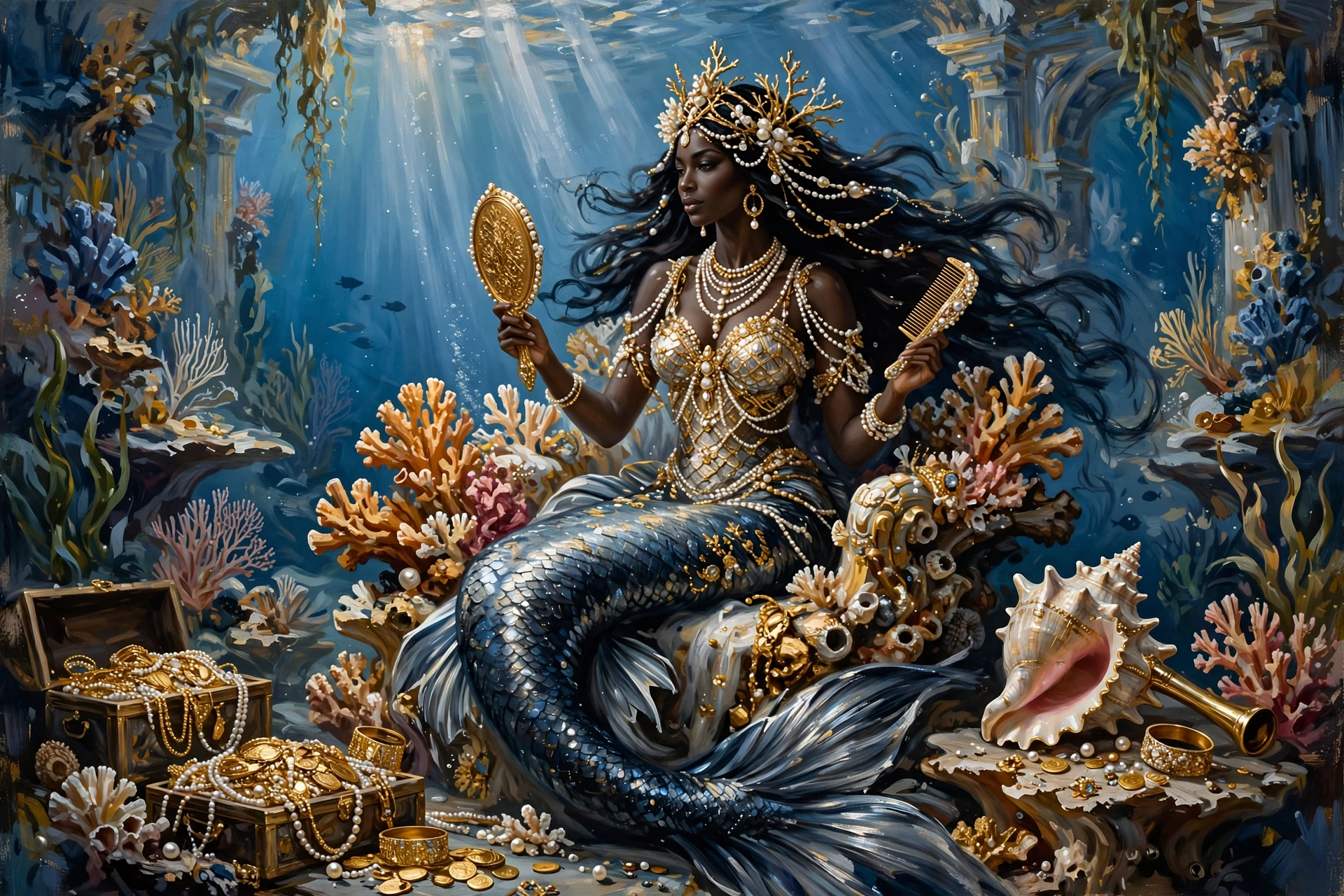
This is her toilette. This is how she is served.
The record
La Sirène is a lwa of Haitian Vodou — the mystery, as Erzulie’s house archive puts it, of both fresh and salt waters. The sea is hers, and the rivers and springs that run to it. Beauty is hers. Wealth is hers — the sea hoards what sinks, and she is its queen. Music is hers; the houses call her a source of song, a patroness of musicians, artists, and dreamers. Dreams, intuition, and hidden knowledge are hers — everything that lives anba dlo, under the water, in the realm where the spirits and the ancestors dwell.
She is the wife of Agwé, sovereign of the sea, and together they hold an undersea court — a palace beneath the waves, attended and adorned, where she reigns as queen. One of her Rada name-forms is La Baleine, the whale: the greatest creature of her element, moving under the same water she rules.
And her kinship to the lady of our last Grimoire post is given two ways in the record, and this altar will give both, because the houses hold both. Erzulie’s archive calls La Sirène “the sister of Ezili Freda” — and on the same page, she is “the water version of Erzulie Freda,” as many houses hold her to be. Sister, and self-in-another-element. Freda keeps the parlour, the cake, the perfume, the longing for perfect love. La Sirène keeps the deep, the treasure, the dream, the song that comes up from under the water. Karen McCarthy Brown, who wrote of them in Mama Lola, groups the Ezili women together — La Sirène, Ezili Dantò, Ezili Freda — each more understandable in relation to the others.
What the record does not hold, anywhere, is a rivalry between the sisters. You will find none invented here. The waters and the parlour are two rooms of one house, and the women who serve these spirits have never needed them at war.
Her colours are blue and white — the pale blue of shallows, the white of foam. Her day is Thursday, as Freda’s is; one house also gives Tuesday, and we note it and move on, because houses differ and that, too, is part of the record.
The toilette
Begin where every source begins, because it is the most consistently documented image of her in the whole tradition: the mirror and the comb.
Elizabeth McAlister’s scholarship records the scene the stories keep returning to — La Sirène spotted on a rock or a riverbank, combing her long hair, looking into a mirror. Erzulie’s lists her symbols plainly: silver comb and mirror. The painter André Pierre showed her, around 1957, blowing a yellow trumpet — music made visible, and the trumpet and the conch are the shared instruments of the sea court she holds with Agwé. Gold is her metal: her jewellery, her treasure, the wealth of the undersea palace she keeps.
So when Kenaz Filan — an initiated author, writing in Vodou Love Magic — instructs her devotees, the first law of her toilette is this: keep for her “the finest comb and mirror you can afford.” Not a comb. Not a mirror. The finest you can afford — the same standard Freda sets in the parlour, carried down into the blue. Around them, Filan’s shrine gathers the shoreline itself: shells, coral, driftwood, sea glass, a bowl of seawater, white cakes resting on pale blue and white silk, champagne or sweet orgeat in a champagne glass. And one rule stated without decoration: nothing black on her altar. Her table is the colour of light on water.
Erzulie’s house record sets her sacred places where springs rise or where land meets sea, and lays her table generously: red fish cooked with sweet onion, roasted white pigeon, fried egg, rice pudding or bread pudding, white or blue-and-white cake, cookies, white or pink flowers, Lotion Pompeia or Florida Water poured in water; to drink, sweet almond syrup, sweet white wine, champagne.
And here this altar must do what it did for Freda — say plainly where the houses part. Another house tradition, Spellmaker’s, forbids La Sirène seafood entirely, holding that as Queen of the Seas she counts all sea life her children, and what is hers is not served back to her. Erzulie’s serves her red fish; Spellmaker serves her none. Both are houses. Both are the record. This post follows Erzulie’s table, as the Freda post followed Erzulie’s house — and it names the disagreement rather than blending two kitchens into a meal no house ever cooked.
In ceremony, when she mounts the one she rides, the record turns to water entirely: those she possesses move as if swimming, and must be kept wet for the whole of it — a queen of the sea does not sit in a dry room, even borrowed flesh must be made a shoreline for her.
The honest mirror
Now the heart of this post, and it is a story about a piece of wood.
At Bord de Mer de Limonade, on Haiti’s northern coast, there stands a devotion to a saint-siren that scholars have studied and the Church has more than once tried to suppress. The local tradition, documented in “The Saint and the Siren” (Studies in Religion, 2012), holds that in 1873 a bow ornament — a carved form that had once adorned the front of a ship — washed ashore, and was received by the people there as the saint, as the siren: St. Philomena and Lasyrenn, fused in one figure of devotion. The paper reaches further back still: a French frigate named La Sirène, a carved siren at its bow, had entered Haitian ports in 1747.
Read what that means slowly. A European ship’s image — carved by European hands, riding the bow of a European frigate — came ashore in Haiti, and Black devotees took it up entirely on their own terms. The scholars who studied the cult call it a “popular liberation hagiography”: a devotion the people wrote themselves, asserting Haitian identity and feminine power, in the face of a hierarchy that periodically moved to shut it down. The figurehead did not convert them. They converted the figurehead.
And she was never only Europe’s. Her roots run deeper and older, across the water her devotees’ ancestors were carried over: to the Afro-diasporic water deities, to Mami Wata and the mother-waters of West Africa. The scholar Henry Drewal’s phrase for that lineage is the honest one, and this altar adopts it as its own stance: she is “at once originally African and imported.” Not a pure survival, not a foreign import — a creole spirit, made the way her people were made to make everything: from what the sea brought, claimed and remade until it was theirs.
Her Catholic counterparts tell the same house-by-house story. Our Lady Star of the Sea — Stella Maris — stands for her in many shrines; St. Philomena stands for her at Bord de Mer, in a living tradition documented in place; other houses name others. This altar crowns none of them the single answer, because no house was ever given the authority to answer for all the others.
The deep
Every account of La Sirène carries one more story, and it is never told as a fairy tale.
She is said to take people beneath the sea. McAlister records it exactly: she entices people to follow her under the water, where they might be lost forever — or they might reappear after a year and a day, having learned secret knowledge in the land anba dlo. Erzulie’s house version gives three years, or seven, and those she keeps beneath the waters return initiated — as prophets, as priests, as healers carrying what the deep taught them. Brown’s record in Mama Lola carries the same shape: a person vanishes for a time, and returns changed, instructed by spirits in the arts of diagnosis and healing — one rural priestess said no human being initiated her at all. Her instruction came from under the water.
Hold the whole shape of it, the way her devotees do. The return is the fortunate outcome. It is not the promise. The same stories that carry healers up out of the deep carry others who simply do not come back, and Filan’s counsel for those who serve her is the counsel this altar repeats: she is served “with love and respect… tempered with a good bit of caution.” The deep gives. The deep also keeps. Both sentences are the tradition, and a glamour that pretends only the first is true is not reverence — it is advertising.
For us
What does the mermaid of the undersea court have to say to a Black woman at her own mirror?
That your dreams are a domain, not a distraction. La Sirène governs what comes in sleep and intuition — the knowledge that arrives from below the surface of things — and her devotees have always treated that knowledge as treasure, because it is.
That wealth is part of her glamour, unashamedly. The sea floor is paved with what the world above lost, and she is its queen: riches hidden, riches withheld, riches waiting in the deep for the one willing to go down and learn. There is no apology in her anywhere for wanting to be adorned, enriched, and crowned.
And that the mirror was always the point. On the rock, in the stories, she combs her hair and looks at herself — not for a lover’s eye, not for a court’s approval, but in the oldest self-regard there is: a queen regarding a queen, at the edge of her own kingdom. Freda’s mirror asks to be adored. La Sirène’s mirror asks nothing. It simply shows her what the deep already knows.
Cautions
Homage, not initiation. Vodou is a living, initiation-based religion. What is written here is respectful homage and an account of how La Sirène is served, drawn from the published record — practitioner houses, initiated authors, and scholars. Formal service belongs in a house, under a manbo or an oungan. This blog initiates no one.
Houses differ — do not blend them. The seafood question, the counterparts, the days: where the record disagrees with itself, this post has said so. If you are ever blessed to sit with a house, keep that house’s rules whole.
The sea is beautiful and unsparing — in her stories, and in fact. The same water that carries her comb and her treasure carries everything else the stories warn about. Honour her at the shoreline with the respect you owe the real ocean: never turn your back on it carelessly, and never mistake its glitter for a guarantee.
On Thursdays, in houses and at shorelines, women lay out blue and white, pour the champagne, and set the finest comb and mirror they can afford before the queen of the deep — sister to Freda, and Freda’s own self in the water; a figurehead the sea delivered and a people claimed; a mirror held under the waves for a hundred and fifty years, still showing whoever looks into it exactly how much wealth can live below a surface.
Comb your hair at the edge of your own deep, sister. Regard yourself the way she regards herself. And let what is hidden in you — the dreams, the knowledge, the treasure — come up shining, in its own good time.
Glamour is yours to conjure. — Lakish