
This post contains affiliate links. If you buy through them, Blaq Vixen Beauty may earn a small commission at no extra cost to you.
Source: Godfrey Selig, Secrets of the Psalms, via the “Psalms and Verses in Hoodoo” compilation at jesterbear.com. The working below is Selig’s documented method, retold faithfully; the framing, the cautions, and the closing are this blog’s own. The mirror working is a modern practitioner variant and is labelled as such.
The hook
Before there was a perfume counter, there was a bottle of oil and a woman’s two hands.
Oil on the skin. Oil through the hair. Oil worked into the palms until they shine. Anointing is the oldest beauty ritual we have — older than the compact, older than the lipstick, older than the mirror as we know it. And in the tradition this altar keeps, anointing was never just grooming. It was a speaking. You did not only scent the oil. You prayed over it, and then you wore the prayer.
There is a psalm for that. The Bible’s own beauty psalm — the one that says, of a woman dressed and anointed and brought before a king: “so shall the king greatly desire thy beauty.”
Tonight we set that psalm on the altar, the way the workers set it a century ago: spoken over olive oil, carried on the skin, and sealed into the palms of the hands.
The record
Godfrey Selig’s Secrets of the Psalms is one of the quiet foundation books of American folk practice. It assigns the psalms their virtues — this one for protection, that one for favor, another for peace in the home — and it teaches the reader to speak them as workings, not merely read them as scripture. In Hoodoo, where the Bible is the great book of conjure, Selig’s assignments travelled far: psalm-work became part of how ordinary people, and Black church people especially, carried prayer into daily life with their hands.
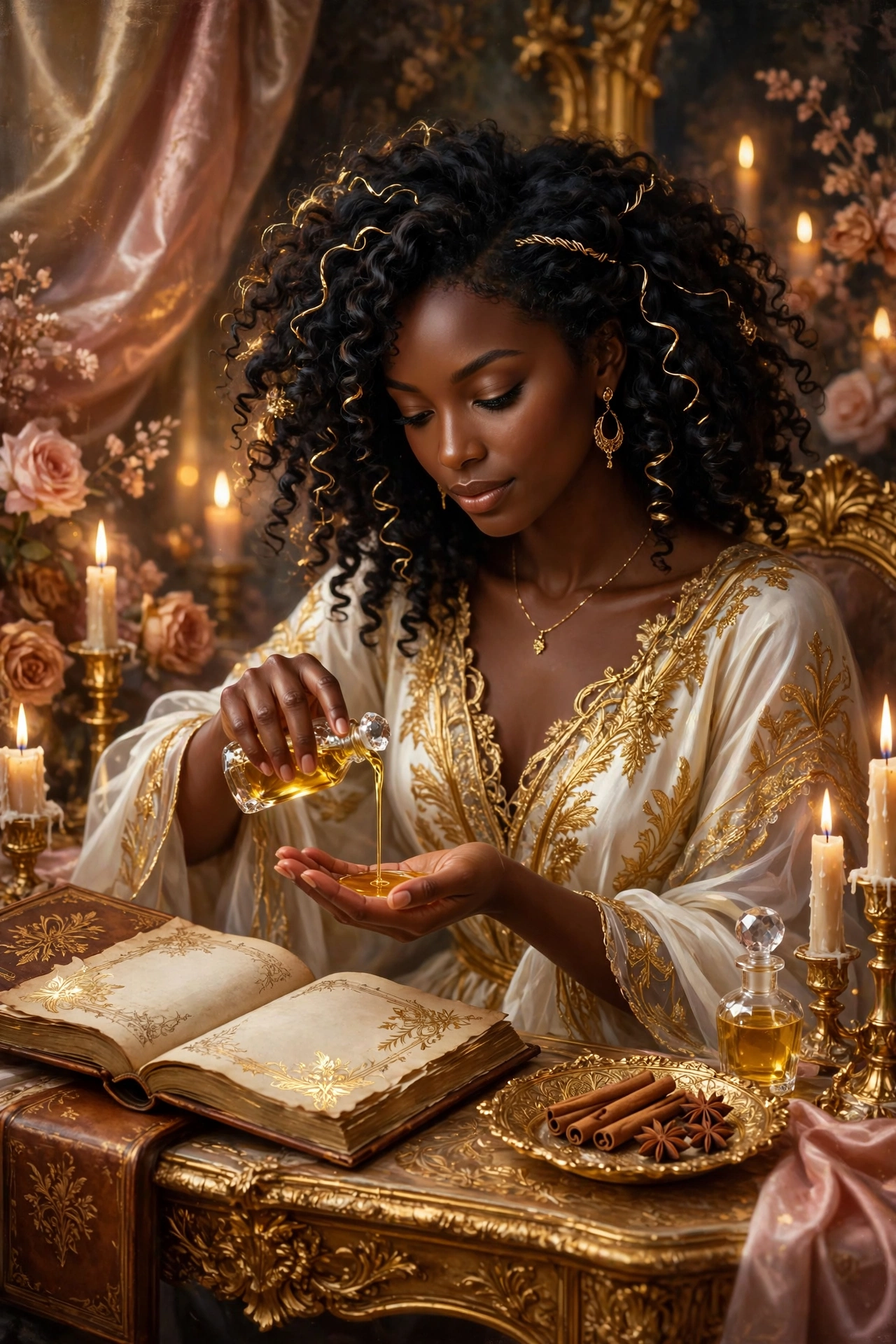
Here is the virtue Selig gives to the forty-fifth psalm: it “is said to possess the virtue of love and passion.” And his instruction, in full, is a woman’s working. She scents a bottle of pure olive oil with pleasing spices. She pronounces the psalm over it. And then she wears it — on her garments, in her hair, on her skin, “especially the palms of her hands.”
The psalm itself earns its place. Psalm 45 is a wedding song, a royal song, and it is drenched in exactly the imagery this working is made of. “Thou art fairer than the children of men: grace is poured into thy lips.” It speaks of myrrh and aloes and cassia coming out of ivory palaces, of a bride whose clothing is of wrought gold, brought unto the king in raiment of needlework. This is not a psalm that apologizes for beauty. It treats beauty — scented, anointed, adorned beauty — as a form of glory.
Selig also records the holy name belonging to this psalm: Adojah. The workers of the old books kept those names the way they kept everything — carefully, and with the understanding that a name spoken over oil is part of what makes the oil more than oil.
One more piece of the record, stated plainly because this blog states everything plainly: Selig’s text also carries an application aimed at a specific man — that if she wishes to attract the attentions of one man in particular, she ought to find a reason to touch one or both of his hands, so the anointed palm meets his. That is in the source, and we will not pretend it isn’t. But the working we set on this altar tonight is aimed where the psalm itself aims: at general glamour and favor — at being regarded with admiration, and at a touch that carries warmth because your hands were blessed first. What the record holds beyond that, we leave in the record.
The working
1. The oil. Begin with pure olive oil in a clean bottle. This is the base the source names, and it is chosen well: olive oil is the anointing oil of scripture itself, the oil of lamps and altars and kings.
2. The spices. Scent the oil with pleasing spices. Selig does not hand you a fixed list — he says pleasing, and the choosing is part of the work. The psalm itself breathes myrrh and aloes and cassia; the old spice cabinets of our grandmothers breathed cinnamon and clove. Choose what pleases you, what smells like the woman you intend to be regarded as, and let the oil take the scent slowly. A glamour you cannot stand to smell will not carry. The worker chooses hers.
3. The speaking. Pronounce Psalm 45 over the scented oil — the whole psalm, aloud, over the open bottle. Speak it the way the psalm asks to be spoken: as a song for a bride being brought in gold. Let the words go down into the oil. This is the step that makes the difference between perfumed oil and an anointing oil, and it costs nothing but breath and intention.
4. The wearing. Now wear what you have made, the way Selig lays it out:
- Your garments — a touch of the oil where your clothing will carry the scent with you through the room.
- Your hair — worked lightly through it, so the fragrance moves when you move.
- Your skin — anointed in the ordinary, loving way of a woman dressing herself with care.
- Especially the palms of your hands — the source’s own emphasis, and the heart of this working. Rub the oil into your palms until they are warm and shining. What your hands touch, from that moment, is touched by an anointed woman.
That is the working, whole, as Selig wrote it: oil, spice, psalm, and the palms last and most of all.
The mirror variant
A modern variant of this working circulates among today’s practitioners, and we give it to you labelled honestly as exactly that — modern, not Selig. In the form taught by Rich Bitch Conjure, the worker dresses a pink or red candle, burns rose and jasmine incense, and recites Psalm 45 while looking in the mirror, blessing the reflection she sees there.
There is something right in it, and this altar will say so. The psalm is a song sung over a woman being adorned; the mirror variant simply turns the singer and the sung-to into the same person. If the plain anointing is the working’s body, the mirror is its face turned toward you. Work it as a companion to Selig’s method, or after it — but know whose is whose. The oil and the palms are the old record. The mirror is our century, looking back at her.
For us
Stay with the palms a moment, because the palms are where this working was always going to land for us.
Black women’s hands have done every kind of work there is. They have braided and cooked and typed and healed, picked and planted and prayed. They have been laid on the sick in church and laid on fevered foreheads at home. Our grandmothers kept a small bottle of blessed oil — from the church, from the storefront, from the elder who prayed over it — and those hands anointed babies, doorposts, and each other. The church mothers did not call it glamour magick. They called it being prayed up, being covered, being blessed before you walked out the door. It is the same river. We are not embarrassed to stand in it, and we name it at this altar with respect for both banks: the psalm-workers in Selig’s book and the mothers in the front pews are kin in this practice.
And the hair — our hair has always taken oil. Pressed with it, dressed with it, shined with it, scented with it. An anointing oil pronounced over with the beauty psalm, worked through Black hair by Black hands, is not an import into our tradition. It is a homecoming with the words attached.
So when Selig says especially the palms of her hands, hear it the way it deserves to be heard by us: the hands that do the work of your life are to be blessed like instruments of glory — because they are. Anoint them last. Anoint them most. Then go out and let your touch, your handshake, your presence arrive the way an anointed thing arrives: deliberately, warmly, and not by accident.
Cautions
- Patch-test the oil. Spiced oils can irritate skin — some traditional spices are warming on the skin in a way not every body welcomes. Test a small amount on the inside of the wrist and wait before you anoint freely, and keep any spiced oil away from the eyes and other tender places. If your skin refuses it, scent the garments and the hair and let the skin step aside; the working has more than one door.
- Use fragrance sense. You are scenting oil to be worn in the world. Let it be present, never punishing — for your own sake and for the asthmatic, the allergic, and the simply sensitive who share your air. Glamour that clears a room has missed its own point.
- Olive oil and fabric. Oil can mark fine cloth. Anoint garments at a hidden seam or hem first, and let the oil settle before the garment meets your best silk.
- This is a working for favor and regard — a blessing spoken over oil and worn with intention. It is not a promise about any person’s heart. The psalm is a song, the oil is a prayer you can touch, and what they open, they open. That has always been enough for the women who worked it.
Closing
A bottle of olive oil. Spices she chose herself. A psalm spoken aloud over the open mouth of the bottle, the way women have spoken over oil for longer than any of our books remember. Then the garments, the hair, the skin — and last, most carefully, the palms.
Go out anointed, sister. Let your hands be blessed before they touch the world, and let the world be touched by blessed hands.
So shall the king greatly desire thy beauty — and so shall every eye that meets you know it was meant to.
Glamour is yours to conjure. — Lakish