This post contains affiliate links. If you buy through them, Blaq Vixen Beauty may earn a small commission at no extra cost to you.
Source: The hyssop and rue uncrossing bath as documented in Gullah Geechee sources (Auntie Root, agenticrootwork.com) and MotherSpells’ bath method. Psalm 51:7 quoted from the public-domain text.
The hook
Sometimes the face is not dull. Sometimes it is covered.
You have done everything the vanity asks. The skin is tended, the hair is right, the colour sits where it should — and still the mirror gives you back somebody dimmer than the woman you know you are. The light is in there. It is simply not getting out.
The old workers had a word for that, and it was not “tired” and it was not “ageing.” They called it crossed. Crossed conditions. Heaviness that settles on a person the way dust settles on a lamp — not hers, not chosen, just gathered: other people’s envy, other people’s words, the weather of rooms she had to walk through to make her living. And they had a working for it, older than any of us, written right into the Psalms: wash it off. Purge me with hyssop, and I shall be clean.
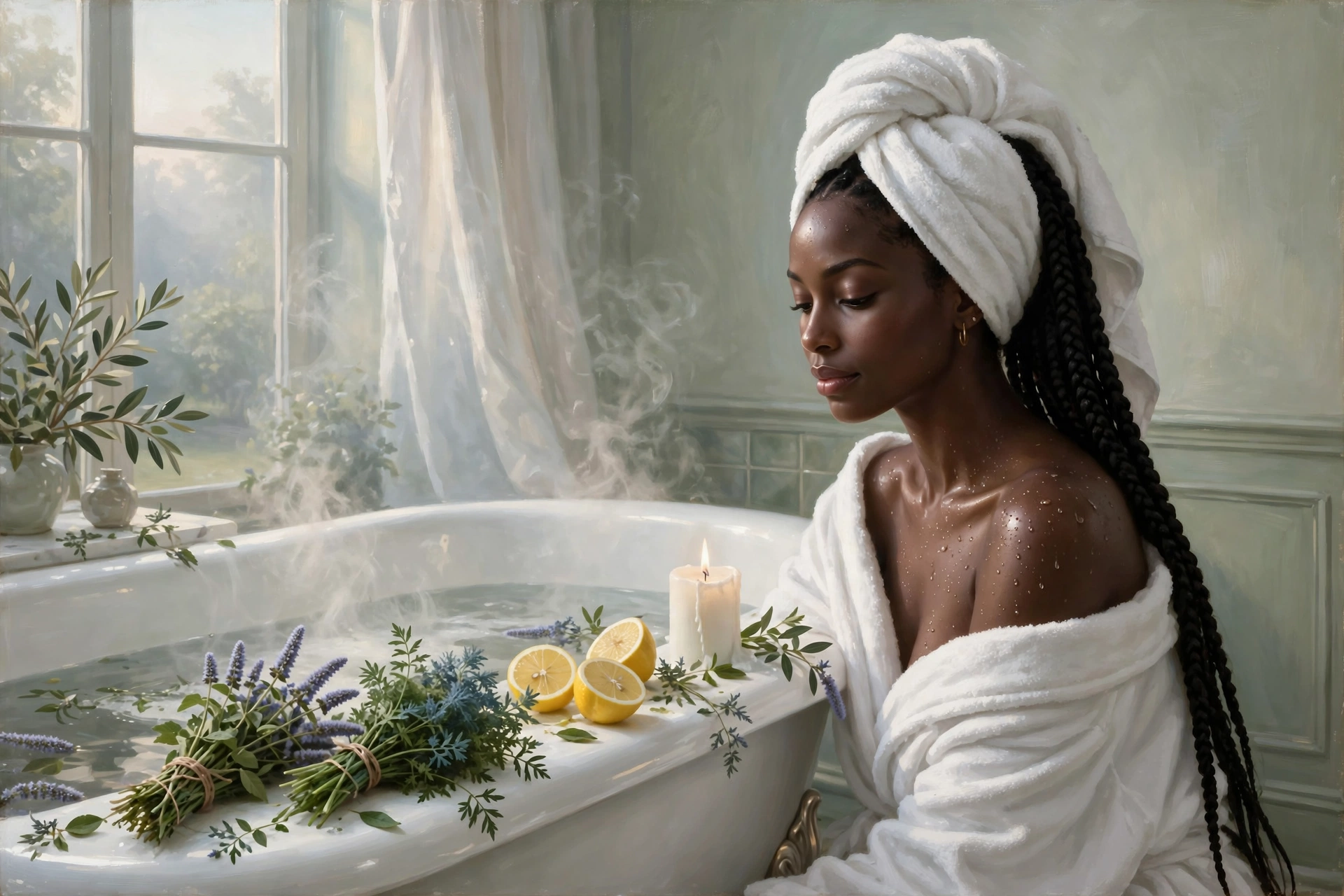
This is the glamour working that comes before glamour. Before the drawing, before the shining, there is the clearing. Tonight, at this altar, we take the bath.
The record
Psalm 51 is the great psalm of cleansing in the tradition — the one spoken when a person needs to be washed all the way down to the spirit. Its seventh verse names the herb outright: “Purge me with hyssop, and I shall be clean; wash me, and I shall be whiter than snow.” Hyssop is not a garnish in this line. It is the instrument. The psalmist is asking to be purged with it, the way a worker asks for the right tool by name.
In Gullah Geechee documentation of the tradition, hyssop holds a particular seat of honour: it is called “the cornerstone of uncrossing work” — the first herb reached for when conditions need lifting, when jinxes and heaviness and crossed-up fortune need to come off a person and go down the drain where they belong. And hyssop does not work alone. Its traditional partner is rue, the old guardian herb, worked alongside it against jinxes and the evil eye — the thrown glance, the spoken ill-wish, the malice that travels. Hyssop purges. Rue protects the ground the purging clears.
This bath is not a beauty treatment wearing a costume. It is uncrossing work, documented in the Sea Islands tradition and carried in the conjure practice of Black Southern women for generations: a bath taken before sunrise, in a series, with prayer on the lips and the water thrown out of the house when it is done. We set it on this altar exactly as it is documented — and we take its cautions just as seriously as its power, because rue is a strong herb with a strong warning, and this altar does not play with either.
The working
1. Brew the tea. Simmer dried hyssop and dried rue together in water for about fifteen minutes, until the brew is strong and dark and smells like the work it is. Take it off the heat. Let it cool. Strain out the herbs. What remains is the heart of the bath — keep it close.
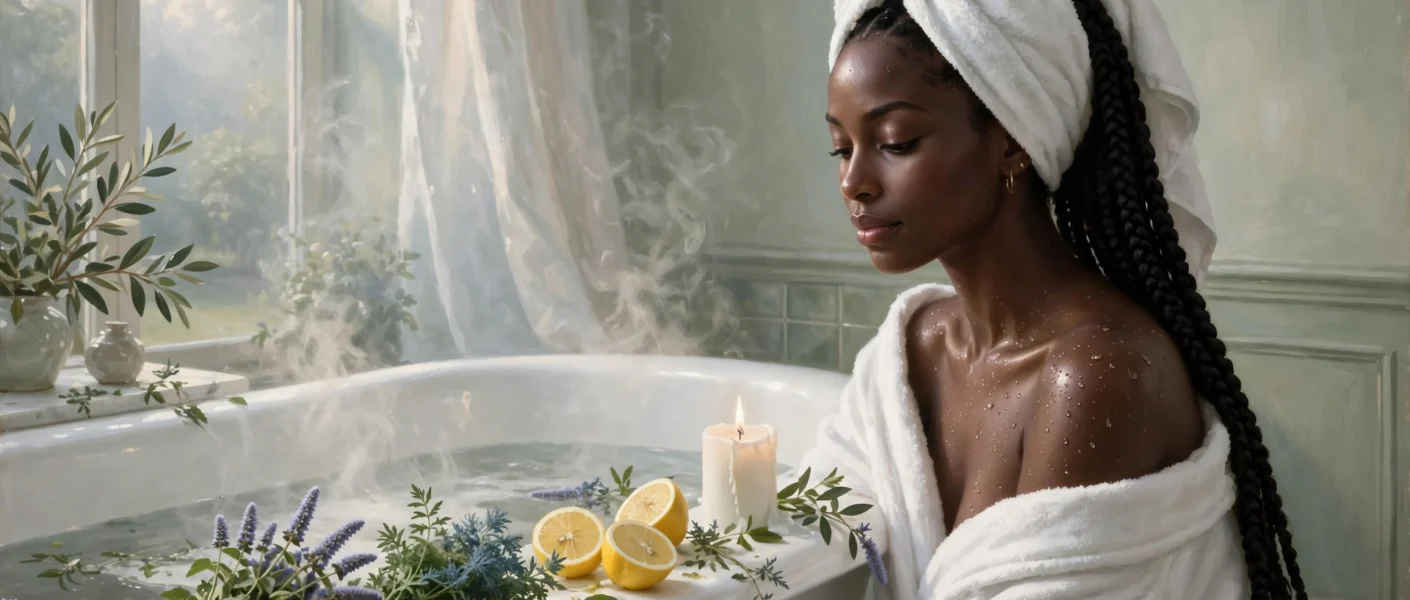
2. Draw the bath. Fill the tub with bath water. Add the strained tea. Add sea salt or kosher salt — salt for the clearing. Add a little white vinegar. Cut a lemon in half, squeeze in the juice, and drop the rinds in after it. If you work with Van Van oil, add nine drops — no more is needed; the tradition counts in nines and means it. Light a white candle and set it by the tub. White for the cleansing. White for the snow the psalm promises.
3. Wash downward. Step in, and wash downward — from the head toward the feet, always down, never up. Direction is doctrine in this work: downward motion removes. What you draw upward, you draw toward yourself; what you wash downward, you send off and away. As you wash, pray Psalm 51 — the whole of it if you carry it, or its seventh verse over and over, or plain words in your own mouth if the psalm is not yours to claim. The prayer is not decoration. The prayer is half the working.
4. Soak, and let it settle. Stay in the water at least fifteen minutes. Let the bath do what a bath does when nobody rushes it. This is not a scrub-and-go. Sit in the clearing until you feel the day — the week, the season — loosen its grip.
5. Air-dry. Step out and do not reach for the towel. Air-dry, the way the tradition teaches, letting the working dry onto the skin rather than being wiped off it. Dress in clean clothes. Let the candle burn with respect and safety, or snuff it with thanks.
6. Throw the water out. The used bath water does not go back into the house’s ordinary life. Carry it outside and throw it toward the west — toward the setting sun, the closing of the day — or take it to a crossroads and throw it there. What came off you does not stay on your doorstep. Walk back in without looking behind you for it.
7. Keep the series. Cleansing baths in this tradition are taken before sunrise, and they are taken in a series: three days, seven days, or nine days, as the condition asks. One bath is a beginning. A series is a course of work. Choose your number honestly — what you can truly keep, kept fully, outweighs a grand number abandoned on day two.
And when the series is done and the ground is clear — then draw. This bath is the companion that goes before a glamour working like Look Me Over: clear first, then call the eyes. Uncrossing empties the vessel. Glamour fills it. In that order, always.
For us
Now the blog speaks plainly, in its own voice.
Consider what a Black woman carries through an ordinary week that was never hers to carry. The projection in the meeting room, where her directness gets renamed before it reaches the minutes. The weather of the workplace — the smiles she must manufacture, the tones she must police in her own throat, the hundred small swallowings that sit on the skin by Friday like a film. The auntie’s grief and the coworker’s envy and the stranger’s stare, all of it landing on the same body, the same face, that is then told to go and glow.
We do not call that vanity trouble at this altar. We call it accumulation. And the tradition our grandmothers’ grandmothers kept has always known what to do with accumulation: you do not paint over it. You wash. Downward. With prayer. Before sunrise, while the house is quiet and the work is only yours.
There is a dignity in this bath that no product has ever sold: it assumes the shine was never lost. It was covered. The woman in the mirror is not asking to become somebody else — she is asking for everything that is not her to be taken off her name, her face, her fortune, so that what is hers can show again. Purge me with hyssop. Not make me new. Clean me. The psalm knew. The Sea Islands knew. Now the altar says it where our daughters can find it.
Cautions
Read these before you run the water. Rue is a powerful herb, and power and caution are the same sentence here.
- Rue is phototoxic. Rue (Ruta graveolens) can make skin react severely to sunlight — blistering, burning, lasting marks. If you use rue in this bath, keep it dilute, keep it external-only, and keep rue-washed skin out of the sun afterward. Bathe before sunrise, as the tradition teaches, and give the skin time and covered clothing before daylight touches it.
- Rue is a skin irritant for many people. If your skin is sensitive, if you have reacted to strong herbs before, or if you simply do not know — work the hyssop-only version of this bath. Hyssop is the cornerstone; the working stands on it alone. Rue is the partner, not the price of admission.
- Rue is UNSAFE IN PREGNANCY. Do not use rue — in this bath or any other — if you are pregnant or may be pregnant. No exceptions, no dilutions, no “just a little.” The hyssop-only bath is yours in full.
- Vinegar stays out of eyes and broken skin. A little in the bath water is the documented method; it does not belong on open cuts, scrapes, or near the eyes. If the skin is broken, leave the vinegar out of that day’s bath.
- Hot water and candles ask for ordinary sense. A white candle by a tub is beautiful and is still fire: set it stable, keep it clear of towels and sleeves, and never leave it burning alone in the room.
- This is a spiritual bath in a documented folk tradition. It is not medicine, not a treatment, and not a substitute for care of body or mind. Work it for the spirit’s weather — and take the body’s weather to those trained to tend it.
Closing
Before the sun is up, a woman stands in dark water that smells of hyssop and lemon, washing downward, speaking an old psalm over her own head — and everything that was never hers runs off her shoulders and down toward her feet, where it belongs: beneath her.
Then she throws the water to the west. Then she dries in the clean air. Then, and only then, does she reach for the glamour — because now there is somewhere for the shine to land.
Clear first. Then draw. Then be seen.
Glamour is yours to conjure. — Lakish