This post contains affiliate links. If you buy through them, Blaq Vixen Beauty may earn a small commission at no extra cost to you.
Source: Erzulie’s practitioner-house archive (erzulies.com); Alfred Métraux, Voodoo in Haiti; Karen McCarthy Brown, Mama Lola: A Vodou Priestess in Brooklyn. What follows is an account of how Ezili Freda is served, drawn from those records — an homage, not an initiation.
The hook
There is a spirit who arrives expecting the finest of everything.
Not the good-enough. Not the clean-enough. The finest — the cake iced pink, the perfume poured generously, the mirror polished, the comb laid out like an instrument on a surgeon’s tray. And still, when she comes, she weeps. The ethnographers who watched her ceremonies wrote it down again and again: Ezili Freda weeps because the love offered to her never equals the love she imagines. She dreams of a devotion so complete, so exquisite, that the real world — with its smudged glasses and its almosts — breaks her heart a little every single time.
If you have ever stood at your own vanity wanting to be adored the way you adore, wanting the room, the dress, the face, the life to rise to the level of the love you carry inside you — you already know her. This is her toilette. This is how she is served.
The record
Ezili Freda Dahomey is a lwa of the Rada nation in Haitian Vodou — the spirit of love, beauty, luxury, and refinement. Her day is Thursday. Her sign is the heart. In the Catholic imagery Vodou has carried alongside its own for centuries, she walks with the Mater Dolorosa, the Mother of Sorrows — a pairing that tells you everything before we say another word: this is a goddess whose beauty and whose sorrow are the same face.
Alfred Métraux recorded her in Voodoo in Haiti, and Karen McCarthy Brown, who spent years serving alongside the Brooklyn manbo Mama Lola, wrote of her in Mama Lola. Between the ethnographers and the practitioner houses that keep her archive today, the portrait is consistent. Freda is refinement itself. She loves what is delicate, what is sweet, what is costly, what is done properly. She is the lwa of the woman who sets a table as if it matters — because to her, it is not decoration. It is the language love speaks when it is fluent.
And she weeps. Hold both truths at once, because her devotees always have: the goddess of luxury is also the goddess of the ache underneath luxury — the knowledge that being adored a little is not the same as being adored enough.
The toilette
A toilette is a lady’s dressing table and everything arranged upon it — her perfumes, her mirror, her comb, her jewels. To serve Freda is to lay out a toilette worthy of her, on an altar dressed in pink and white — in some houses, blue and gold join the pink and white, but the blush and the white are hers above all.
Item by item, as the houses document it:
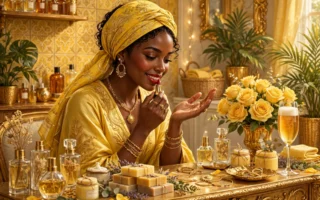
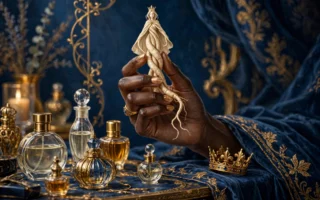
Perfume. First and always, perfume. Traditionally she is given Anaïs Anaïs by Cacharel, or Pompeia, or Lotion Rev d’Or — sweet, floral, unmistakably feminine scents. Perfume is not an accent on her altar. It is the atmosphere she breathes. Devotees preparing to serve her bathe first, dress in clean pink or white, and put on perfume themselves before they approach — you do not come to the goddess of fragrance unscented.
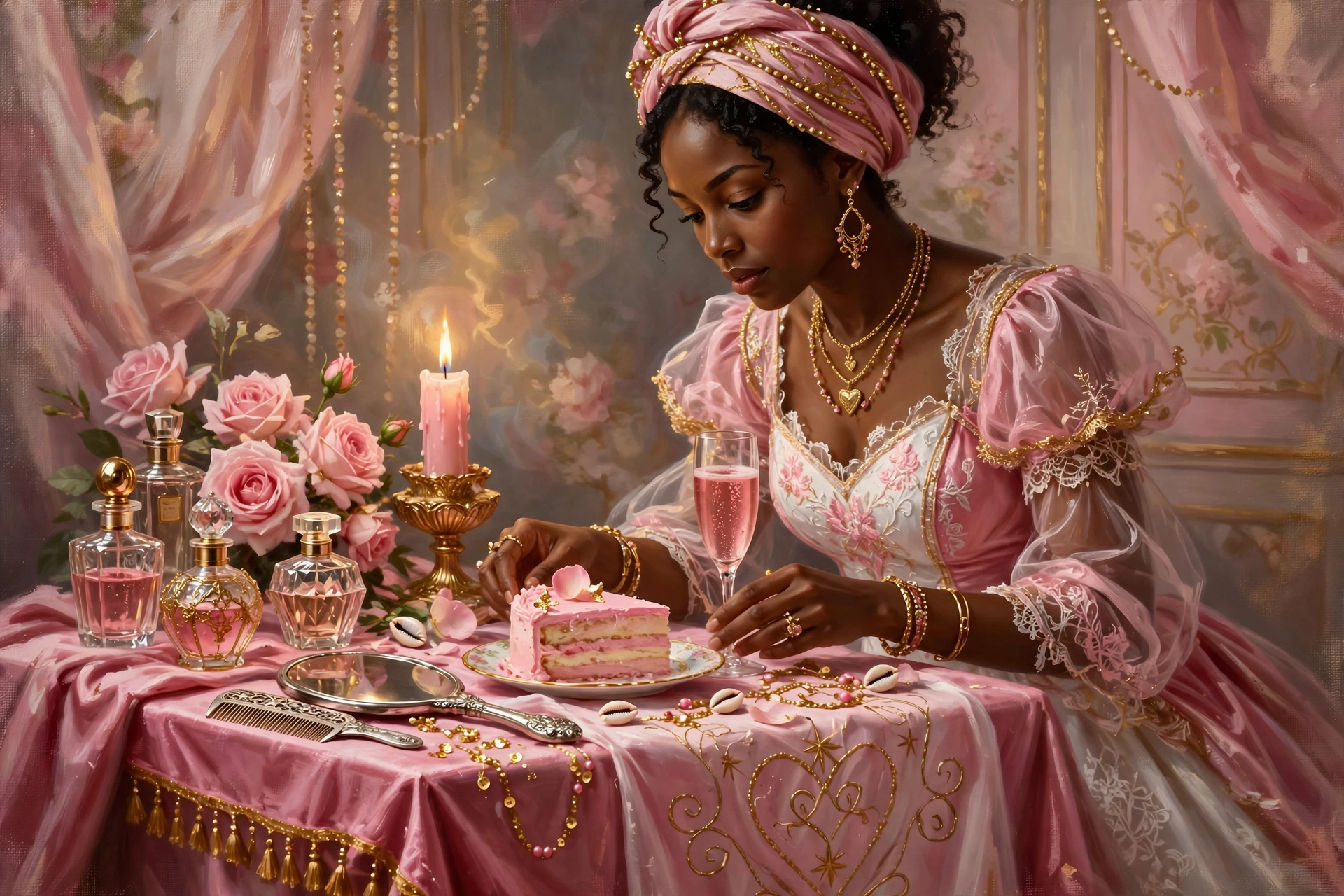
The mirror and the comb. Her toilette is laid out like a vanity: a mirror, so she may behold herself; a comb, so her hair may be dressed. Sit with what that means. The spirits of many traditions are given weapons, tools, harvests. Freda is given the instruments of her own beauty, because her beauty is not vanity to be indulged — it is part of her power, and her servants honour it as power.
Jewellery. Pieces are laid out for her to try on. In ceremony, the person she mounts — the devotee whose body she rides when she arrives in the flesh — is washed, dressed in pink and white, and given her three wedding rings to wear. Three rings. She is forever the bride of an ideal love, and the rings are not costume; they are her story worn on the hand.
The sweets. Pink or white cake. Rice pudding. Vermicelli in milk. Cookies and delicate candies. Her palate runs tender and sweet and milky — nothing coarse, nothing heavy, nothing that would sit roughly on a refined tongue.
The drinks. Sweet ones: orange syrup, grenadine, pink champagne. Even her thirst is elegant.
The light. A white or pink candle, or an olive-oil lamp, burning steady over the whole arrangement.
The roses. Pink or white roses, laid among it all.
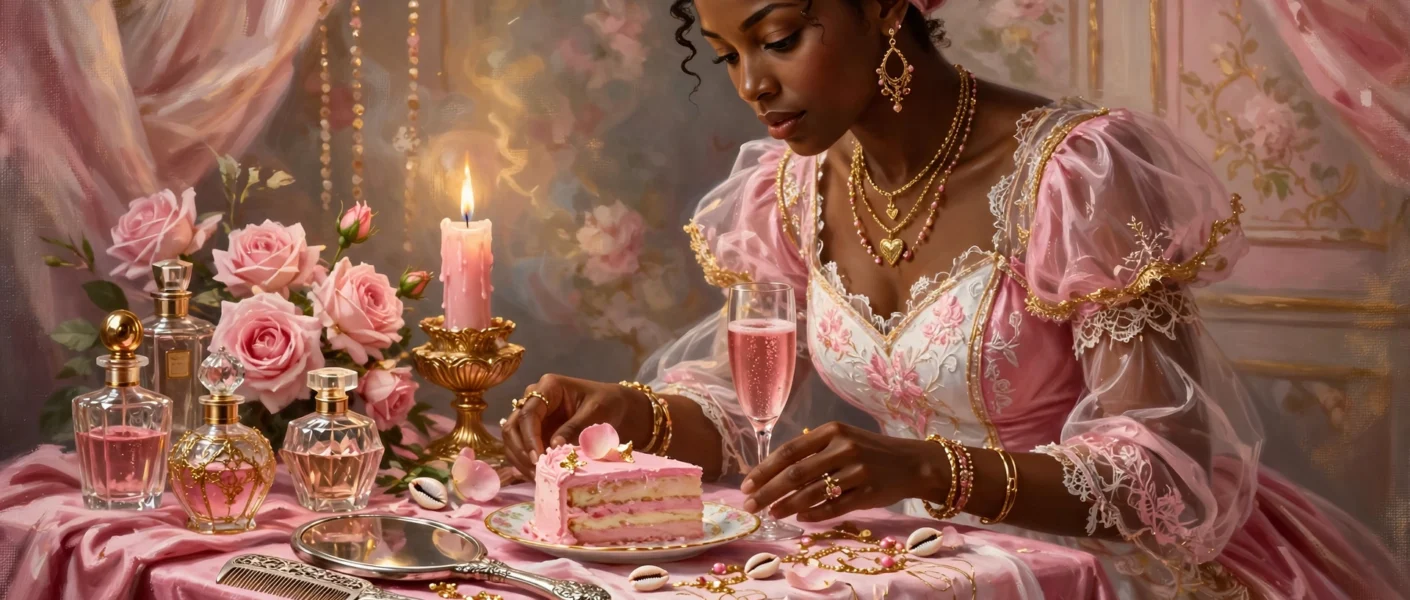
Picture the finished altar: pink and white cloth, perfume open and rising, a mirror catching candlelight, a comb laid straight, rings waiting, cake iced, champagne pink in the glass, roses breathing beside the flame. It is not an altar that looks like an altar in the way most people imagine. It looks like the dressing table of the most adored woman in the world, at the moment before she sits down at it. That is precisely the point.
The honest mirror
Now the part this altar will not skip, because Freda deserves honesty and so do you.
In the chromolithographs and the traditional imagery, Ezili Freda is depicted as a light-skinned woman of luxury — pale, fine-featured, draped in the trappings of colonial-era elegance. That image has a history, and the history is not innocent: it comes out of a world that taught, with pictures as much as with laws, that beauty and refinement and being-adored wore a light face.
Here is what is also true, and truer: her devotees — the women who have bathed and dressed in pink and white for her, who have saved for her perfume and iced her cakes and wept with her when she weeps — are overwhelmingly Black women, and they have loved and served her for generations. They did not look at that picture and ask its permission. They recognised something in Freda that the picture could only partly hold: the conviction that a woman is owed beauty, luxury, tenderness, and adoration as a matter of course — and the sorrow of a world that keeps failing to deliver it.
So let this blog’s stance be plain. Beauty was never the property of the chromolithograph. Luxury was never the property of the image. Being adored was never the property of a skin tone on a printed card. Freda’s Black devotees have known this in their bones for two hundred years, and they have served her — not in spite of who they are, but as who they are: women who understood that the goddess of refinement belongs to whoever shows up refined in spirit and generous in love. The mirror on her altar is for her face. It has room for yours.
For us
What have Black women always known about Ezili Freda?
That the desire to be cherished is not weakness. That wanting the finest — the real perfume, the good cake, the room done beautifully — is not frivolity; it is a standard, and standards are a form of self-respect. That a woman can be soft and be sovereign in the same breath. That grief and glamour are not opposites: Freda weeps in her jewels, and neither the tears nor the jewels cancel the other out.
When a Black woman lays out pink and white, bathes, dresses clean, scents her own skin, and stands before a mirror with intention, she is not borrowing somebody else’s goddess. She is standing in a line of women — Haitian women, diaspora women, her own grandmothers in their own ways — who insisted that luxury is a birthright, not an apology, and that being adored begins with refusing to accept less than the finest you can offer yourself.
Cautions
Homage, not initiation. Vodou is a living, initiation-based religion. What is written here is respectful homage and an account of how Ezili Freda is served, drawn from the published record. Formal service belongs in a house, under a manbo or an oungan. This blog initiates no one, and a beautiful altar laid at home is a gesture of devotion and study — receive it as that, and let the houses keep what is theirs.
Perfume, gently. If you anoint yourself in her honour, patch-test any fragrance on a small place on your skin first, and keep strong scent off broken or sensitive skin. The goddess loves perfume; she does not ask you to burn for it.
Take the ache seriously. If Freda’s weeping finds the weeping in you — the wanting-to-be-loved-more that no purchase has ever quieted — let the ritual hold it for an evening, and then let the people who love you, and the care you deserve, do the longer work. A toilette can honour a longing. It was never meant to carry it alone.
On Thursdays, in houses from Port-au-Prince to Brooklyn, women bathe, dress in pink and white, scent their skin, and lay out a mirror and a comb for the goddess who demands the finest and weeps for more love. They have done it for generations, in full knowledge of what the old pictures showed and what their own mirrors show. Both reflections are welcome at her table. Only one of them is yours — and she has always made room for it.
Lay out your mirror. Pour the perfume. Ask for the finest, starting with what you offer yourself.
Glamour is yours to conjure. — Lakish