This post contains affiliate links. If you buy through them, Blaq Vixen Beauty may earn a small commission at no extra cost to you.
Before the working, the record raises the power.
The modern shelf tends to picture that raising as a solitary, interior event — a visualization, a glow imagined around the hands. The documented record pictures something else entirely: a room full of people, breath deepened, song taken up and answered, feet moving in a ring, until the air itself seems to thicken. The older record did not raise power by imagining it. It raised power by generating it, in bodies, together.
This altar keeps the record’s scale. And it keeps the house order first: before any force is asked to move, consult your benevolent ancestors first. They are the first authority — before any root, any book, any flame. The first raising this house teaches is remembrance: the names said aloud, in a gathered room, before anything else is attempted.
The Ring
The record’s central engine is the ring shout.
In the praise houses and clearings of the Black South, worshippers formed a ring and moved counterclockwise — shuffling, never lifting the feet into what the church’s letter of the law would call dancing — while stick and handclap kept the time and a song-leader raised the line for the room to answer. Call and response: the leader raises, the room answers, the answer raises the leader higher. Outside observers described the shout as early as Slave Songs of the United States (1867), the first published collection of the spirituals; the practice’s living carriers, the McIntosh County Shouters of Georgia, have kept it documented into the present day.
This piece describes the shout in portrait, with its sources named, and goes no further — deliberately. The ring shout is a sacred practice of a specific people, not a technique in a catalogue, and this altar does not hand it out as one. What the glamour worker is meant to take from its record is not its steps. It is its law, and the law is this: power in the documented record is a physical, communal event. Bodies make it. Rooms hold it. It is raised on purpose, by work, before any working begins.
Breath and Song
The mechanics, as the record gives them, are breath and song — technology in the plainest sense.
Breath is the bellows: the long line sung on one breath, the moan that begins low in a single voice and is taken up around the room. Song is the carrier: a melody simple enough for everyone present to hold, a structure — call and response — built so that no one voice carries the charge alone. Zora Neale Hurston’s fieldwork in Mules and Men (1935) records song and dance inside the gatherings of the conjure world as well as the church’s; in her record, the singing is not decoration around the serious business. It is load-bearing. The room is charged the way a battery is charged: by sustained, rhythmic, collective effort, until the gathered people can feel the level rise.
Scholarship has named what the practitioners built. Albert J. Raboteau’s Slave Religion (1978) and Sterling Stuckey’s Slave Culture (1987) document the ring as both African retention and American creation — an old form made new under American conditions, and made, under those conditions, to carry a people’s worship, grief, and power in a space no larger than a cleared floor.
Direction While It Is High
The record never raises power for its own sake.
The shout turns — toward prayer, toward healing, toward testimony. The raised room is a charged instrument, and an instrument exists to be pointed. Here the piece states this altar’s doctrine, labeled as this altar’s and not the shout’s: raise first, then work, then ground — and never work flat. A glamour laid on an unraised worker is paint on an unprimed wall; the magnetism piece in this Grimoire describes the stored force, and this piece describes its charging. Breath before petition. Song before speech. The room gathered before the work begins. And when the work is done, the charge is thanked and let down, the way the ring slows and opens — power raised is power owed an ending.
Name it in this altar’s taxonomy: raising the power is foundational work — the craft beneath the workings, and every house’s primer coat. It is not glamour itself, and it is not beauty magic; it is the charge both are laid on. That is why this piece stands among the Grimoire’s foundations and not inside any single working’s room.
The Modern Language, Labeled
The contemporary vocabulary — energy work, raising energy, grounding — is a modern synthesis, and this altar uses it the way it uses all modern terms: labeled. The cone of power belongs to modern witchcraft, Gardner’s circle, a different house, named as its own. Reiki’s vocabulary is twentieth-century and Japanese, its own house likewise. None of it is back-projected here onto the Black Southern record, which had its own words — the Spirit, the shout, the power falling — and does not need ours.
The Gathered Room
At vanity scale, the law survives translation, and the translation is this altar’s own: no glamour holds on an unraised worker.
The woman who sits down to her mirror depleted, scattered, running on the dregs of the day, and begins to paint, is working flat. The record’s counsel is older than the mirror: gather first. Breath, slowed on purpose. A song — the record does not care whether the room holds forty voices or one; it cares that the voice is raised, not muttered. The names of the foremothers, said aloud, which is this house’s first and smallest ring. Then the work, while the charge is high. Then the thanks, and the letting-down.
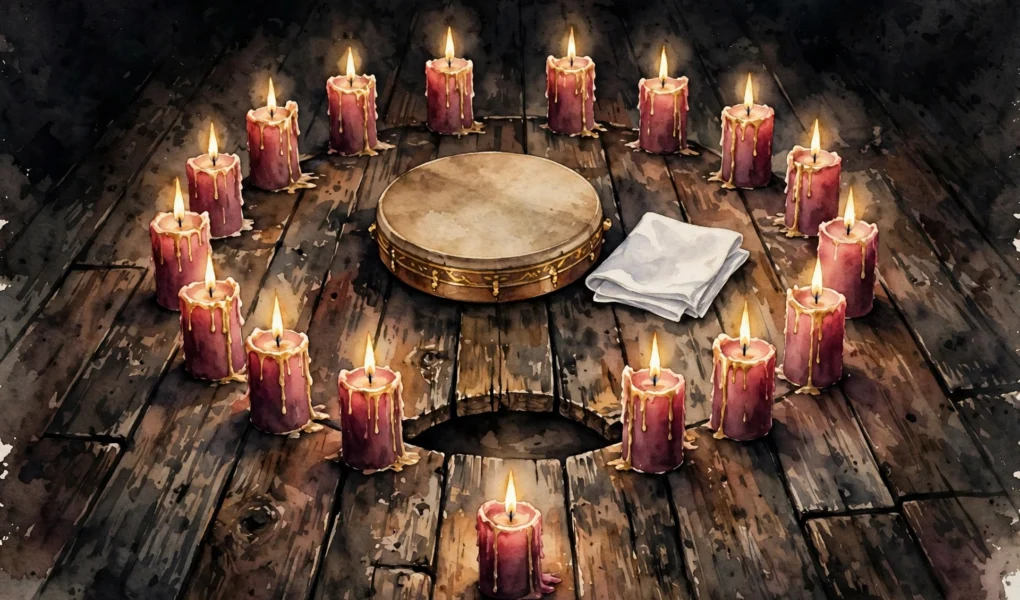
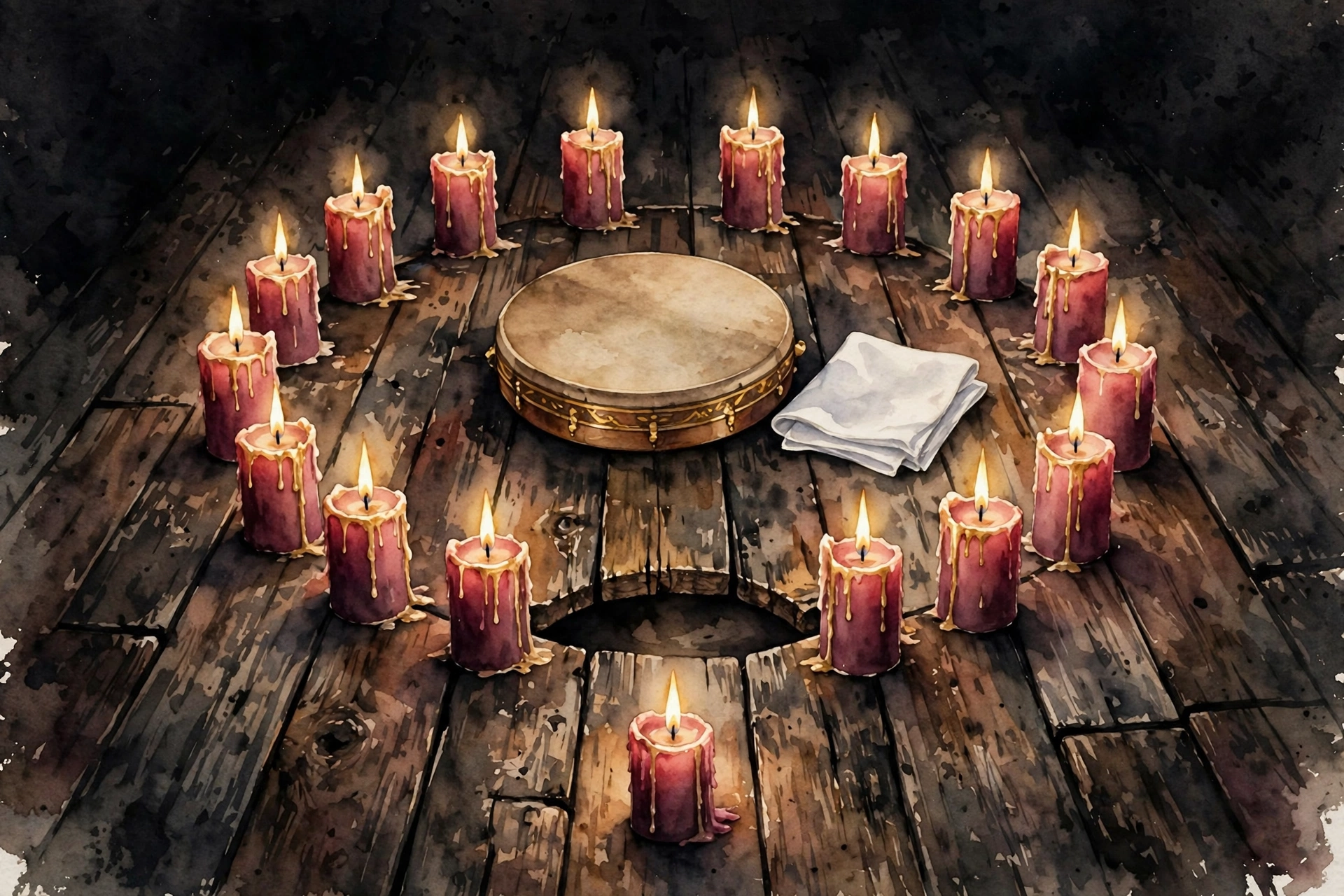
The empty ring in this piece’s image is not a vacancy. It is an invitation with a history: the room is the instrument, the body is the bellows, and the power — the record is consistent across two centuries — rises where it is raised.
Glamour is yours to conjure. — Lakish
From the Altar’s Bookshelf
- Zora Neale Hurston, Mules and Men (1935)
- Albert J. Raboteau, Slave Religion: The “Invisible Institution” in the American South (1978)
- Sterling Stuckey, Slave Culture: Nationalist Theory and the Foundations of Black America (1987)
- William Francis Allen, Charles Pickard Ware, and Lucy McKim Garrison, eds., Slave Songs of the United States (1867)
As an Amazon Associate, Blaq Vixen Beauty earns from qualifying purchases.