This post contains affiliate links. If you buy through them, Blaq Vixen Beauty may earn a small commission at no extra cost to you.
This altar borrows nothing without shelving it honestly, so the shelving comes first.
The chakra system, in the form most modern practitioners meet it — seven seats along the spine, each with its color, rising in rainbow order from root to crown — is a modern system. Its root is genuinely old and genuinely Indian: the Sanskrit texts knew wheels of force in the body long before the West had a word for them. But the bridge that carried the idea to us was built in our grandmothers’ century: Sir John Woodroffe’s The Serpent Power (1919), translating the Sanskrit sources for English readers, and C. W. Leadbeater’s The Chakras (1927), rebuilding the system under Theosophy’s hand. The tidy rainbow order of colors is younger still — a later twentieth-century convention, neat enough to print on a poster. This piece backdates none of it. The framework is not Hoodoo. It is not Vodou. It sits in its own house, labeled with its own history, and the altar’s authority in borrowing it comes from the labeling — not from borrowed antiquity.
And before any framework is borrowed at this altar, the order of the house is kept: consult your benevolent ancestors first. They are the first authority, before any root, any book, any system — including this one.
Two Seats of Seven
Seven seats is a whole map, and a map is not this piece’s business. Glamour’s business is narrower. Of the seven, two govern the glamour’s whole circuit: the crown and the heart.
The crown sits at the top of the head — in the modern system’s grammar, the seat of connection, of consecration, of what a woman is aligned with above her own effort. The heart sits at the center of the chest — the seat of love given and received, of regard that can land as well as radiate.
Hold those two against the vanity and the doctrine writes itself. The crown is what the room meets: presence, carried high, consecrated before it is displayed. The heart is what the room’s answer meets when it comes back. A glamour is a circuit — out through the crown, home through the heart — and a circuit fails at either break. A glamour whose crown is tended and whose heart is closed is a lamp with the door shut: lit, and lighting nothing.
The Crown You Can See
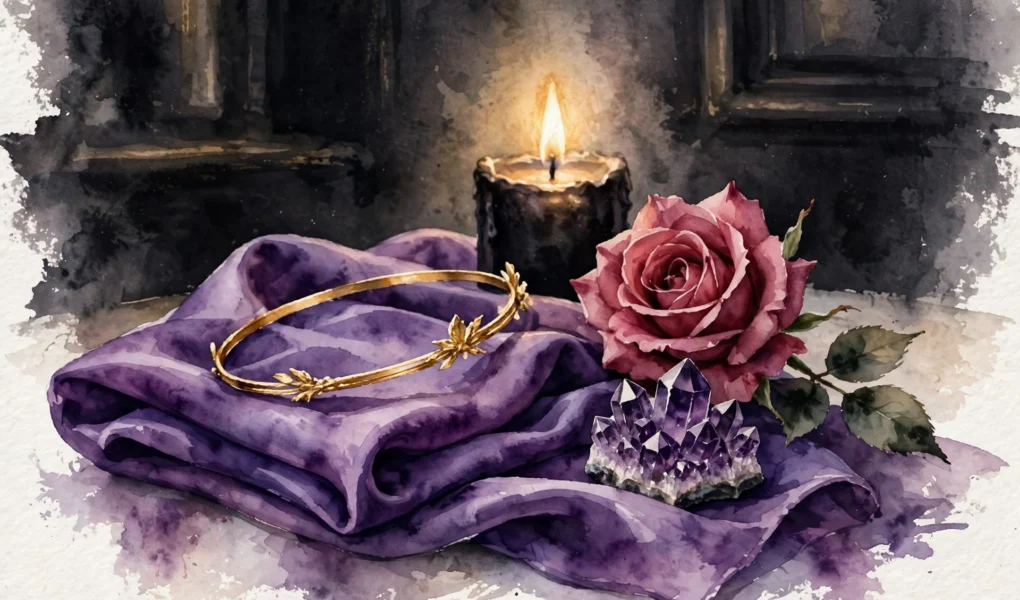
The modern system assigns the crown the color violet — and violet is already at work on this site. In Beauty Is Alchemy, the living violets were named as the shades that understand light, the purple register where glamour stops performing and starts knowing. The altar did not borrow that thread from the chakra map; the thread was already here, in the makeup, waiting for the map to arrive and point at it. That is how honest borrowing works: the framework illuminates what the house already holds. It does not import what the house lacks.
And the crown itself — this altar has never treated it as a metaphor only. The church hat is a crown you can wear. The turban is a crown wound by hand. Hair dressed with intention is a crowning performed at the mirror, daily, by women who understood the seat long before any poster named it. The Dressing Room keeps that whole doctrine in its own room; this piece only marks the correspondence: what the modern system calls the crown seat, the foremothers covered, wrapped, and crowned — on purpose, and in public.
The Heart’s Address
If the crown is glamour’s going out, the heart is its coming home — and the heart is where self-regard actually lives.
The Beauty Jar‘s petition, written in the first person and spoken to the face in the glass, is addressed to this seat whether its writer uses the word or not. So is every act of reception a glamour requires: the compliment that must be let in to nourish, the admiration that curdles when it meets a closed chest, the love that a radiant woman can somehow never manage to keep. The altar’s teaching is plain. Radiance is a skill; reception is a discipline. The crown is dressed at the vanity in minutes. The heart is dressed across a life.
The Working, in the Altar’s Grammar
What this altar does with the two seats is its own modern practice, built on the labeled framework, and it claims no lineage beyond that:
Attention, at both seats, in order. The crown dressed deliberately — hair, hat, wrap, or bare head held like a crown, which is also a dressing. The heart addressed in the mirror work the altar already teaches — the petition spoken, the regard practiced as something received and not merely projected. Breath between the two, because the circuit is a body before it is a symbol.
No initiation is borrowed to say this. No healing is promised by it. The framework is a map; the territory is the woman; the working is hers.
And let the naming be exact, as this altar names everything it keeps. This piece is a map, not a working — but the practice it describes sorts truly, and the sorting matters. The attention kept at both seats is foundational work: alignment, the keeping of the current, named for itself and not dressed in glamour’s name. The mirror petition it leans on is beauty magic, and the Beauty Jar’s own piece says so in its own house. Glamour proper is neither the map nor the maintenance. Glamour is what a tended circuit makes possible out in the room — presence that goes out consecrated, and regard that can come home. The altar does not call the wiring the light.
The Current Between
Crown and heart. Consecration and reception. The glamour is not at either seat — the glamour is the current running between them, out in presence and home in love, around and around, for as long as both ends of the circuit are tended.
Tend the crown. It is the visible half of you, and it deserves its ceremony. Tend the heart. It is the half that decides whether everything the crown draws can stay.
Glamour is yours to conjure. — Lakish
From the Altar’s Bookshelf
- Sir John Woodroffe (as Arthur Avalon), The Serpent Power (1919)
- C. W. Leadbeater, The Chakras (1927)
As an Amazon Associate, Blaq Vixen Beauty earns from qualifying purchases.