This post contains affiliate links. If you buy through them, Blaq Vixen Beauty may earn a small commission at no extra cost to you.
Cleopatra has a witness. Nefertiti has a portrait.
Thirteen centuries before Cleopatra was born, another queen of Egypt sat for the most famous face of the ancient world — and her name was not a name at all. It was an announcement. Nefertiti: “The Beautiful One Has Come.” Imagine carrying that through every doorway of your life. Not a hope, not a wish — a headline, written in advance, that your arrival itself was the event. That is not vanity. That is doctrine, and it is the second pillar this altar stands on: Cleopatra teaches that glamour is presence. Nefertiti teaches that glamour is proclamation.
The Face That Outlived an Empire
Nefertiti was Great Royal Wife to Akhenaten, the heretic pharaoh who overturned Egypt’s ancient gods for the single sun disc, the Aten — and she was no ornament to that revolution. She stood at the center of the new religion, took a throne name of her own — Neferneferuaten, “Beautiful Are the Beautiful Ones of the Aten” — and appears in the art of the reign with a prominence no Egyptian queen had held before her. Some scholars believe she ruled as co-regent; some believe she became pharaoh in her own right after her husband’s death. The record argues about her power. It has never argued about her face.
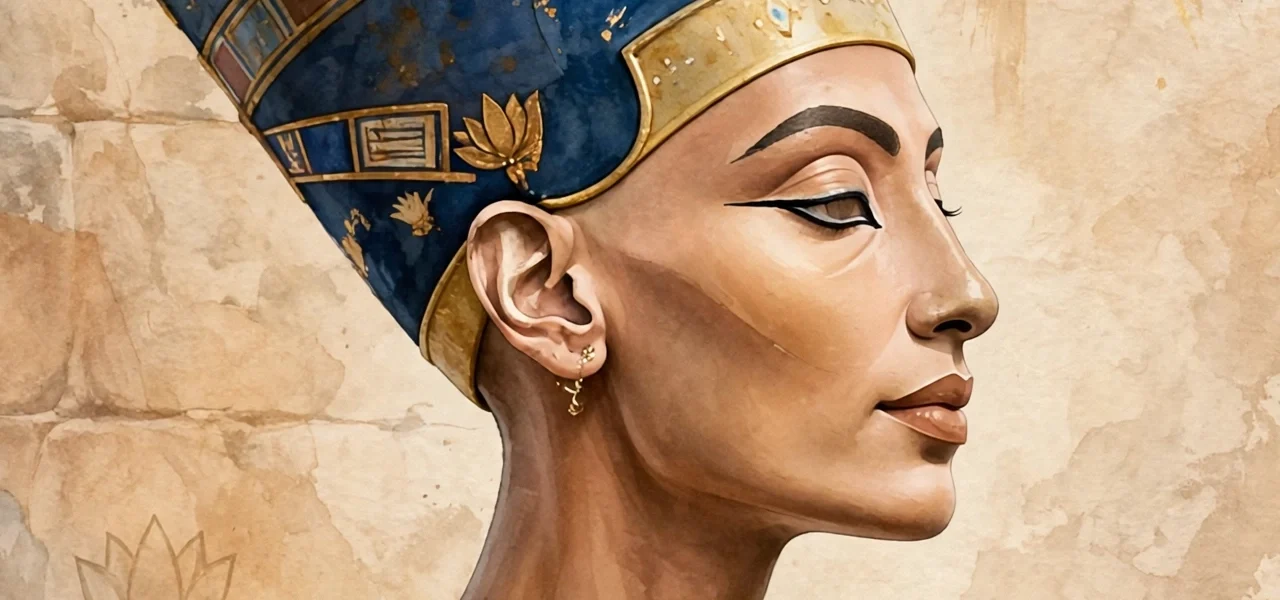
Around 1345 BC, in a workshop in the royal city of Amarna, the sculptor Thutmose carved her in limestone and stucco: the tall blue crown, the long serene neck, one eye inlaid with quartz and set in black-dyed beeswax — kohl, fixed forever — the other eye left blank. The bust was a master’s model, the pattern from which her image would be made. Then the city fell, the court scattered, and the most beautiful face in the world lay face-down in the sand of a ruined studio for more than three thousand years.
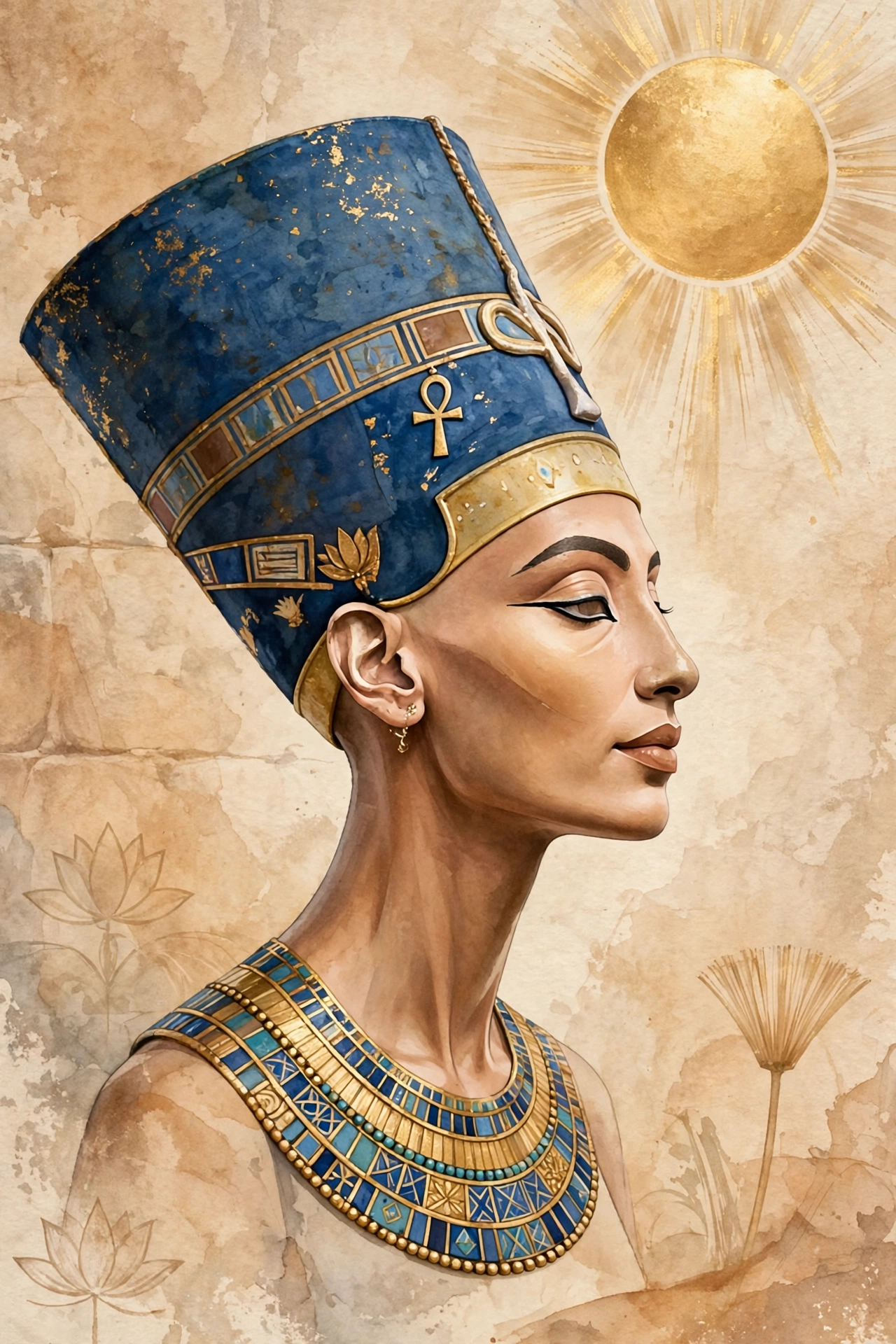
On December 6, 1912, a German excavation dug her out of Thutmose’s workshop. When she finally went on display in Berlin in the 1920s, the public response was so fevered it got its own name — Nefertiti fever. Egypt has asked for her back ever since. She remains in the Neues Museum, still arriving, three millennia later, in every room she enters. The name was not a description. It was a prophecy, and it is still being fulfilled.
What the Bust Is Really Wearing
Look closely at that face the way this altar has taught you to look. The brow is smooth and unhurried. The lips carry the faintest red. And the eye — the one finished eye — is lined and set with a precision any modern hand would recognize. The bust is not a woman caught unawares; it is a woman composed. Every element placed. Nothing accidental. Amarna’s artists worked in a style of unusual naturalism, and still they gave her symmetry like architecture.
That is the Nefertiti lesson, and it is colder and cleaner than Cleopatra’s warmth: glamour can be built. Cleopatra enchanted a room she was standing in; Nefertiti built an image that enchants rooms she will never stand in, for thousands of years, without her. Presence is the living spell. The portrait is the permanent one. Every woman who has ever composed her face with intention — who decided what the world would be given to look at — has worked in Thutmose’s studio.
Her Rites at This Altar
The proclamation. Speak your arrival before you make it. Her name did the work before she entered a single room; choose what yours says about you and let it arrive first.
The composition. Build the face like the bust was built — element by element, nothing accidental, the line drawn to last. This is the rite of the steady hand: kohl, brow, lip, done with the patience of a sculptor who expects the work to be seen in three thousand years.
The stillness. The bust does not strain, plead, or perform. Its power is poise — beauty held so completely it no longer needs to move. Some days the glamour is not the entrance. Some days it is the stillness after it.
Two queens now stand at this altar’s Egyptian door. Cleopatra, who proved a woman need not be the most beautiful in the room to rule it. Nefertiti, who proved a face, truly composed, can rule rooms long after the empire falls. The Beautiful One has come — and by every account, she has never left.
Glamour is yours to conjure. — Lakish