This post contains affiliate links. If you buy through them, Blaq Vixen Beauty may earn a small commission at no extra cost to you.
Source: This post is grounded in 1 Kings 10 (with its parallel in 2 Chronicles 9), quoted here from the public-domain World English Bible. Her Ethiopian name, Makeda, and the story of her son come from Ethiopian tradition — the Kebra Nagast and the tradition that treasures it — and this post labels them as tradition wherever they appear. The historian Josephus is named where his account is used. What the Kings text says and what tradition adds are kept apart throughout, on purpose.
The hook
The most glamorous arrival in the whole Bible belongs to a queen whose face the text never describes.
No verse tells us her eyes, her hair, her skin, her gown. The writer of Kings had every chance to paint her as other women in scripture are painted, and never reached for the brush. He measured her the way courts measure power: by what she carried, by what she asked, and by what she refused to take on anyone else’s word.
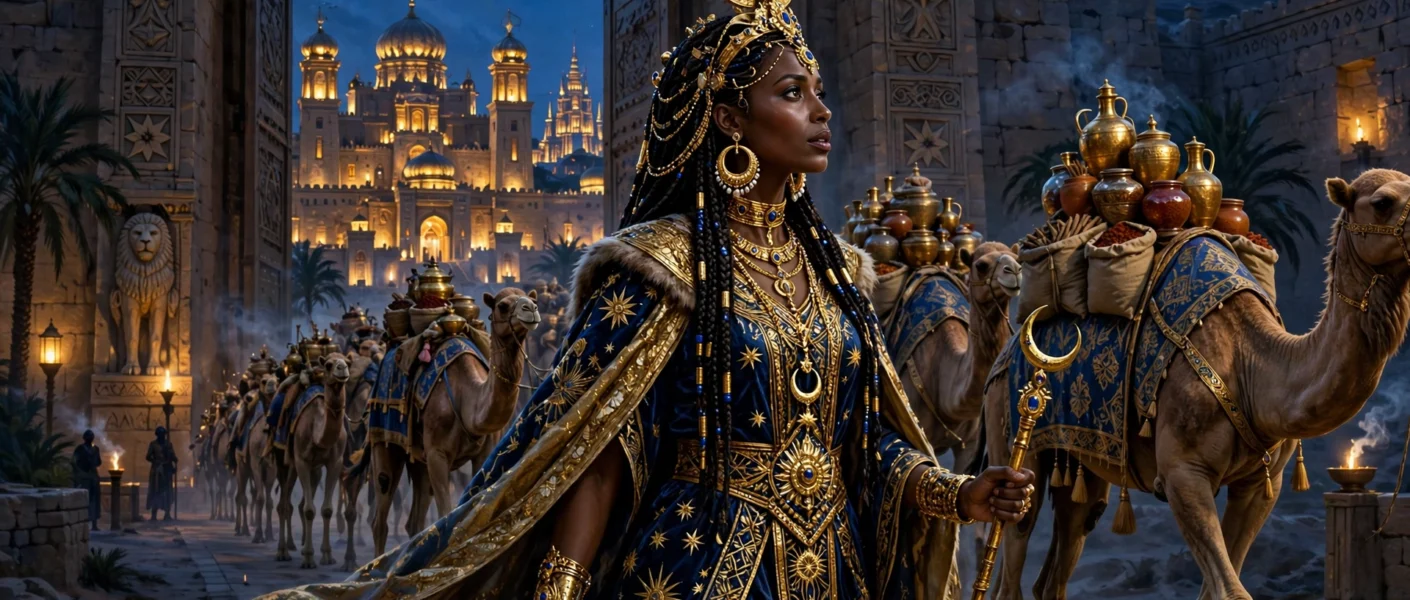
She heard of a king’s wisdom far away, and she did not send for a report. She loaded camels with spices and gold and precious stones, gathered her court, and went to see for herself — carrying hard questions the whole way, like drawn swords in a beautiful sheath.
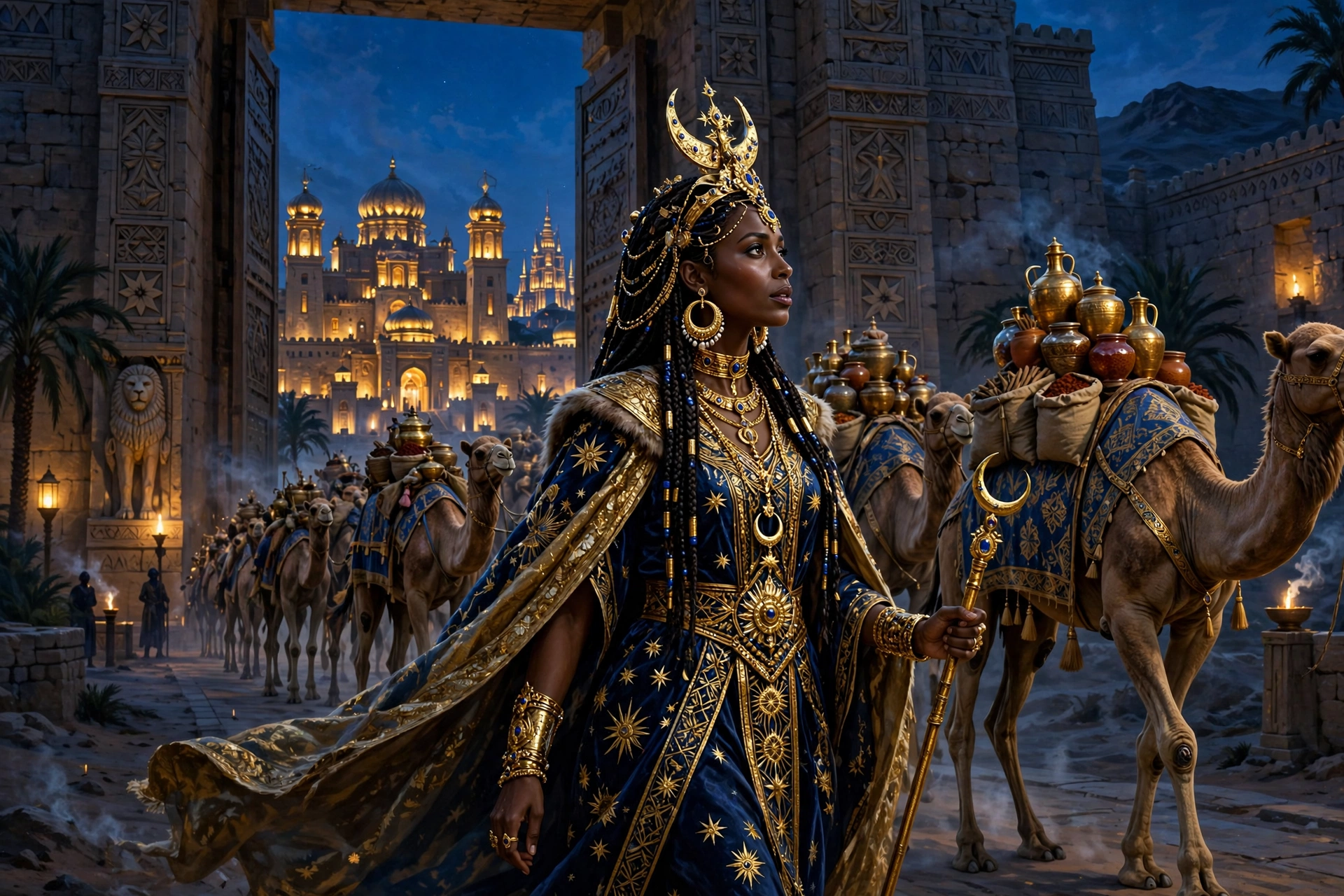
This altar has honored queens at their mirrors and ladies at their waters. Tonight we honor another kind: not the splendor that sits still and waits to be admired, but the splendor that traveled — that heard of something excellent, prepared its cargo, and crossed the world to stand in its presence and test it.
Her name in the text is simply her title: the Queen of Sheba. Come and watch her arrive.
The record
The account is one chapter long and wastes nothing. “When the queen of Sheba heard of the fame of Solomon concerning the name of Yahweh, she came to test him with hard questions” (1 Kings 10:1, WEB). Note the verb: she did not come to admire him, or petition him, or be presented to him. She came to test him — the initiative hers from first line to last.
She “came to Jerusalem with a very great retinue, and with camels that bore spices, and a very great quantity of gold, and precious stones; and when she had come to Solomon, she spoke with him of all that was in her heart” (10:2). All that was in her heart — the text insists on it. This was no audience of pleasantries over the gifts. She unloaded her questions the way her servants unloaded the camels: completely, holding nothing back — and Solomon answered every one.
Then came the moment the whole chapter bends toward. She toured his kingdom — the wisdom, the house he had built, the food of his table, his servants in their clothing, the ascent by which he went up to the house of the Lord — “and there was no more spirit in her” (10:4–5). The Hebrew picture is of breath taken clean away. A queen who had crossed the desert so she could not be fooled stood amid the evidence, for one honest moment undone by it.
And she said so to his face, in the sentence this altar would carve over its door: “I didn’t believe the words until I came and my eyes had seen it, and behold, the half was not told me” (10:7). She had believed nothing on credit. She came, she saw, and only then did she render her verdict — and her verdict was that the reports had understated the truth.
The exchange that followed was gift for gift, throne to throne. “She gave the king one hundred twenty talents of gold, and of spices a very great quantity, and precious stones” — and the writer stops to marvel: “never again did such abundance of spices come” as what the Queen of Sheba gave (10:10). Then the record closes the way it opened, with her agency intact: Solomon “gave to the queen of Sheba all her desire, whatever she asked,” and “she turned, and went to her own land, she and her servants” (10:13). She came summoned by no one, left when she was ready; no one in the chapter ever tells her to do anything.
Centuries later, Jesus himself reached back for her as the standard: the “queen of the South” who “came from the ends of the earth to hear the wisdom of Solomon” (Matthew 12:42). In his mouth she is no curiosity and no romance. She is the example: the one who traveled for wisdom while others beside it would not move.
Makeda
Everything in the section above is the Kings text. What follows in this section is Ethiopian tradition, and this altar names it as such with love and without apology, because a tradition treasured for centuries is its own kind of record — simply not the same record, and the two must not be blurred.
In the Kebra Nagast — the “Glory of the Kings,” Ethiopia’s great national epic — the Queen of Sheba has a name: Makeda, queen of Ethiopia. The tradition tells her journey in full: how she heard of Solomon’s wisdom from a merchant of her own court, resolved to go and see him, and tested him as he tested her in return; and how their union gave her a son, Menelik, who, in the tradition’s telling, carried the Ark of the Covenant home to Ethiopia and founded its imperial line. In Ethiopia she is no visiting dignitary in somebody else’s story, but a founding mother of the nation, whose journey is the hinge of its sacred history.
The historian Josephus, writing in the first century, also calls her a queen of Egypt and Ethiopia. And in the centuries after, other traditions kept retelling her: the romance that blooms in some of those retellings belongs to them, to the centuries after the text, and this altar leaves it there.
Hold the two the way this altar always asks: in the Kings text she is unnamed and sovereign; in Ethiopian tradition she is Makeda, mother of kings. Both are honored here; neither is dressed up as the other.
The honest mirror
Now the honesty this post owes you: a reader could come to the Queen of Sheba looking for one thing and be handed something else — and the something else is better.
The Kings account never describes her beauty. Not once. It never makes her a prize to be won, a bride to be chosen, or a temptation to be survived — the three costumes so often handed to women who enter a king’s court. She is none of those things in this text. She is a sovereign conducting statecraft.
Watch what she does across one short chapter. She hears a report and refuses to credit it. She tests the most celebrated mind of her age with hard questions and stays until every one is answered. She verifies with her own eyes — the house, the table, the court, the worship — and only then renders judgment to the king’s face. She trades gift for gift as an equal, giving treasure the chronicler had never seen matched. And when she has what she came for, she turns and goes home, laden and satisfied, on no one’s schedule but her own.
If you came looking for a beauty queen, the text declines to give you one. It hands you something rarer and more useful: a queen whose glamour is intellect, wealth, and initiative — a woman whose presence was so complete that the record keepers wrote down her cargo and her questions and never once thought to describe her face.
Her glamour teaching
So what does she teach this altar about glamour? Everything the parlour and the deep could not, because her glamour never sat down.
Splendor that travels. Every other lady on this altar is met in her place — Freda at her toilette, La Sirène at her waters, Oxum at her river. Sheba is met on the road. Her presence was not a room she kept; it was a force she moved. She heard of something excellent in a far country and went to it in state, her whole court rolling behind her. There is a glamour that waits to be discovered, and there is a glamour that does the discovering. Hers was the second kind.
Questions as regalia. She is the only figure in the chapter who asks anything. Solomon answers; Solomon explains; Solomon gives. She inquires — and the text treats her hard questions not as impertinence but as the whole purpose of the visit. This altar has said that glamour is regard — how you see, and how you are seen. Sheba adds the other half. She would not be told how to see. She asked until she could see for herself.
Cargo as language. Do not mistake her spices for decoration. One hundred twenty talents of gold and a flood of aromatics no chronicler had ever seen equaled — that was diplomacy conducted in the grammar of wealth, a sovereign announcing, before she spoke a word, what her kingdom was worth. Her preparation was her presentation: she did not arrive and then become impressive — she arrived impressive because she had prepared to be.
Departure as dignity. When it was done, she left — with everything she asked for, on her own terms, her sovereignty undiminished by the most splendid court on earth. Her glamour includes the exit. She never dissolved into Solomon’s story. She completed her own and went home inside it.
For us
What does the queen who traveled hand to a Black woman at her own mirror, all these centuries later?
That your regard runs in both directions. This altar has taught you to practice how the world sees you — and Sheba teaches the complement: practice what you go and see. Hear of something excellent — a teacher, a city, a craft, a truth — and do not settle for the report of it. Load what you have, prepare your questions, and go stand in its presence yourself. A woman who verifies with her own eyes cannot be sold a smaller life by somebody else’s telling.
That your questions are not a lack in you. She arrived at the wisest court on earth carrying hard questions, and the text honors it, not as ignorance. Bring yours the same way — prepared, unembarrassed, and unwilling to leave until they are answered.
And that your splendor is allowed to be the moving kind. Not every season of a woman’s life is the parlour season, the tending and the anointing. Some seasons are the road: the journey undertaken in state, the gift carried at cost, the verdict rendered in your own voice, the turning for home when the work is done — laden, satisfied, and still entirely your own.
Cautions
Text and tradition are both honored — and never blurred. In the Kings account she is the unnamed Queen of Sheba, and everything this post quotes is from that account. Makeda, her son Menelik, and the Ark’s journey to Ethiopia belong to Ethiopian tradition, which treasures them — labeled here as tradition every time, and to be carried with respect for the people whose memory they are.
There is no romance in the Kings text, and this altar will not invent one. She was not courted, chosen, or won in 1 Kings 10. She came, she tested, she exchanged, she departed. Later traditions told other stories, and those stories are theirs; the text this post stands on tells of two sovereigns, splendid enough without a love plot laid over it.
Her wealth is the text’s record, not a prosperity promise. The gold and spices of 1 Kings 10 are the chronicler’s account of one queen’s statecraft — not a formula, and not a promise that splendor will make riches come. This post teaches presence: preparation, inquiry, and self-possession. What she carried home was not a method. It was everything she asked for, because she had the standing to ask.
She heard of glory she had not seen, and she would not believe it secondhand. So she loaded the camels, gathered her court, crossed the ends of the earth with her questions drawn — and when she stood in the middle of the evidence, breathless, she told the wisest man alive the truth: the half was not told me.
Go and see for yourself, sister. Carry your questions like regalia. Let your splendor be the kind that travels.
Glamour is yours to conjure. — Lakish