This post contains affiliate links. If you buy through them, Blaq Vixen Beauty may earn a small commission at no extra cost to you.
Source: Kelly E. Hayes, Holy Harlots: Femininity, Sexuality, and Black Magic in Brazil (2011) and “Wicked Women and Femmes Fatales,” History of Religions (2008); Marlyse Meyer, Maria Padilha e toda a sua quadrilha (1993); Reginaldo Prandi, as carried in the practitioner record; Blanchette, da Silva & De Lisio, “‘Pomba Gira Keeps an Eye on Us’,” Studia Religiologica (2018); the practitioner archives of Joia Mística Laroyê and Chaos Society. What follows is an account of how Maria Padilha is served, drawn from those records — an homage, not an initiation.
The hook
You will hear her before you see her.
In the terreiros of Brazil, when Pomba Gira arrives, she announces herself with a laugh — the gargalhada, a throaty, unladylike cackle that rolls through the room and tells everyone present that the Queen of the Crossroads has come down to hold court. She takes her cigarette. She takes her drink. She adjusts herself like a woman who has never once, in any century, apologized for wanting what she wants.
And of all her names — and she has many — the greatest belongs to a woman who was once flesh: a Castilian noblewoman who ruled a king, died in 1361, and was still being called upon by women four hundred years later, in another hemisphere, in another language, by women who needed exactly what she had been: desired beyond reason, and sovereign in it.
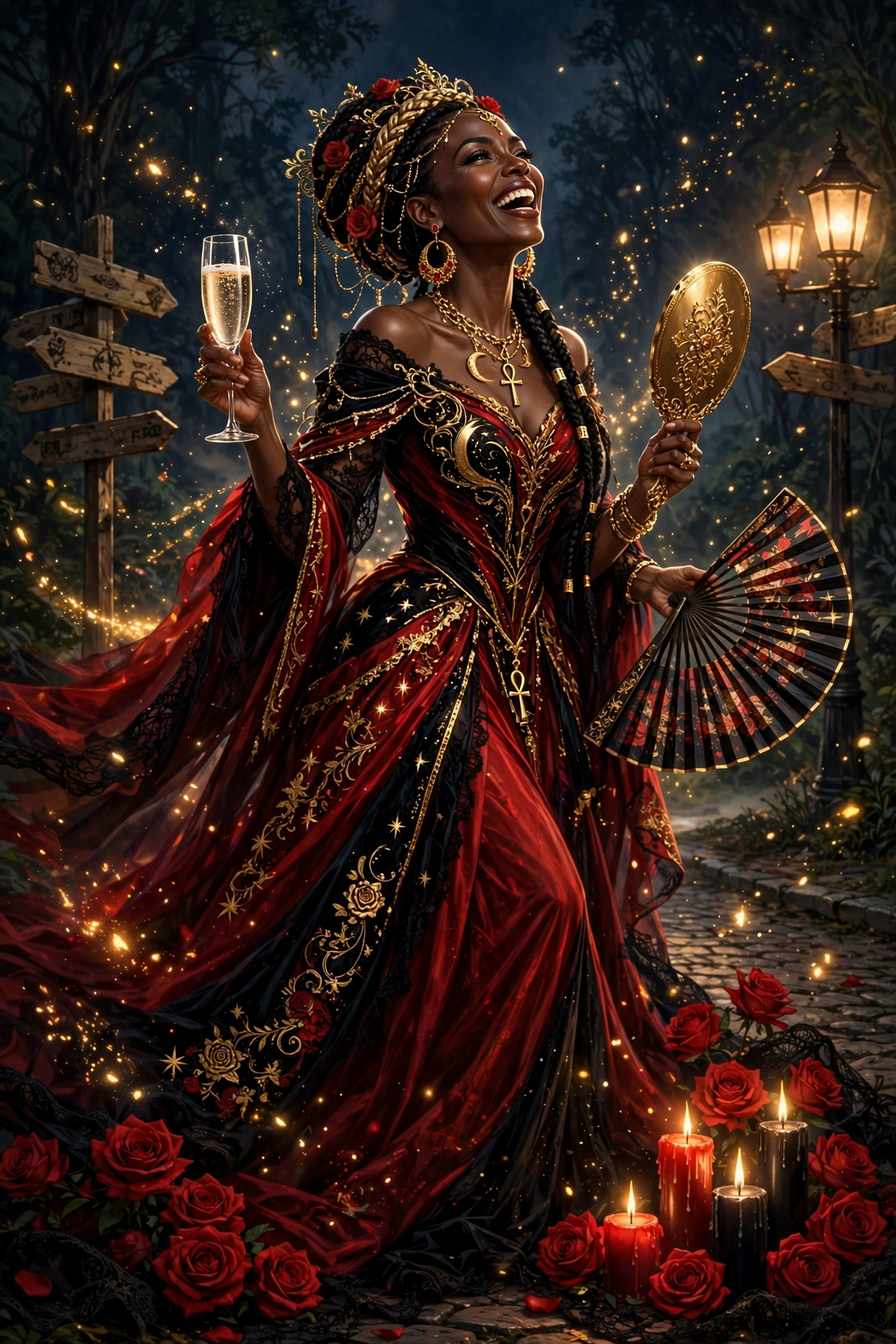
Her name is Maria Padilha. This is her court. This is how she is served.
The record
First, the house she reigns in. Pomba Gira is not one spirit but a class of female spirit entities in the Afro-Brazilian religions of Umbanda and Quimbanda — the female form, the counterpart, of Exu, lord of the crossroads. The scholar Kelly E. Hayes, who studied her world in Rio de Janeiro and wrote Holy Harlots, describes how she is recognized: by her distinctive gargalhada, her brazen manner, her appetite for cigarettes and strong drink, her statues voluptuous in red, sometimes brandishing a trident. Her titles accumulate like the rooms of a palace: Sovereign of the Cemetery, Queen of the Crossroads, Mistress of the Night.
What does she do? Hayes puts it plainly: she specializes in resolving intimate questions of love, erotic attraction, money, and power — attracting and keeping a lover, and the whole tangled weather of desire. And she is not commanded. She must be persuaded, with flattery and with gifts — most especially, Hayes writes, items that gratify her vanity or satisfy her vices: sweet wine, cigarettes, perfume, jewelry. Sit with that economy for a moment: a spirit whose worship runs on the very things respectable religion calls women’s sins — adornment, appetite, pleasure — offered up not as shame but as tribute.
Her name tells her story. Pomba Gira descends from Pambu Njila, the Bantu nkisi of the crossroads in Angola-nation Candomblé, carried through Bombogira into Portuguese mouths — a lineage the anthropologist Stefania Capone has traced. But Hayes is clear, and this altar will be clear with her: Pomba Gira is a New World creation, not a traditional African deity transplanted whole. She was made in Brazil, by the people who needed her. That is not a lesser pedigree. On this altar, it is a familiar one.
The queen’s own story
Now the woman herself, because her road to the crossroads runs through a throne room.
María de Padilla lived from 1334 to 1361. She was the mistress of Pedro I of Castile — and “mistress” does her a smallness the record does not support: after her death, Pedro declared her his legitimate wife, and she was honored as a queen. In life she was understood to hold the king’s heart entirely; after death came the slander that comes for such women — she was whispered to be a witch. The woman who ruled a king must have used something, the story goes. She had. It was herself.
Here is where the record turns to gold. The scholar Marlyse Meyer, in Maria Padilha e toda a sua quadrilha (1993), traced what happened to that name. In Portuguese Inquisition trials, women appear again and again calling on “Maria Padilha and all her band” — invoking her, by name, to bind a lover. Laura de Mello e Souza found the same invocations in colonial Brazil. Read that slowly: women in trouble with the most feared tribunal of their age, risking everything, spending their courage on a prayer to a dead king’s beloved — because she was the one who had held a man’s heart completely, and they wanted what she had had.
The prayers crossed the ocean with the women who prayed them. And in the twentieth century, in the terreiros of Brazil, María de Padilla rose again as Maria Padilha — a queen among the pombagiras, first among the ladies of the left-hand line. The name came from Spain. The spirit is a genuinely Brazilian construction: a European queen’s beloved, carried in the mouths of accused women, crowned at last by Black Brazil. She has been, at every step of that road, women’s — prayed to by women, carried by women, crowned by women.
One honesty this altar owes you: Hayes’s great ethnography, Holy Harlots, walks beside a particular devotee — Nazaré da Silva, a woman of the favelas — and the pombagira at the center of her story is Maria Molambo of the Seven Catacombs, not Padilha. The scholarly frame here is Hayes’s; Padilha’s own legend comes down through Meyer’s history and the practitioner record. This blog does not blur the two to borrow authority it has not earned.
The toilette of the crossroads
Her colors are red and black — the red of roses and blood and lipstick, the black of the night she mistresses. Her day is Monday or Friday night, varying by terreiro, because houses differ and hers are no exception. Her greeting is Laroyê.
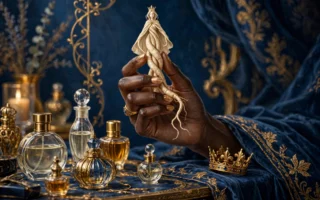
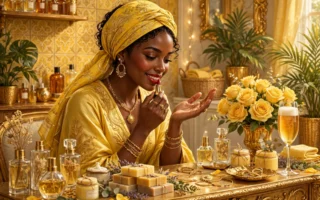
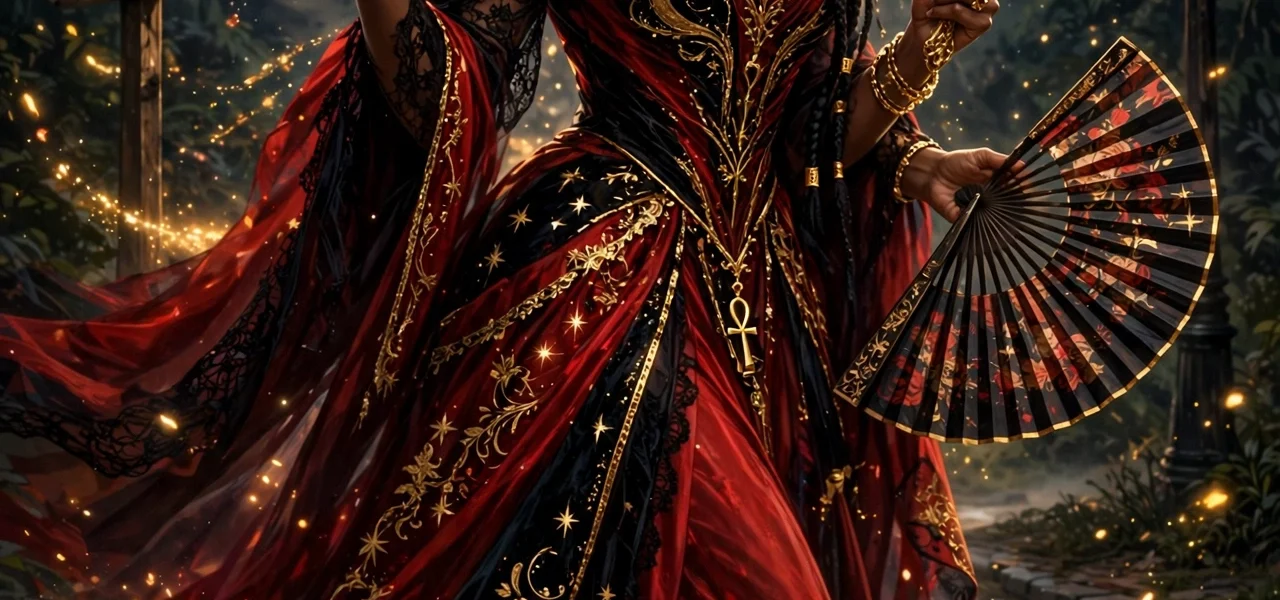
What is laid out for her, as the practitioner record consistently gives it: red roses. Champagne, sparkling in the glass. Perfume. A mirror. A fan. Jewelry. Cosmetics. A cigarette. Red candles, and black. It is a toilette, as surely as Freda’s pink table is a toilette — but where the parlour spirit takes pastel and tears, the queen of the crossroads takes scarlet and laughter. The mirror is here too, sister. On every altar this Grimoire has visited, the mirror is here. The spirits of glamour, in every tradition the diaspora built, are given the instrument of self-regard — because self-regard, in their keeping, is not a weakness of women. It is one of the powers of women.
And her food has a name and a recipe the record does give: the padê. The sociologist Reginaldo Prandi documents what she is gifted — the things she uses in the terreiro when she comes down: red and black fabrics, perfumes, jewelry, champagne, a cigarette, and open red roses, with candles red, black, and sometimes white. Her padê itself is cassava farofa with honey — where Exu’s takes dendê and pepper, hers takes sweetness. The roses laid for her are almost open and without thorns; the bud, the record says, symbolizes purity, and the thorn is not offered to her. Place matters as much as substance: the T-shaped crossroads are Pomba Gira’s; the open crossroads, the crossing of two full roads, belongs to Exu. Her brother keeps the cross. She keeps the turning.
Two disciplines of the record must stand beside the beauty of it. First: in present-day Brazil, the guidance around street offerings has grown careful — devotees are counseled to return and collect the bottles, the candles, the dishes afterward, because glass and paraffin left in the street have become a genuine conflict with the cities her people live in. Reverence, in her living tradition, now includes cleaning up after your own devotion. Second, and above all: in the gira, Pomba Gira herself says what she wants, and the devotee checks with the pai de santo. The step-by-step of her workings is terreiro foundation. It is learned in a house, from those responsible for the house. It is not open text, and this blog will not pretend otherwise.
And one item you will meet everywhere except the record: the famous bath — champagne poured over rose petals, perfume, honey — circulates endlessly on popular spell sites under her name. Let this altar name it exactly: that formula is commercial blog material. No scholarly or terreiro source retrieved for this post gives a Pomba Gira bath. What the houses hold, the houses hold. What the internet sells, it sells. They are not the same shelf.
The honest mirror
Why does she matter enough to fill a Grimoire page? Because of who has always come to her.
Hayes centers her ethnography on a favela devotee facing gender violence — a woman the world gave very little power, who found in Pomba Gira a power that answered her. Women consult her, the record says, and find strength against domestic violence and abandonment. And in 2018, scholars Blanchette, da Silva, and De Lisio published what they found in Rio’s brothels: Pomba Gira devotion alive among the women who work there, functioning as what they call a counter-hegemonic spirituality — one that protects women involved in the sale of sex. She keeps an eye on them. That is the title of their study, and it is the truest sentence ever written about her: Pomba Gira keeps an eye on us.
This altar has stood at this crossroads before. Cleo May taught us that the women respectable history called ruined were building glamour as armor and livelihood both. Maria Padilha is their patroness in the fullest sense — not a metaphor for working women, but a spirit working women have actually prayed to, in actual danger, for actual protection, for generations. She is served with the same respect here: her devotees’ labor and peril are the record, never decoration.
Against that stands the other Maria, the one Brazil’s pop culture made. Hayes herself documents the flattening: Pomba Gira is recognized far outside the terreiros — in telenovelas, literature, cinema, popular music, street slang — where she shrinks into the quintessential femme fatale, femininity’s dark side in a red dress. The femme fatale is a costume. The spirit is a sovereign: a queen who takes petitions from women with few other courts to appeal to, who must be persuaded and never commanded, who laughs out loud in a world that prefers its women quiet.
For us
What does the Queen of the Crossroads say to a Black woman at her own mirror?
That desire is not a disqualification. Every altar before hers agreed, but she says it loudest and laughing: the wanting — for love, for money, for power, for the room’s eyes — is not the shameful part of a woman. It is, in her court, the petition itself, and it deserves champagne.
That sweetness is a strategy and a standard. Her padê takes honey where her brother’s takes pepper. She is persuaded, flattered, gifted — never ordered, never rushed, never taken for granted. There are women who needed four hundred years of other women praying to learn to be approached that way. Be approached that way.
And that somebody is keeping an eye on you. The women in the brothels of Rio, the woman in the favela, the women before the Inquisition with a dead queen’s name in their mouths — they built, between them, a court where a woman with nothing could still file her petition and be heard by a queen. The crossroads at midnight is not a lonely place in her tradition. It is where the court is in session.
Cautions
Homage, not initiation. Quimbanda is a living, initiation-based, house-held tradition, transmitted in terreiros under those responsible for each house. What is written here is respectful homage drawn from the published record — scholars and practitioner archives. This blog initiates no one, and her workings are learned where they have always been learned: in a house.
She is a spirit, not a self-help character. Not an aesthetic, not a mood, not a synonym for a confident woman, and — the tradition’s own teachers insist — not Lilith, not Venus, not anyone else in a red dress. She is Maria Padilha, of a specific people, a specific history, a specific court. Borrow her image without her record and you have taken the costume and left the queen.
Her table involves alcohol and cigarettes, as the record gives them. They are documented here because they are hers, not as a recommendation. Honour at your own table is yours to shape; the record is the record.
On Monday and Friday nights, in terreiros across Brazil, a laugh rolls through the room in red and black, and the women who have always been told to want less bring their petitions to a queen who never wanted less in her life. Four hundred years ago they whispered her name to a tribunal. Tonight they pour her champagne in the open. The name crossed an ocean in women’s mouths and arrived crowned.
Stand at your crossroads like you own the turning, sister. Pour something sparkling. Let them hear you laugh.
Glamour is yours to conjure. — Lakish