This post contains affiliate links. If you buy through them, Blaq Vixen Beauty may earn a small commission at no extra cost to you.
Source: Kyrah Malika Daniels, “The Coolness of Cleansing,” ReVista (Harvard DRCLAS); Elizabeth McAlister, “Sacred Waters of Haitian Vodou,” in Sacred Waters (Routledge, 2020); the Saut-d’Eau record as carried in the Encyclopedia of African Religion and the pilgrimage’s documented history; practitioner and commercial sources named in the body where they are used. What follows is an account of what the record holds — an homage, not an initiation, and not a recipe.
The hook
Every July, in the hills of Haiti, the water falls out of the rock and the people come to stand under it.
They come by the thousands to a waterfall called Saut-d’Eau — Sodo, the falls — and they do not come to look at it. They come to get in it: to bathe beneath the cascade, to be soaked through and prayed over, to tie their ribbons to the trees and leave their misfortune hanging there when they climb back down. It is one of the great pilgrimages of the Black Atlantic, and at its center is the simplest instrument in all of Vodou: water, made sacred, and a body standing in it on purpose.
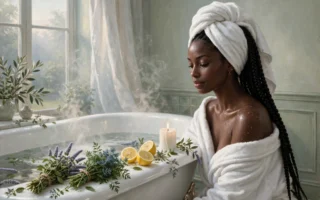
This altar has already taken one bath in public — the hyssop uncrossing bath of the Hoodoo tradition, printed here in full, the way Hoodoo prints its work. Tonight we turn to Vodou’s waters, and we meet something different: a bath tradition just as old, just as powerful, whose recipes are kept. Not lost. Not missing. Kept — by houses, by elders, by the people to whom they belong. This post will tell you what the baths are, what the waters mean, and why the keeping is itself part of the teaching.
The system
Begin with what the scholarship documents plainly, because the system is not secret even where the recipes are.

Kyrah Malika Daniels, writing for Harvard’s ReVista, describes the Vodou ritual bath as a joining of consecrated waters, blessed liquids and oils, and medicinal plants — flower blossoms, herbs, and leaves — worked for deliverance, for healing, for good fortune, for protection. And she sets down the law that governs every bath in the tradition without exception: all sacred baths must be accompanied by prayer, intentionality, and ritual action. A Vodou bath is never water alone. It is water addressed — spoken over, intended, enacted. Strip the prayer out of it and you do not have a simpler bath. You have no bath at all.
The forms vary. There are leaf baths. There is cleansing by smoke. There is the bath the record calls the white bath: a bath of white flower petals, taken to establish balance and restore harmony in relationships — white for cooling, white for peace, the temperature of the spirit brought down to where it can rest. Parsley appears in the record as a leaf that removes negative energy. Elizabeth McAlister, whose scholarship on Haiti’s sacred waters anchors this post, describes the baths simply: water “with added herbs and other strengthening agents.” Strengthening. Hold that word. The Vodou bath is not primarily about taking something off, the way the uncrossing bath is. It is about putting something in — strength, fortune, balance, the coolness Daniels names in her title — restoring a person to the condition in which the spirits can reach them and luck can find them.
That is the system, and it is documented, and this altar can set it before you whole.
The falls
Saut-d’Eau is the bath written at the scale of a nation.
The falls, by the documented history, were created by the earthquake of 1842, when the earth moved and the water found its new road down the rock. In 1849, an apparition of the Virgin was reported there, and the place became doubly holy — for the pilgrimage that gathers each July is a Catholic and Vodou pilgrimage at once, twined around the July 16 feast of Our Lady of Mount Carmel, the Vièj Mirak, the Miracle Virgin. The two faiths do not take turns at Sodo. They stand in the same water.
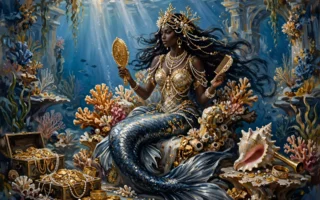
And the water has its own court. McAlister’s record names the lwa of these waters: Danbala Wèdo and Ayida Wèdo, the ancient serpent and his rainbow wife; Simbi Dlo, spirit of the fresh waters; and Lasirèn — La Sirène, whose toilette this altar has already honored, the queen who keeps the realm anba dlo, under the water, where the spirits and the ancestors dwell. To bathe at Saut-d’Eau is to enter her country standing up.
So the pilgrims bathe under the falls — for healing, for deliverance, in hope of possession, that the lwa might come down in the water as they do in the peristyle. And they tie ribbons to the trees at the falls, blue and pink, the colours of Ezili and of the Virgin both, each ribbon a vessel: disease tied off, misfortune tied off, left hanging in the branches when the pilgrim descends, so that what was carried up the mountain soaking wet does not come back down it dry and unchanged.
Whose feast is it, finally — Freda’s or Dantò’s? Here the record itself splits: one reference gives the falls to Ezili Freda; another gives them to Ezili Dantò. This altar will not settle what the sources leave open. Houses differ, regions differ, and the falls are large enough — in every sense — for the disagreement to stand in print exactly as it stands in the tradition.
The kept recipes
Now the honest center of this post, and this altar will not dress it up.
You will search the scholarship in vain for a Vodou beauty bath you can run at home, because it is not there. What circulates under names like Bain de Chance, the luck bath, lives at the level of commerce and community: practitioners describe a bath taken once a year, at the turning of the year, built from many perfumes, oils, and powders, costly and fine, its preparation varying by region of Haiti — and no authoritative source, scholarly or house, publishes what is in it. Where a named bath is sold — one well-known house’s pink bath for Erzulie Freda is a trademarked kit — its contents are, by the seller’s own presentation, undisclosed.
Read that the right way. This is not a gap in the research. It is the shape of the tradition. Vodou is an initiated religion, house by house, elder to student, and a bath in Vodou is not a cosmetic preparation with a prayer sprinkled over it — it is a rite, compounded for a person, for a condition, for a spirit, by hands trained to compound it. Daniels’ law holds at every level: no prayer, no bath. And prayer, in a house tradition, is not a paragraph this blog can hand you. One house’s published protocol for serving Freda says the quiet part out loud, and this altar quotes it with respect: the bath taken before her service, in waters infused with sacred herbs, flowers, milk, perfumes, and prayers, is “not for beauty — for spiritual rebirth.”
Sit with that sentence, because it corrects something in us. We came to these waters, some of us, looking for the beauty bath — the recipe, the list, the shine. The tradition answers: the bath is not for beauty. The bath is for rebirth. What it restores is not the surface. It is the person.
The contrast at this altar
This blog has stood at two tubs now, and the difference between them is a lesson in how Black traditions keep their knowledge.
Hoodoo printed its bath. The hyssop uncrossing bath lives in psalm and Sea Island record, carried in books and working papers meant to travel, and this altar set it before you step by step. Vodou keeps its baths. The system is public; the compounding is house knowledge, earned in service, given in person. Neither way is a failure of the other. They are two sovereignties, two answers to the same question of who knowledge belongs to — and a blog that honors the printed tradition by printing it must honor the kept tradition by not prying it open.
So this post hands you no recipe, and that is not the post failing you. That is the post keeping faith. What it can hand you is true and it is enough: the knowledge that these baths exist, what they are for, whose waters they are, and where — every July, under a waterfall in Haiti — you can watch a whole people step into them together.
For us
What does a kept bath say to a Black woman at her own mirror?
That not everything sacred is content. Some of what heals us was never meant to be transferable — it is meant to be entered: in a house, in a community, under hands that know your name. The pilgrims at Saut-d’Eau do not bathe alone with a printout. They bathe in a crowd of their people, under a falls, in a country where the water itself is somebody’s mother, somebody’s queen.
And it says that rebirth outranks beauty, in the tradition’s own words. The white bath restores harmony. The falls wash off misfortune and tie it to a tree. The bath before Freda is for being born again, not for being looked at. If the shine comes — and at this altar we believe it does — it comes the way it comes at Sodo: as the overflow of a person restored to herself, standing in sacred water, among her spirits and her people, made strong first and radiant as a consequence.
Anba dlo — under the water — is where La Sirène keeps her court and where the ancestors dwell. The baths of Vodou are how the living visit that country and come back carrying its coolness on their skin. That is the teaching. It was never the ingredient list.
Cautions
Homage, not initiation. Vodou is a living, initiation-based religion. This post is an account of what the published record holds about its baths and its great pilgrimage — practitioner houses, initiated scholars, documented history. It teaches no rite, compounds no bath, and initiates no one. Formal service belongs in a house, under a manbo or an oungan.
Do not blend houses. The falls’ own attribution stands split in the sources, and this post has left it split. Where houses and regions differ — in baths, in colours, in whose feast a day is — the difference is the record. Keep each house’s way whole.
Beware the recipe for sale. Any source that offers you a complete, authentic Vodou beauty bath in a list is selling you something the tradition itself has not published. The named baths that circulate commercially are named honestly here as commercial — kits with undisclosed contents and luck baths described but never disclosed. Let the absence instruct you rather than send you shopping for a substitute.
The falls are a pilgrimage, not a backdrop. Saut-d’Eau is a living sacred site where Haitians go to heal. It is honored here as what it is — a place of prayer under falling water — and not as scenery for anyone’s aesthetic.
Every July the water falls out of the rock at Sodo, and the ribbons go up in the trees, blue and pink, and the people come down the mountain lighter than they climbed it. The baths are real. The waters are kept. And the coolness Daniels names — that balance, that restored harmony — is carried home the old way: on the skin, in the body, by people who stood in the water together and meant it.
Go down to the water when your tradition calls you, sister. And where the recipes are kept, let them be kept — some doors in the house of the spirits open only from the inside, and honoring that is its own kind of devotion.
Glamour is yours to conjure. — Lakish