This post contains affiliate links. If you buy through them, Blaq Vixen Beauty may earn a small commission at no extra cost to you.
This altar already keeps one jar, and you have met it. The Honey Jar: Sweetening, Slow and Sure teaches the oldest grammar in the jar family — a sweet medium, a written petition, a candle fed on the sealed lid in weekly sittings — aimed outward, at the regard of bosses and rooms and households.
This jar is not that jar.
The honey jar works on the eyes of the room. This jar works on the eyes in the mirror. They are cousins, not twins: same grammar, opposite direction, and a reader who keeps them in one house will muddle both. Keep them separate. This piece keeps them separate.
Before any working at this altar — before the jar is filled, before the petition is written — consult your benevolent ancestors first. They are the first authority at this table, before any root, any book, any teacher. Hoodoo is a closed Black American practice, and this altar teaches from within its own record, in its own house. A jar begun without them is only sugar in glass.
The Grammar Underneath
Across Harry Middleton Hyatt’s interview volumes — thousands of pages of testimony gathered from Black Southern rootworkers in the 1930s — sweetening work recurs in form after form: a condition drawn toward kindness by being kept in sweetness. Zora Neale Hurston’s Mules and Men (1935) carries the same world in narrative: petitions written and folded, workings fed and tended, patience doing what force cannot. The elements repeat because they are load-bearing. A sweet medium, because the working is an act of regard. A petition on paper, because a thing written is a thing meant. A candle on the lid, burned in sittings, because a working that is never fed is a working that was never believed. And time — always time — because sweetening was never a spell for the impatient.
That is the tradition. What follows is this altar’s building on it, and the altar names its own building when it builds.
The Adaptation, Labeled
The beauty jar takes the documented grammar and turns it, openly and by name, toward the one pair of eyes every working must pass before it enters any room: the worker’s own.
And let the naming be exact, because this altar names its workings truly. This is beauty magic — not glamour magick. Glamour works on perception in the room: how the worker is beheld by other eyes, whether she is seen, unseen, or obeyed. This jar never leaves the mirror. Its object is the worker’s own regard for her own face, kept and ripened at home — and work whose object is beauty itself is beauty magic, honored here under its own name. The jar was first drafted under glamour’s name; the altar corrects the name before the piece goes out, because a working misnamed is a working misunderstood.
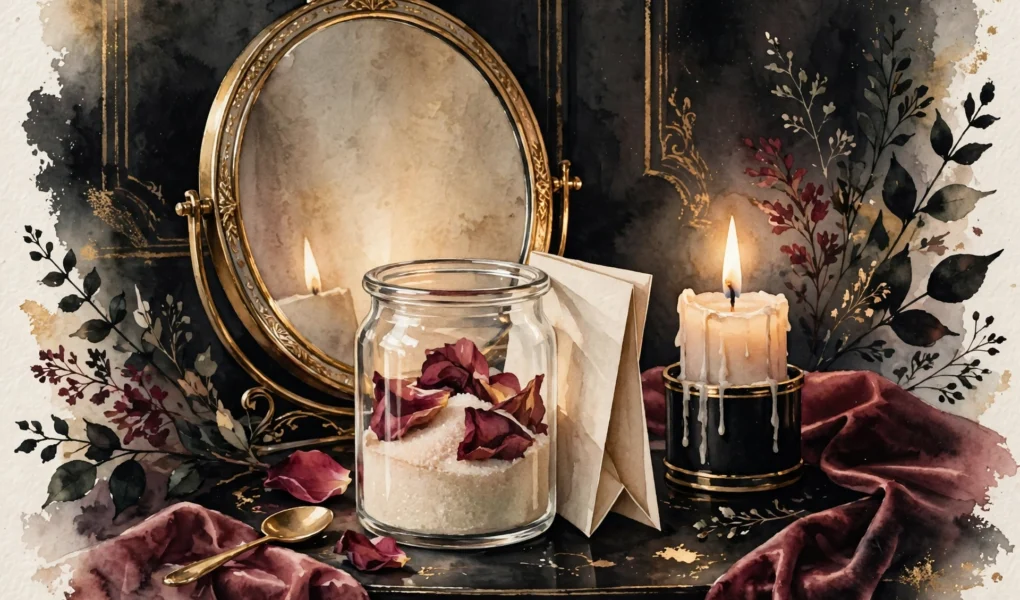
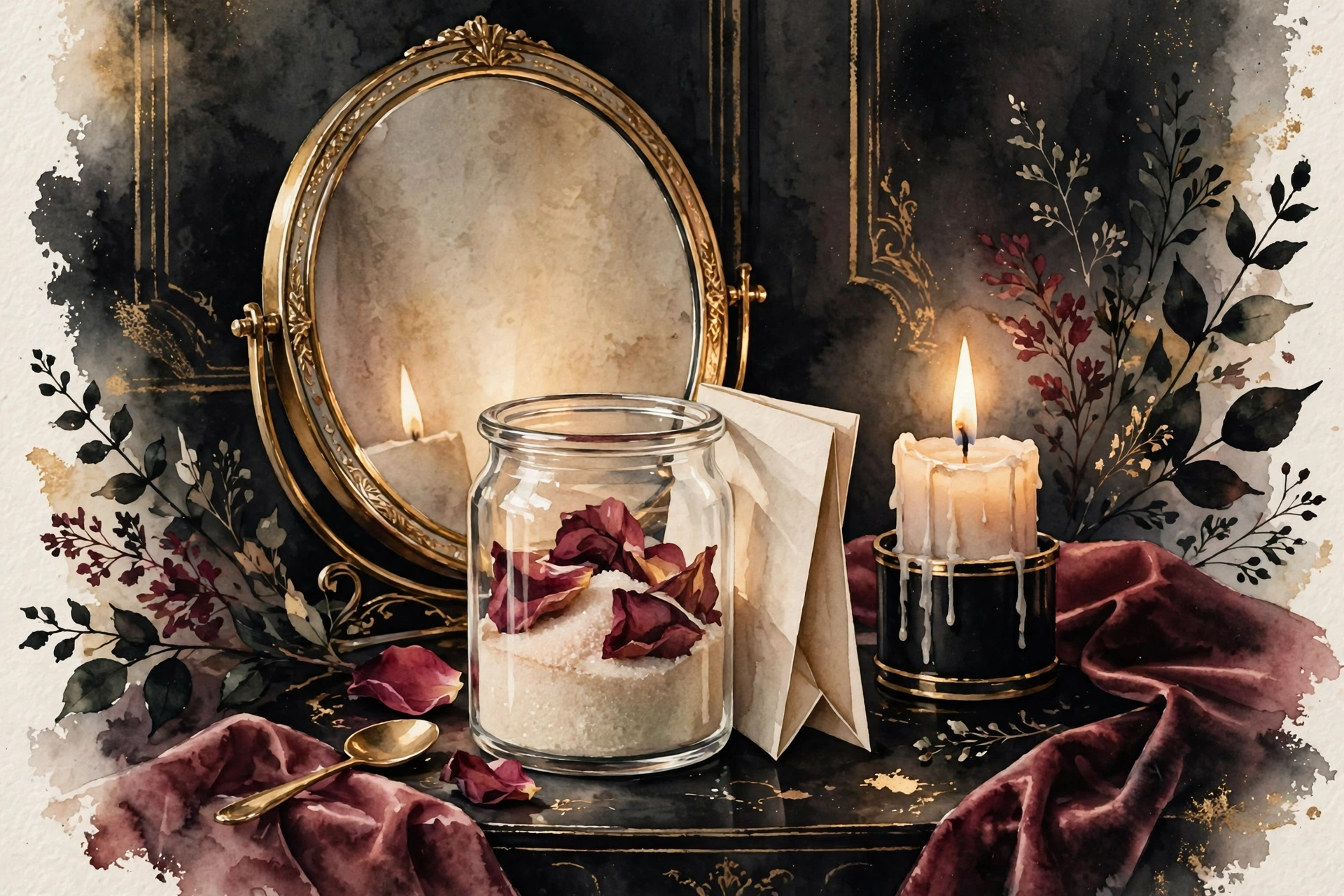
The jar lives at the vanity — the mirror is its home altar, and that placement is the adaptation’s heart. Into the glass go sugar, the sweet medium in its dry and keeping form, and rose, beauty’s oldest flower, for the regard the working is meant to ripen. Against the jar rests the petition, folded — and here the direction shows itself plainest. The honey jar’s petition names a situation between the worker and the world. The beauty jar’s petition is written in the first person, and it names no one but its writer: not a plea to be seen kindly, but a statement of self-regard, set down in ink so the eyes can read what the mouth will say.
Fed at the mirror, the working keeps the family schedule: the candle lit in its sitting, the petition’s words spoken — not whispered to the room, not performed for any witness — spoken to the face in the glass. That is the whole of the form. It is modern. It is this altar’s own. It stands on documented grammar the way a new verse stands on an old melody, and it claims no older birthday than it has.
Why a Jar, Why Kept
A regard that lives only in occasions dies between them.
The dress rehearsed for one evening, the face beaten for one room — these are events, and events end. What the jar teaches, the honey jar already taught in its own direction: a kept working is tended in ordinary time, on ordinary mornings, by a woman who returns to it when nothing is being asked of her but return. The beauty jar is that discipline aimed inward. It sits at the vanity among the brushes and the bottles, unshowy as a metronome, and it does its work the way climate does its work — not in the storm, but in the season.
That is the distinction this whole piece exists to hold. The room’s regard is weather: it changes by the hour, and no working at this altar promises to govern it. The mirror’s regard is climate. Sweeten the climate first, and the weather becomes a thing you dress for — not a thing you are.
The First Eyes
Every glamour ever worn entered the room twice: once when the room saw it, and once, earlier, when its wearer did. The second entrance is pageantry. The first is doctrine — and the first entrance is prepared by beauty work like this jar, long before any glamour is laid over it.
Keep the jar where you keep your face. Feed it on its schedule. Speak its petition to the only witness whose verdict you will carry into every room you ever enter. And when the eyes in the mirror have settled — when their regard is no longer the weather of a morning but the climate of a life — the rest of the altar’s glamour work stands on ground that does not shift.
Glamour is yours to conjure. — Lakish
From the Altar’s Bookshelf
- Harry Middleton Hyatt, Hoodoo — Conjuration — Witchcraft — Rootwork (interviews conducted 1930s; published 1970–1978)
- Mules and Men — Zora Neale Hurston (1935)
As an Amazon Associate, Blaq Vixen Beauty earns from qualifying purchases.