This post contains affiliate links. If you buy through them, Blaq Vixen Beauty may earn a small commission at no extra cost to you.
The Color Story posts on this site read color the way artists read it: what was chosen, how it sits, why it works. That is the craft floor, and it is a good floor. This piece stands underneath it.
Beneath every question of why a color reads is an older question of what a color does — what the old systems say it carries, and what it means for a woman to choose it on purpose. That is the doctrine here. Before any working at this altar, the house order holds: consult your benevolent ancestors first. They are the first authority, before any root, any book, any system of correspondences — including every system named below.
The Grimoire Record
The Western correspondence tradition is a record before it is a vibe, and its anchor text is old: Heinrich Cornelius Agrippa’s Three Books of Occult Philosophy (1533), the great filing system of Renaissance occultism, where every planet keeps its colors the way it keeps its metals, its stones, its hours. As that tradition assigns them: the Sun carries gold; the Moon, silver and white; Mars, red; Venus, green; Jupiter, blue; Saturn, black.
Read that list slowly, because the vanity already has. Gold for sovereignty and the solar claim. Silver-white for the moon’s reflective shine. Red for Mars — heat, war, signal, command. Green for Venus, the love planet’s growing color. Blue for Jupiter’s largesse and law. Black for Saturn — the boundary, the ward, the planet of limits and time. The modern makeup bag inherited these carriers whether it names them or not. The names are simply older than the bag.
The Black Southern Record
In the documented testimony of Black Southern rootworkers — Harry Middleton Hyatt’s interview volumes, gathered from the workers themselves — the dressed candle is chosen by its color for the work at hand, the way every other element of a working is chosen: deliberately, and because the color belongs to the purpose. Color in the conjure house is not decoration on the work. It is one of the work’s moving parts, as load-bearing as the herb or the name paper. Hoodoo is a closed Black American practice; this altar credits its record to the workers who gave it and keeps it in its own house, apart from the grimoire shelf — two houses, two records, both older than the industries that now sell their vocabularies back to us.
The Modern Scales, Labeled
The twentieth century added its own orderings: the ceremonial color scales, and the rainbow assignments that give the crown its violet and the heart its green. Those systems are modern, and this altar shelves them as modern — the crown-and-heart piece on this site does that shelving in full. Where the systems disagree, the disagreement is worth more than a smoothing-over: Agrippa’s Venus is green and the modern heart is green and the modern love-candle is pink, and a worker who knows her sources knows which house she is standing in when she chooses. Color magick is not one table. It is a shelf of tables, each with its author’s name on it.
The Red Lip
Now bring the doctrine to the mirror, where this blog lives.
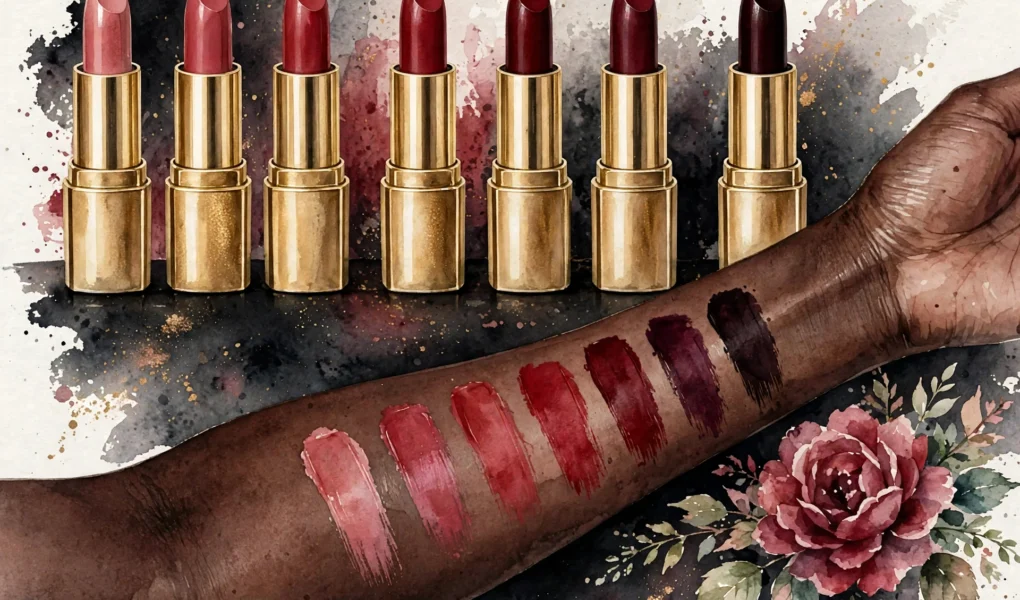
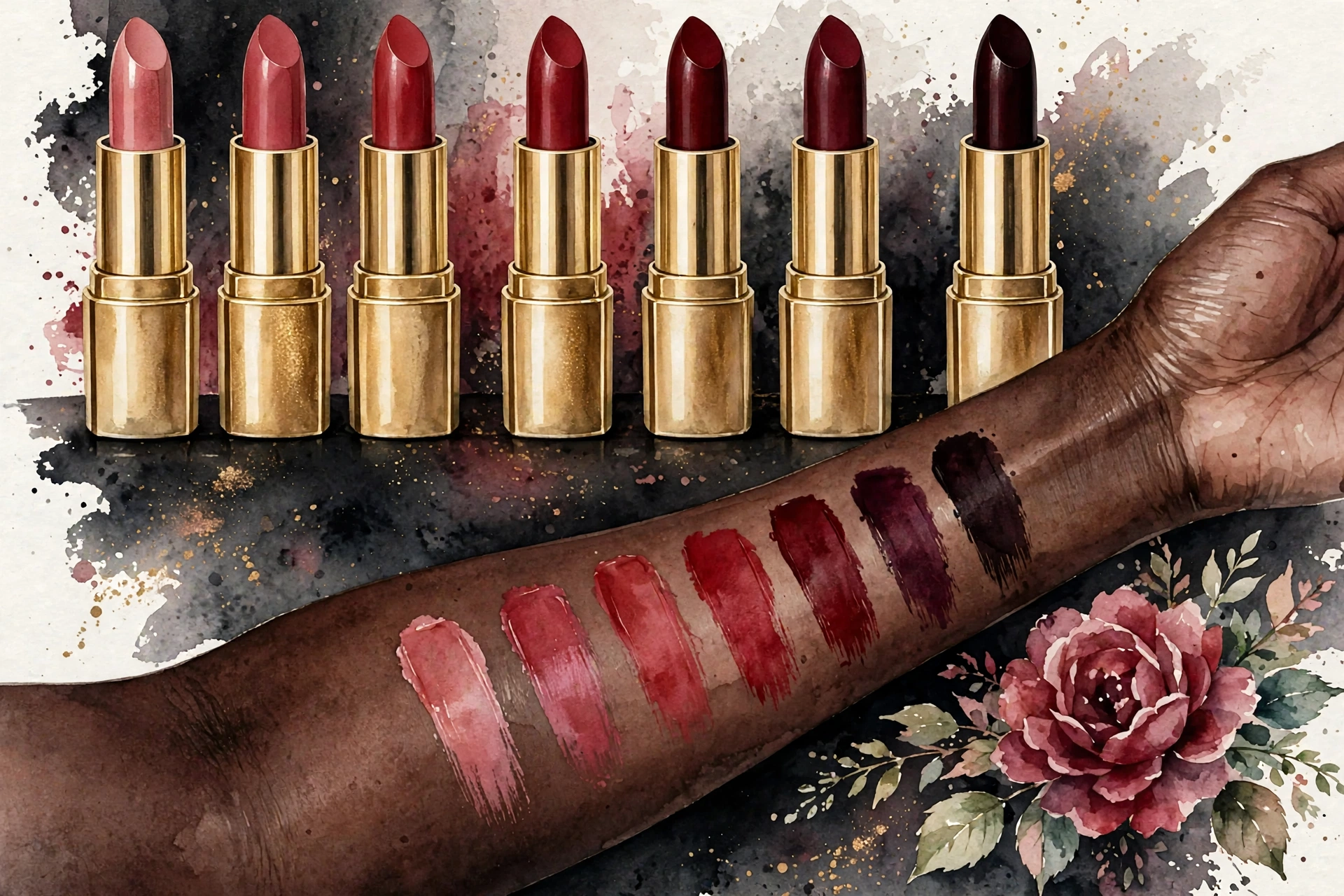
Red is Mars’s color in the oldest table on the shelf: heat, signal, command, the color that arrives before the woman does. When a worker chooses a candle, she chooses by what the candle carries. When a woman chooses a red lip deliberately — not by habit, not by trend, but by what the day requires and what the room must understand — she is making the same species of choice at a smaller altar. The selection is the decision. The application is the rite, performed with a worker’s care, at the mirror, in the open. The wearing is the working, carried into the room on the face itself.
This is not a claim that lipstick performs miracles, and this altar does not sell outcomes. It is a claim about intention’s address: a color chosen on purpose is a statement made on purpose, and statements made on purpose are the entire substance of glamour. The woman who picks her red the way a worker picks her candle has already changed what the red is doing — because she has changed who is doing it.
And the Red Nail
Yes — the nail too. (Lakish’s own ruling, entered into this doctrine the day it was drafted: red nails are a working too.)
Consider the geography. The lip speaks; the hands do. This site has already given the hands their doctrine — Mercury’s Hands teaches them as glamour’s instruments, the tools that gesture, point, sign, bless, and beckon. What the hands wear, they carry into every act they perform. Red at the fingertips is Mars’s color placed on the instruments themselves: heat and signal at the exact points where the woman touches the world. A red lip addresses the room. Red nails address everything the room contains — every glass lifted, every page turned, every hand extended is the working, delivered by hand.
The nail is also the glamour’s smallest canvas and its most constant one. A lip is reapplied; a manicure stays, working through the week’s ordinary motions, seen by its wearer more often than any face she makes. That is why the choice of it belongs in this doctrine and not only in the salon’s: a color carried that long, that visibly, that close to the work of the hands, is either chosen on purpose or it is chosen by default. This altar has one opinion about defaults.
Speak It on Purpose
One naming before the close, because this altar names its means and its ends separately. Color itself is none of the three houses — color is the vocabulary, the means. The house is named by the end the color serves. The red lip in this piece is glamour because its address is the room: it is worn to be read, and being read is glamour’s whole business. The same red, chosen at the mirror as an offering — beauty kept for beauty’s own sake, before any room exists to read it — is beauty magic. And color worn purely for the pleasure of being regarded is vanity magic, which this altar names without a blush. A worker who can say which end her color serves is never confused about which working she is doing. The vocabulary is one. The sentences differ.
Every color on a face is a statement. That was never the question. The question is only whether the woman wearing it made the statement — or whether the statement made her, by default, by drawer, by whatever was left in the bag.
Color is the glamour’s vocabulary: gold, silver, red, green, blue, black, each carrying what its record says it carries. Learn the vocabulary from its sources. Keep the houses separate. And speak it on purpose.
Glamour is yours to conjure. — Lakish
From the Altar’s Bookshelf
- Heinrich Cornelius Agrippa, Three Books of Occult Philosophy (1533)
- Harry Middleton Hyatt, Hoodoo — Conjuration — Witchcraft — Rootwork (interviews conducted 1930s; published 1970–1978)
As an Amazon Associate, Blaq Vixen Beauty earns from qualifying purchases.