This post contains affiliate links. If you buy through them, Blaq Vixen Beauty may earn a small commission at no extra cost to you.
Source: This post studies Jason Miller’s Advanced Planetary Magic (Strategic Sorcery, 2013), the sorcerer’s own self-published ebook, and describes his system and the purposes of his workings in this altar’s words. His invocation texts are his own and are not reproduced here — not one call is printed in this post. Where this altar adapts his pairing logic for its own practice, it says so plainly and speaks in its own voice.
The hook
A modern sorcerer built a machine out of seven planets: forty-nine small spells, each a pair of powers blended like two notes struck together. And some of the finest workings in the machine — by the author’s own naming — are glamours: spells for radiance, for favor, for the fascination that lives in a woman’s voice.
Tonight the Grimoire opens his book, as this strand opens every source: credited, and read with both eyes open. The book is Jason Miller’s Advanced Planetary Magic, and its pairs have something to teach a vanity altar about how glamour is built — not from one planet alone, but from two, in the right order, at the right hour.
The man and the book
Jason Miller, who writes as Inominandum, teaches what he calls Strategic Sorcery — sorcery aimed frankly at results. In the summer of 2013 he gathered three techniques from his practice and self-published them as a sixty-two-page ebook, bundled with recordings of his own voice reading every call aloud. The book assumes basic planetary magic and declines to re-teach it; his shorthand is brisk to the point of comedy — Venus for love, Jupiter for wealth, Mars for kicking butt. The three techniques: the Greek vowels as the planets’ seed-sounds; a set of seven planetary seals, shared before this book only with his students; and the forty-nine calls, released for the first time anywhere.
The seals have an origin worth telling straight. In the summer of 2007 Miller set out to generate new planetary seals with the artist Matthew Brownlee: Miller invoked Agrippa’s planetary Intelligences and Spirits, and the visions that answered were received and drawn by Brownlee. Two intentions governed the design: the seals were built to reach a planet’s power even in foul astrological weather — through retrogrades and eclipses — and they were built deity-neutral, the planet represented directly, so a seal could work alongside Sumerian deities, Coptic archangels, Olympian gods, or entirely on its own.
The calls, Miller has said plainly, he wrote himself — each composed in its proper day and hour, after meditating on the powers and chanting the vowels. Not channeled, not dictated. A craftsman at a workbench — and a made thing can be studied as a made thing.
The architecture
Begin with the seven classical planets, in the Chaldean order Miller calls vital to the book: Luna, Mercury, Venus, Sol, Mars, Jupiter, Saturn.
Each planet has a sound: one of the seven Greek vowels, presented as the vibrations — the seed syllables — of the planets themselves, drawn from the Greek Magical Papyri. He is candid that no single ancient arrangement survives undisputed; the one this book uses runs in ascending order, Alpha equals Luna: Alpha the Moon, Epsilon Mercury, Eta Venus, Iota the Sun, Omicron Mars, Upsilon Jupiter, Omega Saturn. Venus’s vowel, then, is Eta, sounded “ay.”
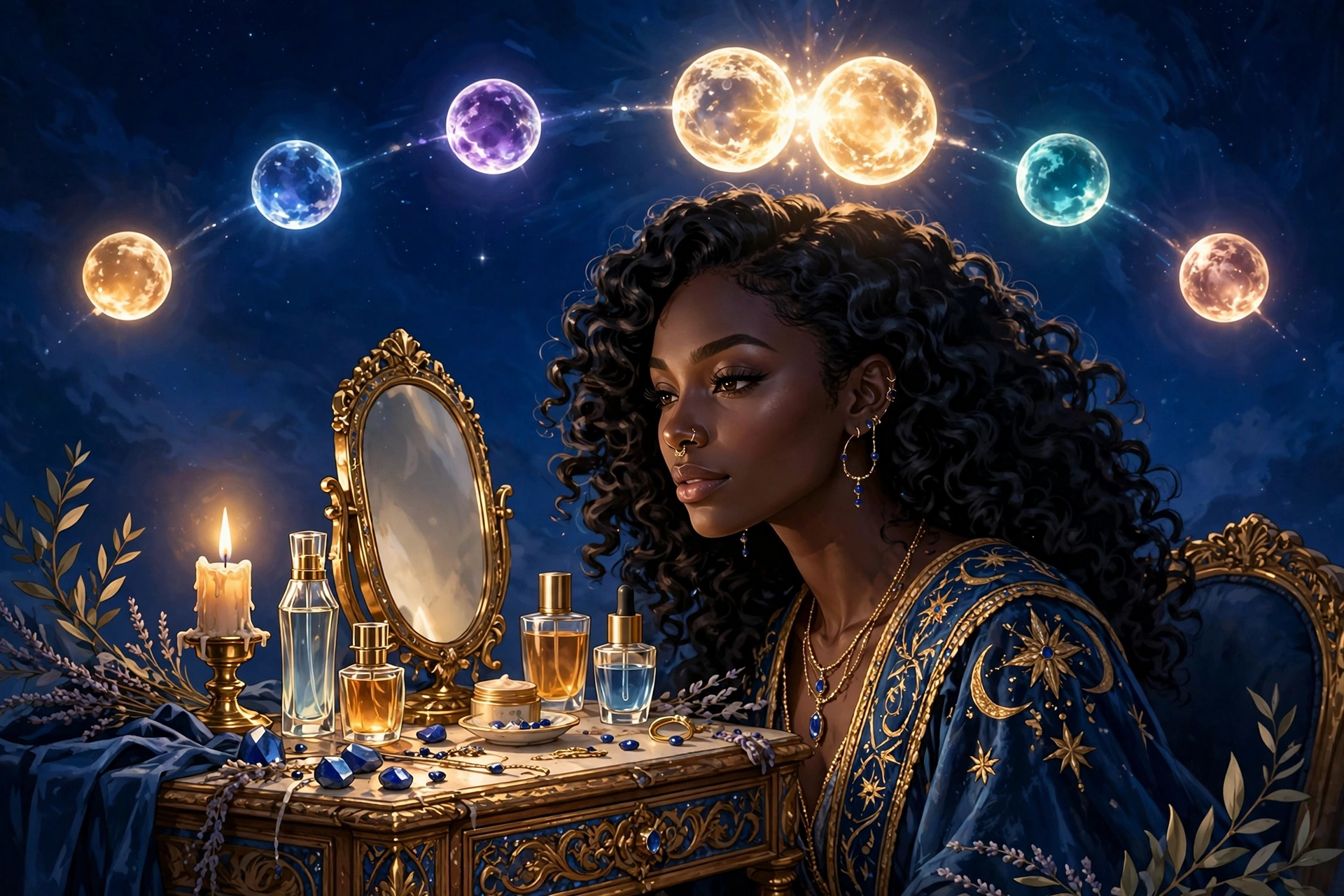
The pairing is the engine. Every day belongs to a planet, and every hour belongs to one. A call named X of Y means the hour of X on the day of Y: the hour-planet is the stronger factor, a direct ray of that planet’s power; the day-planet is a lens, an ambiance that filters the ray. So Venus of Luna sends Venus’s ray through a lunar lens, while Luna of Venus reverses the current. Different workings, different purposes; Miller wrote both. Seven days by seven hours make forty-nine ordered pairs, each a short invocation opening with the two vowels, the day’s sounded briefly and the hour’s held longer.
The glamour calls
Venus touches more of the forty-nine than any other planet.
Jupiter of Luna is the flagship: Jupiter’s hour on the Moon’s day, addressed to Pandeia, daughter of Zeus and Selene — her name means all-luminous; she is also called Ersa, the Dew. Miller’s own note says the call produces both an outward glamour and a state of inner grace, and marks it best performed on a full moon. Its tides run both ways, waxing toward increase and grace, waning toward cleansing.
Mercury of Venus is the only call Miller himself flatly labels a glamour — his whole note calls it “a pretty straightforward glamour spell.” With Aphrodite on one side and Hermes on the other, the glamour works through speech: blessed, bold, fascinating words that charm minds and stir the passions of everyone listening.
Sol of Venus kindles favor: a shining visage, a compelling voice, others following her lead; Miller assigns it to managers and leaders. Its reverse, Venus of Sol, is gentler — radiance and divine desire celebrated in all existence; not a targeted spell, Miller says, but a blessing. Venus of Venus, her own hour on her own day, is pure devotion to Aphrodite, asking her boons outright: an aura of attraction, the morning star for a guide. Venus of Luna draws desired partners in and mesmerizes onlookers — for a new mate, Miller notes, or a long marriage rekindled; Luna of Venus reverses the pair toward sacred sensuality, enlightenment through love and lust.
The Jupiter pairs carry glamour into splendor. Venus of Jupiter prays to Aphrodite and Zeus for beauty and benevolence in a working cycle — prosperity funding one’s passions and art, art extending one’s affluence; Miller insists a woman need not be starving to be an artist. Jupiter of Venus runs it the other way: love and wealth expanding each other, wealth named as a way of caring for the beloved.
The Mars pairs carry it into fire. Venus of Mars is charm weaponized — voice and visage enchanting even enemies; Miller observes that Aphrodite started more wars than any Greek deity. Mars of Venus reverses the current: dominance and surrender as an erotic, creative spark.
And the Saturn pairs bind it. Saturn of Venus, built on Aphrodite’s birth from Cronus, holds love firm, strong, and deep. Its reverse, Venus of Saturn, is the spectrum’s dark end: an inverse glamour, corroding a target’s affections into apathy. Miller calls it dark stuff — and records that this very working was once used, alongside blessings, to free a woman from an abusive relationship, so she could see her danger and leave. In his system, attraction can be withdrawn as well as bestowed.
The glamour that is not a call
One correction this Grimoire owes its readers: the most quoted glamour in Miller’s book is not among the forty-nine at all. It lives in the seals chapter, as the Love application of the Sun’s seal: add the sun’s radiance to your aura, and you become more visible to the one you want noticing you than anyone else in the room. It is a seal working, not a call, and accounts that credit it to a “Sun and Venus spell” have misread the book’s architecture — seals and calls are different instruments, kept in different chapters for a reason.
The Venus seal stands nearby in the same chapter, and it deserves its own look. Brownlee, receiving its vision, noticed the sigil’s arms resemble a woman with one hand on her hair and another on her hip — the seal, Miller writes, has the curves of a woman — and a wrapping line that suggested ensorceling, almost like words that spell “bind.” Her portfolio runs to emotions, love, friendships, romance, enchantment, beauty, art, parties, and nearly every kind of attraction and influence there is. The Grimoire notes the portrait and moves on, respectful.
The altar’s mapping
What follows is this blog’s own reading — Miller’s pairs laid beside the altar’s own ladies and lessons, as correspondences in prose. Miller did not make these meanings; we did, and we sign them.
Sol of Venus sits beside this blog’s Look Me Over working: favor, a shining visage, the practice of being seen. Mercury of Venus sits beside Abigail, whose beauty in the record is inseparable from her eloquence — she talked a future king out of bloodshed with a single speech; glamour through fascinating speech is her native country. Saturn of Venus sits beside Vashti: presence held firm rather than displayed on command, beauty that knows its bounds. Jupiter of Venus sits beside the Queen of Sheba, whose splendor and wealth were never decoration but diplomacy and care, each enlarging the other. Venus of Mars sits beside the Shulamite, who described her beloved head to heel in public and let her voice fascinate. And Jupiter of Luna sits beside the altar’s moon ladies — Freda at her toilette, La Sirène at her waters, Mami Wata at the water’s edge — and beside the full-moon timing this altar already honors: outward glamour and inner grace, drawn down together.
How the altar would keep them
The incorporation, then, proposed plainly as this blog’s own practice. Miller’s book goes on the Grimoire’s guest shelf: studied, credited, argued with, never costumed as this altar’s own tradition. A reader begins the way this blog’s Venus Return post teaches her to begin — with her season. She picks the pairing whose two planets name her season’s work: visibility, speech, splendor, bounds, desire, grace. She keeps the pairing at her vanity on the day-planet’s day — a Luna-day call on Monday, a Venus-day call on Friday. And she speaks her intention in her own words, at her own mirror. The pairing logic is borrowed, and the borrowing is confessed in print, in this post. His architecture; her voice; no ventriloquism in either direction.
His seals stand apart, deliberately: images received in vision and drawn by another man’s hand, they are his to teach. This post describes and credits them but does not draw them; the reader who wants them learns them from Miller’s book, from Miller.
The honest mirror
Now the honesty this strand owes every source it shelves. Miller’s lineage is ceremonial: Greek Magical Papyri air, seals born from evoking Agrippa’s Intelligences and Spirits, instruments of vowel-sounds and planetary hours. This altar’s heart is elsewhere — Hoodoo and Vodou, the toilette and the bath, the mirror and the crossroads. Different houses, and the Grimoire keeps its shelves distinct: a guest is honored by not being dressed in the host’s clothes.
It must also be said, because an unscrupulous essay would hide it: the book never tells its readers to substitute other traditions’ figures into the calls. The calls speak Greek — Selene, Hermes, Aphrodite, Zeus, Ares, Cronus, Pandeia — and those names are the calls’ own vocabulary. The mapping above is this blog’s adaptation, labeled as ours; it is not a permission Miller granted, and this post will not counterfeit one. What is genuinely his is narrower and stronger: he designed the seals to sit beside any pantheon or none, and his own list of their uses names folk magic — mojo bags, candles, parchment talismans. The bridge between his house and this altar’s is real, but it is the bridge he built: the planetary frame, portable by design — not a license to redecorate his calls.
And the spectrum stays whole: his glamour includes charm as a weapon and attraction withdrawn as a curse, and this altar shelves the book as it is, not as a prettier excerpt of itself.
Cautions
His words are his. The forty-nine calls are a living author’s copyrighted work, composed, by his own account, at his own workbench. This post prints none of them and paraphrases their purposes only. The woman who wants the calls themselves goes to the source and learns them from the man who wrote them.
Adaptation is labeled, never laundered. Everything here marked as this altar’s reading is this altar’s reading. It will not be passed off as Miller’s teaching or as old tradition. A borrowed architecture, confessed, is scholarship; the same architecture unconfessed would be theft wearing a veil.
No glamour guarantees. Not from his shelf and not from ours. A pairing can name your work with wonderful precision — ray and lens, planet and planet — but regard is practiced, not promised, and no arrangement of the seven wanderers does a woman’s practicing for her.
Forty-nine small doors, and behind several of them a woman is being made more visible, more fascinating, more her own. A sorcerer built that machine out of vowels and visions and wrote every word of it himself. The Grimoire honors the craft, keeps the credit where it belongs, and leaves his doors on his hinges.
But the pairing — ray through lens, Venus through Luna, Jupiter through Venus — is a grammar older than any of us, written in the sky’s own order. Take the grammar to your mirror, sister. Speak in your own words. Let the planets keep their pairs, and keep your voice defiantly yours.
Glamour is yours to conjure. — Lakish