This post contains affiliate links. If you buy through them, Blaq Vixen Beauty may earn a small commission at no extra cost to you.
Every love working has an address. Most of them, in most of the record, are addressed to somebody else.
This one is not.
Before the address is corrected, the house order is kept: consult your benevolent ancestors first. They are the first authority at this altar, before any root, any book, any candle — and in this working they are more than authority. The foremothers’ faces are the first beloved faces most of us ever studied. Self-regard does not begin at our own mirrors. It is inherited there, and the inheritance is consulted first.
The Distinction, Stated Plainly
Love work aimed at another person — the drawing of a named heart, the sweetening of someone else’s regard — is not this piece’s subject, and it is not taught here. Not from timidity: from accuracy. A working addressed to another’s will and a working addressed to one’s own heart are different species, with different ethics and different grammar, and an altar that blurs them teaches neither honestly.
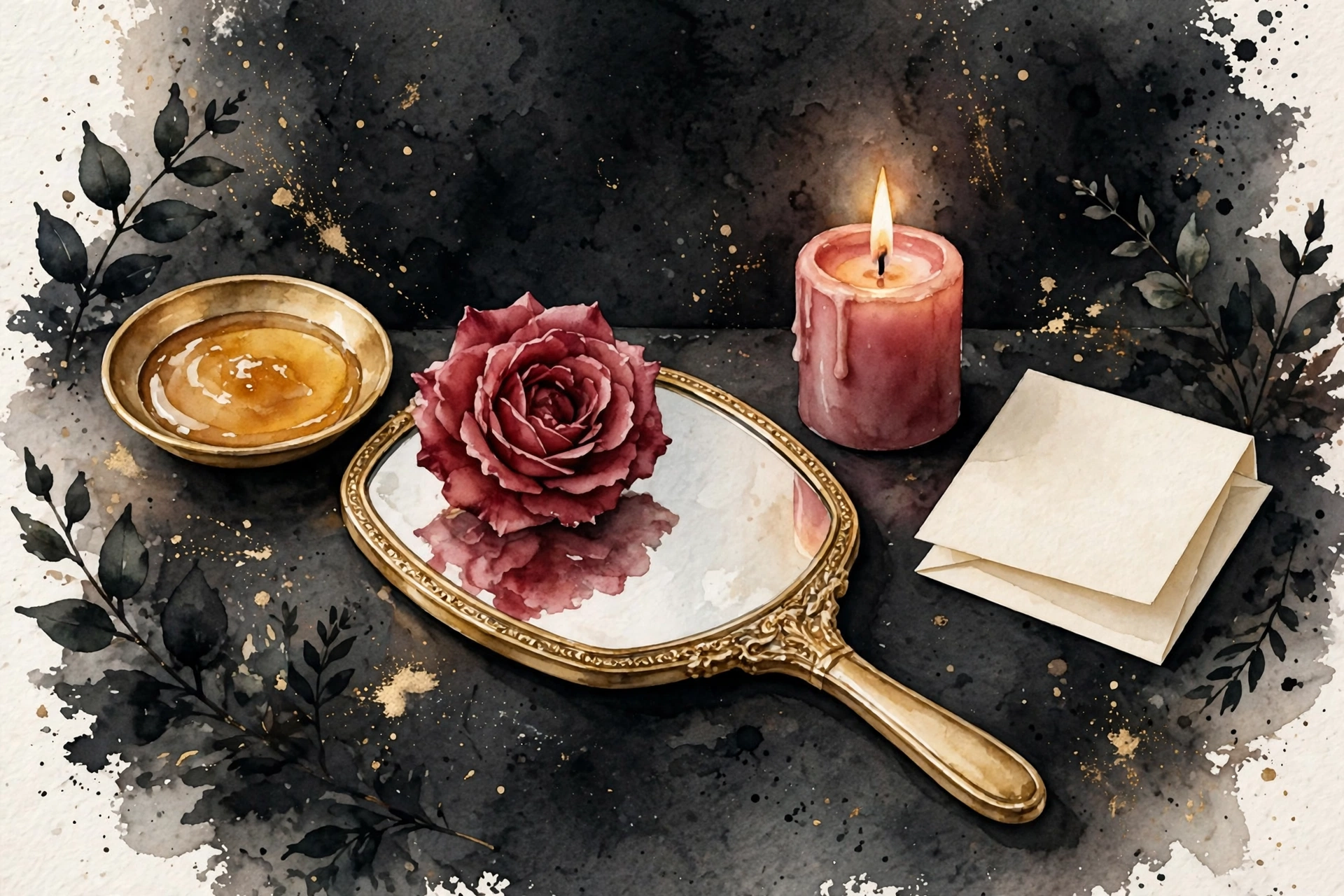
The self-love working has exactly one name in it, and the name is the worker’s own. Its petition is not let him see me. Its petition is let me see me — and stay in the room after I’ve looked.
And name the species truly, as this altar names all its workings: this is beauty magic. Glamour magick governs how the room beholds the worker; the self-love working never addresses the room. Its object is the worker’s own heart — beauty itself, kept at home — and so it stands in beauty’s house, not glamour’s, whatever the modern shelf chooses to call it.
The Grammar, Turned Inward
The instruments are the record’s own, and this altar has already built two of them in this series.
Sweetening, documented across Harry Middleton Hyatt’s interviews and Zora Neale Hurston’s Mules and Men as the grammar of drawing regard toward kindness, is turned inward here — and the turning is labeled, here as everywhere on this site, as this altar’s adaptation of the documented grammar. Its instrument is the Beauty Jar: sugar and rose at the vanity, the petition written in the first person, the candle fed on schedule, the words spoken to the face in the glass. The jar piece teaches the form. This piece teaches the address it serves.
The bath is the working in water: the Beauty Bath, where the sweetening is not kept in glass but soaked in — the body addressed directly, the old self-image sent down the drain, the becoming rehearsed in warmth. Jar and bath are the same doctrine in two elements: regard, kept on purpose, at home.
The mirror is the delivery room. Every other love working in the record sends its petition out into the world and waits. This one is delivered on the spot, to the only addressee whose answer the worker will hear every day for the rest of her life.
The Modern Shelf
The contemporary literature names this working more directly than the old record does, and the altar shelves it as what it is. Deborah Castellano’s Glamour Magic (2017) — the anchor title of the modern glamour shelf — treats glamour itself as self-regard’s craft: the deliberate, magical keeping of one’s own image and power. This altar reads her gladly and names the work otherwise: the keeping of one’s own image and power is beauty magic under this house’s taxonomy, and the difference is a naming, not a quarrel. It is a modern book, of the modern revival, shelved in the modern house without apology. Where its doctrine agrees with the older grammar — sweetness, repetition, the kept appointment — the agreement is noted. Where the old record is silent, the modern book is not dressed in the old record’s clothes.
Devotion, Not Desperation
Here is the whole ethics of the piece, in one distinction.
Desperation performs once and checks the door. It casts in a crisis, at midnight, with shaking hands, and then it watches the phone, the mirror, the horizon — did it work, did it work — until the watching itself becomes the wound. Desperation is not too much feeling. It is feeling with no schedule, no return, no keeping.
Devotion returns. Devotion feeds the jar on its evening whether the day was kind or not. Devotion draws the bath in an ordinary week. Devotion keeps the appointment at the mirror in the plain light of a Tuesday, and says the petition to a face that has not changed yet, and comes back tomorrow and says it again. The record of the practitioners — the jar-keepers, the bath-takers, the women of the documented houses — describes the fruit of that keeping in unglamorous words: steadiness. A regard that stops swinging with the weather of other people’s attention. This altar reports that fruit as the record reports it, and promises nothing beyond it. Steadiness is not a small thing. For most women, it is the thing itself.
The Appointment
The beloved in this working is not coming. She is not across town, or across a misunderstanding, or across a lifetime of being overlooked by the right eyes.
She is already at the vanity. She has been there the whole time, waiting out the years when every working in the house was addressed to somebody else.
The spell is the appointment. Keeping it is the magic.
Glamour is yours to conjure. — Lakish
From the Altar’s Bookshelf
- Zora Neale Hurston, Mules and Men (1935)
- Deborah Castellano, Glamour Magic: How to Get Anything You Want (2017)
As an Amazon Associate, Blaq Vixen Beauty earns from qualifying purchases.